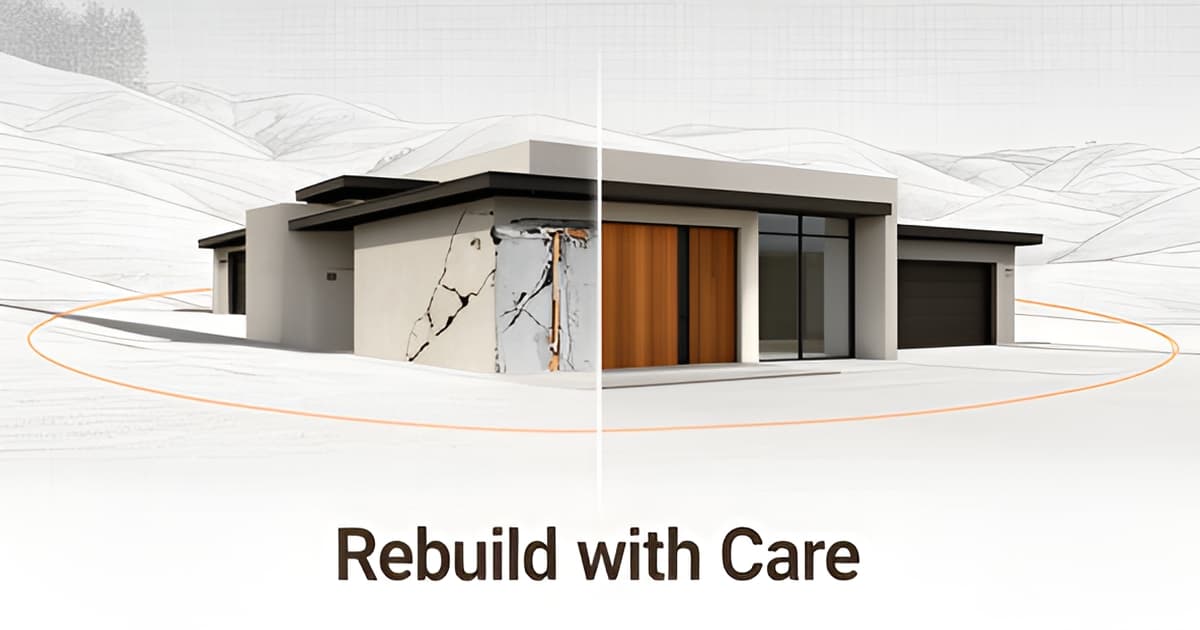
Zero-Lot-Line Building in Altadena: What LA County Allows
Key Facts
- Only 23 of nearly 6,000 significantly damaged Altadena properties had fully rebuilt as of December 2025, according to Catalyst California's tracker.
- Rebuild costs average $500 per square foot, leaving a typical 1,500-square-foot home about $143,000 short of average insurance coverage, per rebuilding cost data.
- Just 43% of Eaton Fire-affected owners had applied for or received permits by December 2025, per Catalyst California.
- Under the IBC framework, exterior walls within 10 feet of the property line must be fire-rated for exposure from both sides, per code reference material.
- Only 23% of significantly damaged homes region-wide sat in 'very high' fire hazard severity zones, per Catalyst California data.
- Over half of all Altadena rebuild applications include an ADU, with 220+ ADU applications filed, per Spectrum News reporting.
- SB 1090 pauses Altadena's 10-unit density provision through January 2030, but SB 9 lot splits remain usable, per Inside Climate News.
Why Altadena Homeowners Are Asking About Building at the Property Line
Walk down any burned street in Altadena today and you'll see lots that suddenly matter more than they used to. The Eaton Fire didn't just destroy homes — it compressed thousands of families onto rebuild decisions where every square foot of a 5,000- or 7,000-square-foot parcel counts, and building closer to the property line has become a genuine question rather than a theoretical one.
The economics explain why. A tracking report from Catalyst California pegs rebuild costs at roughly $500 per square foot — meaning a 1,500-square-foot home runs about $750,000, against an average insurance coverage of just $607,000. That six-figure gap pushes owners to squeeze maximum usable footprint from minimum lot area, and lot-line-adjacent construction is one way to do it.
Density legislation adds another layer. Under recent reporting on California's housing bills, SB 9 lets single-family lots split into two parcels with up to four units, and SB 1123 (effective 2025) allows up to 10 small homes on a single-family-zoned plot. SB 1090 pauses the 10-unit provision in Altadena from October 1, 2025 through January 7, 2030, but SB 9 lot splits remain usable — and more than 220 ADU applications have already been filed, with over half of all rebuild applications including an ADU.
At the same time, the permitting environment remains demanding. As of December 2025, only 23 of nearly 6,000 significantly damaged properties had been fully rebuilt, and just 43% of owners had applied for or received permits. LA County's One-Stop Recovery Permitting Center and Unified Permitting Authority now govern the process, with review spread across Building and Safety, Regional Planning, and the Fire Department's Prevention Division. Any lot-line-adjacent design will move through that same machinery — no shortcuts, and no guaranteed timelines.
Neighbors are watching, too. Residents have voiced concern that developers could "build out to the property line and up two stories," blocking views and changing neighborhood character. That wariness is real, and it shapes how any rebuild near a lot line should be approached: thoughtfully, transparently, and with the existing streetscape in mind rather than against it.
That's the philosophy behind Altadena Home Remodeling's preserve-first approach — renovating and rebuilding in keeping with Altadena's Craftsman and historic character, not maximizing density at the expense of it. If you're weighing a rebuild or major addition and want to understand how far your design can realistically push toward the lot line, a free remodel-scoping consultation with a before/after concept render is a practical first step. Featured builder JMB Builders LLC (CSLB #1103479), an Altadena-based licensed general contractor, handles Eaton Fire rebuilds, custom homes, and whole-home remodels throughout the area.
The 10-Foot Fire Separation Rule: How Code Treats Walls Near the Lot Line
If your exterior wall sits within 10 feet of the property line, building code treats it differently than almost any other wall on your house. That distance — known as the fire separation distance — determines whether the wall must resist fire from one side or both.
Under the general framework in the International Building Code, exterior walls are rated based on construction type and fire separation distance. Walls more than 10 feet (3048 mm) from the lot line need only be rated for fire exposure from the inside. Walls at or within 10 feet must be rated for exposure from both sides, according to code reference material on fire-resistance ratings.
A true zero-lot-line wall — one built at the property line — represents the most demanding case in this framework: a fire separation distance of 0 feet. The two-sided exposure requirement applies in full, which typically means higher fire-resistance ratings, protected openings, and careful detailing of anything that penetrates the wall.
Here's the critical caveat for Altadena homeowners: the code text confirming this 10-foot threshold comes from the Illinois Building Code 2021, not the California Building Code. The IBC framework is widely adopted as a model, but LA County's local amendments and California's specific provisions for Altadena were not confirmed in available sources. Before planning any lot-line-adjacent construction, verify the applicable requirements directly with LA County Building and Safety.
That verification step matters more than ever in Altadena's current rebuilding environment. Rebuilds are governed by multiple county agencies — Public Works Building and Safety, Regional Planning, and the Fire Prevention Division of the LA County Fire Department — and progress has been slow: as of December 2025, only 23 of nearly 6,000 significantly damaged properties had completed rebuilding, and just 43% of owners had applied for or received permits, per Catalyst California's rebuilding tracker.
Your parcel's fire hazard designation adds another layer. Key variables to check before designing a lot-line wall:
- Whether your property falls in a high or very high fire hazard severity zone, which triggers defensible space and wildland-urban interface requirements
- Whether you're in Fire Zone 0, which requires ember-resistant barriers in the first 5 feet around homes
- The exact fire separation distance from your wall to the lot line, measured to the code's methodology
- Any local amendments affecting exterior wall ratings or openings near the line
Notably, most burned Altadena properties were not in a designated fire zone at all — only 23% of significantly damaged homes region-wide sit in "very high" zones. That gap between mapped risk and actual destruction is one reason fire officials scrutinize exterior wall design closely during plan review.
At Altadena Home Remodeling, we treat fire separation as a design constraint to resolve early, not a surprise at plan check — our preserve-first approach to whole-home renovations and additions assumes code verification comes before concept drawings. For lot-line-adjacent work, we recommend a free remodel-scoping consultation with a before/after concept render so the wall assembly, setbacks, and rating requirements are scoped together from day one.
Planning a rebuild or addition near your property line? Scope it with Altadena Home Remodeling — request a free consultation with a before/after concept render. Featured builder: JMB Builders LLC (CSLB #1103479), an Altadena-based licensed general contractor whose custom home, ADU, and Eaton Fire rebuild work is documented at jmb-builders.com. No timeline or permit outcomes are guaranteed; all requirements should be confirmed with LA County Building and Safety.
Fire Hazard Zones and Defensible Space: What Your Parcel Designation Changes
Here's the uncomfortable truth about fire-zone mapping in Altadena: the parcels that burned weren't, for the most part, the parcels the maps flagged. Before planning any rebuild or addition — especially one that pushes a wall toward the property line — your fire hazard severity zone designation is one of the first things to check, because it changes what the county will ask of you.
Owners in high or very high fire hazard severity zones must establish defensible space and comply with wildland-urban interface (WUI) regulations. Those zones were finalized between April 2024 and March 2025, according to Catalyst California's rebuilding tracker, so even longtime Altadena homeowners may be working with designations newer than their last renovation.
The stricter tier is Fire Zone 0, which requires an ember-resistant barrier in the first 5 feet around a home. Per Inside Climate News, only a small sliver of Altadena — the San Gabriel foothills area — actually falls within Zone 0. Most burned properties sit in no designated fire zone at all.
That mismatch between mapped risk and actual destruction is striking:
- Only 23% of significantly damaged homes region-wide were in "very high" fire hazard severity zones.
- In West Altadena, just 19% of damaged properties carried that designation.
- East Altadena fared somewhat higher, at 33% — still a minority of burned homes.
State Senator Sasha Renée Pérez, who sponsored the SB 1090 pause on certain density development in Altadena, put it plainly: "I recognize that Altadena is not in a high-fire severity zone, but it was burnt down all the same." For homeowners, the takeaway isn't that fire-zone rules don't matter — it's that a favorable zone designation is no substitute for fire-conscious design decisions, including how close your exterior walls sit to neighboring parcels.
What does this mean for a lot-line-adjacent build? Three practical implications:
Your zone determines your defensible-space obligations, which can constrain where structures, landscaping, and hardscape sit relative to your home — a real consideration when you're already negotiating tight setbacks. In Zone 0 areas, that 5-foot ember-resistant perimeter adds another layer to site planning.
Second, county review will look at fire performance regardless of designation. Rebuilds in Altadena move through LA County Public Works Building and Safety, Regional Planning, and the Fire Department's Fire Prevention Division — the same agencies Catalyst California recommends staffing up given how slowly recovery has moved. As of December 2025, only 23 of nearly 6,000 significantly damaged properties had completed rebuilding, and just 43% of owners had applied for or received permits.
Third, verify before you design. Because zone designations were so recently finalized, pull your parcel's current map status before committing to a site plan.
At Altadena Home Remodeling, we approach these questions with a preserve-first mindset — working within what your lot and its designation allow rather than forcing a build-out that invites friction with neighbors or reviewers. For a free remodel-scoping consultation with a before/after concept render, our featured builder JMB Builders LLC (CSLB #1103479), an Altadena-based licensed general contractor handling Eaton Fire rebuilds and whole-home remodels, can help you scope it accurately from the start.
Navigating LA County's Permitting Pathway for Lot-Line-Adjacent Rebuilds
Building close to a property line in Altadena means your plans pass through several county desks before a single footing gets dug — and in a community still rebuilding from the Eaton Fire, understanding that pathway up front saves months of frustration.
Because Altadena sits in unincorporated Los Angeles County, your rebuild answers to county agencies rather than a city hall. According to tracking by Catalyst California, rebuilds run through the Regional Planning Department, Public Works Building and Safety Division, and the LA County Fire Department's Fire Prevention Division — three reviews your lot-line-adjacent design must satisfy simultaneously.
The county has tried to simplify this. Legislation by Supervisor Kathryn Barger established a Unified Permitting Authority — the One-Stop Recovery Permitting Center — so Eaton Fire rebuild applicants can coordinate approvals under one roof rather than shuttle between departments.
Set realistic expectations about pace. As of December 2025, only 23 of roughly 6,000 significantly damaged properties had fully rebuilt, and just 43% of owners had applied for or received permits. No one can promise you a timeline, and any contractor who does is guessing.
Each review desk cares about something different when your wall sits near the lot line:
- Regional Planning — zoning conformance, setbacks, and lot configuration, including whether your parcel's design respects the neighborhood character the county is working to preserve.
- Building and Safety — structural and code compliance, including how fire separation distances are calculated and documented for walls near the property line.
- Fire Prevention — fire hazard severity zone requirements. Most burned Altadena properties sat in no designated fire zone, but parcels in high or very high zones face defensible-space and WUI rules, and Fire Zone 0 requires ember-resistant barriers within the first five feet of a home.
Check your parcel's fire zone designation before finalizing a design — it can change your materials, landscaping, and wall assembly. And since specific LA County zero-lot-line allowances aren't published in one tidy document, confirm any property-line-adjacent plan directly with Regional Planning and Building and Safety.
At Altadena Home Remodeling, we approach these projects with a preserve-first mindset: renovate thoughtfully, respect the neighbors, and build once. If you're weighing a rebuild or remodel near your lot line, our free remodel-scoping consultation includes a before/after concept render so you can see the plan before committing.
Disclosure: JMB Builders LLC (CSLB #1103479), an Altadena-based licensed general contractor experienced in Eaton Fire rebuilds, is a featured builder through paid placement. Learn more at jmb-builders.com.
A Preserve-First Alternative: Scoping a Lot-Line-Sensitive Remodel the Right Way
Before you sketch a plan that pushes a wall to the edge of your parcel, it's worth asking a different question: what does your lot actually need? In Altadena right now, the most valuable move for most homeowners isn't maximizing buildable square footage — it's renovating what's there in a way that respects the code, the neighbors, and the neighborhood's character.
The community has made its feelings clear. Residents have voiced concern about developers who "build out to the property line and up two stories," and that wariness is now part of the local conversation about who gets to shape Altadena's recovery. A remodel designed with generous setbacks and thoughtful massing avoids that friction entirely — and tends to protect long-term property value rather than chase short-term density.
The regulatory environment also rewards patience. As of December 2025, only 23 of nearly 6,000 significantly damaged residential properties had completed rebuilding, and just 43% of owners had applied for or received permits, according to a Catalyst California tracking report. Any project touching a property line adds review complexity on top of an already deliberate process, since rebuilds move through LA County Public Works Building and Safety, Regional Planning, and the Fire Department's prevention division.
A preserve-first remodel also sidesteps the biggest fire-code variable. Under the general building-code framework, an exterior wall at or within 10 feet of the property line must be rated for fire exposure from both sides, not just the inside — a requirement that shapes materials, cost, and design freedom. And because fire hazard severity zone designations drive defensible-space and wildland-urban interface rules, your parcel's designation matters before any lot-line-adjacent decision. A whole-home renovation within existing footprints keeps those variables manageable.
So what does scoping look like? A practical starting point:
- Confirm your parcel's fire hazard severity zone designation and what it triggers.
- Map your existing setbacks and identify where additions are actually viable.
- Prioritize interior reconfiguration, kitchen and bath upgrades, or a second story over speculative lot splits.
- Verify any lot-line-adjacent intent directly with LA County Regional Planning and Building and Safety before paying for plans.
That last point matters because specific LA County zero-lot-line allowances were not confirmed in available sources — no timeline or permit outcome can be guaranteed, and county review of post-fire rebuilding has been described by county officials as requiring more time and planning to preserve Altadena's historic character.
This is where a scoping conversation pays for itself. Altadena Home Remodeling offers a free remodel-scoping consultation with a before/after concept render, so you can see what a code-compliant, neighbor-respectful design looks like on your actual lot before committing to architectural fees. For homeowners who want a builder's perspective early, JMB Builders LLC (CSLB #1103479), an Altadena-based licensed general contractor experienced in Eaton Fire rebuilds, custom homes, ADUs, and whole-home remodels, is a featured (paid-placement) resource whose work is documented at jmb-builders.com.
Scope it, price it, do it once, do it right — a whole-home renovation planned with the lot's real constraints in mind is almost always the better investment than a density play that fights the code and the community.
Frequently Asked Questions
Can I build my Altadena home right at the property line?
What does the 10-foot rule mean for walls near my property line?
How long will it take to get permits for an Eaton Fire rebuild in Altadena?
Which LA County agencies review a rebuild near the property line?
Does my fire hazard zone designation change what I can build?
Can I split my lot or add an ADU to make rebuilding financially feasible?
Build to the Lot Line — or Build to Last?
Zero-lot-line construction in Altadena isn't a simple yes-or-no question. It's a design decision shaped by the 10-foot fire separation rule, your parcel's fire hazard zone designation, and a county permitting pathway that — with only 23 of nearly 6,000 damaged properties fully rebuilt as of December 2025, per Catalyst California's rebuilding tracker — rewards homeowners who verify requirements before drawing plans. The honest answer is that LA County's specific allowances must be confirmed directly with Regional Planning and Building and Safety. What you can control is your approach: confirm your fire zone, map your setbacks, and design with the neighborhood rather than against it. That's the philosophy behind Altadena Home Remodeling's preserve-first approach — a code-compliant, neighbor-respectful renovation usually protects long-term value better than a density play that invites friction with reviewers and residents alike. Your next step: request a free remodel-scoping consultation with a before/after concept render, and see what a lot-line-sensitive design looks like on your actual parcel before committing to architectural fees. Featured builder JMB Builders LLC (CSLB #1103479) brings Eaton Fire rebuild experience to that conversation. Scope it, price it, do it once, do it right.