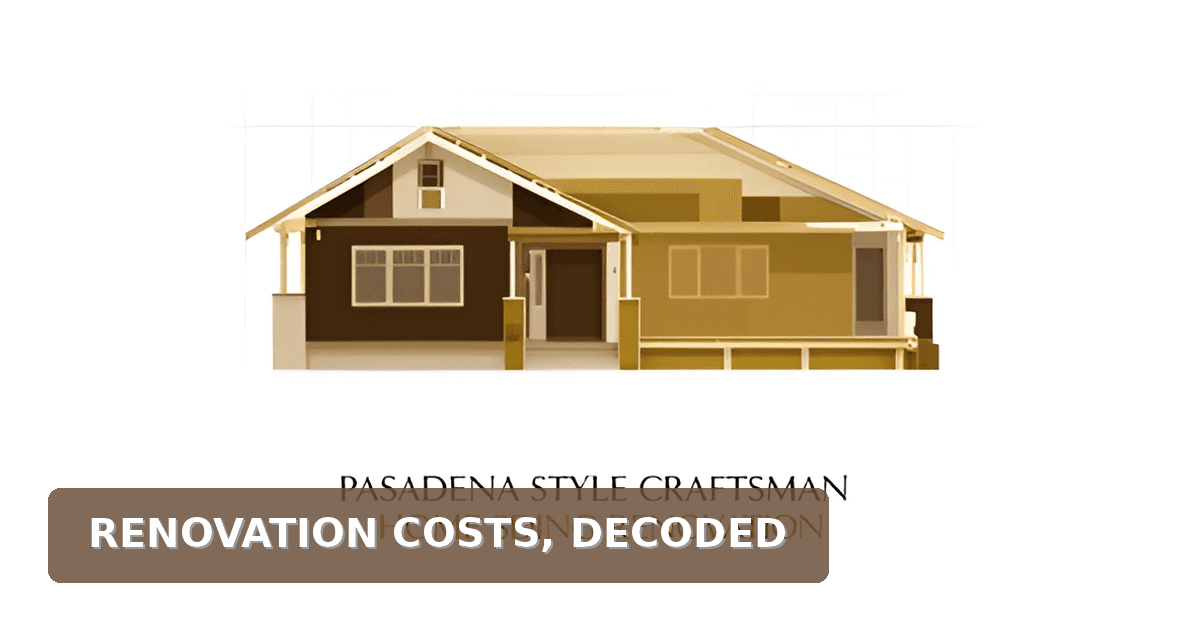
Whole-Home Renovation Costs in Pasadena
Key Facts
- Whole-home renovations in the Pasadena area run $150–$500+ per square foot, per converging data from Sweeten's LA guide and MDRN Construction's framework.
- A 2,500 sq ft Pasadena home renovation can cost $375,000 to $1,000,000+, according to MDRN Construction's LA cost framework.
- Wet rooms cost four times dry rooms: kitchens and baths start near $400 per square foot versus $100 for bedrooms, per Sweeten's LA cost guide.
- Soft costs for permits, design, and engineering add 25–35% to Pasadena project budgets, according to local construction cost analysis.
- Pasadena's pre-1960 housing stock makes a 10–20% contingency standard advice for older homes, per MDRN Construction's renovation guide.
- New Pasadena construction runs $400–$600 per square foot — often making renovation the cheaper path to the home you want, per local cost analysis.
- The U.S. construction industry needs 349,000 new workers in 2026, with over 1 in 5 tradespeople older than 55, per Pasadena Now reporting.
What a Whole-Home Renovation Really Costs in Pasadena
Ask five Pasadena homeowners what they spent on a whole-home renovation and you'll likely get five very different numbers. That's because no source publishes Pasadena-specific renovation pricing — every figure circulating locally is an LA-regional benchmark or a contractor's self-reported range. Most homeowners end up budgeting blind.
The most reliable planning framework comes from converging regional data. Sweeten's LA cost guide puts full-home renovation at $125–$500+ per square foot, while MDRN Construction's framework lands at roughly $150–$250 per square foot for light-to-moderate work, $250–$400 for mid-level, and $400+ for high-end scopes with major reconfiguration. Overlapping as they do, these two independent guides support a $150–$500+ per square foot planning band for the region.
Translated into real totals, that band scales quickly with home size:
- 1,200 sq ft home: roughly $180,000–$480,000+
- 1,800 sq ft home: roughly $270,000–$720,000+
- 2,500 sq ft home: roughly $375,000–$1,000,000+
At the extreme premium end, one LA design-build firm reports comprehensive engagements of $1M–$3M for homes of 3,000–6,000 square feet — a single contractor's self-reported range, not a market survey, but it illustrates where top-of-market scopes land.
So why does the number swing so widely? Three factors do most of the work. First, wet rooms versus dry rooms: per Sweeten's LA guide, bedrooms and living rooms ("dry rooms") start around $100 per square foot, while kitchens and baths ("wet rooms") start closer to $400. A renovation that touches three bathrooms and the kitchen costs vastly more per foot than one that doesn't.
Second, finish level. A budget-grade bathroom runs $18,000–$25,000 in LA, while a high-end version starts around $40,500–$45,000 — and finishes alone can consume half a high-end budget. Third, home size compounds everything, since more square footage means more of both.
Pasadena's housing stock adds a final wildcard. Many local homes predate 1960, and code upgrades — knob-and-tube wiring, undersized electrical service, outdated plumbing — "often add more than owners initially expect," which is why a 10–20% contingency is standard advice for older homes. Soft costs like permits, design, and engineering add another 25–35% to project budgets, per Pasadena-focused construction analysis.
At Altadena Home Remodeling, we treat these figures as planning benchmarks, not promises — no honest guide can guarantee a final number before the walls are opened. The best first step is scoping your specific home: our free remodel-scoping consultation includes a before/after concept render so you can see what your budget actually buys before committing to it.
Why Pasadena's Older Homes and Permit Process Inflate Budgets
Behind every plaster wall in a 1920s bungalow waits a budget surprise: knob-and-tube wiring, galvanized plumbing, and an electrical panel sized for a radio and a refrigerator. Pasadena's pre-1960 housing stock makes whole-home renovations here a different financial exercise than in newer parts of Los Angeles.
Contractors consistently report that code upgrades in older LA homes "often add more than owners initially expect" — and Pasadena is full of homes built before 1960 that lack modern layouts and energy efficiency. One LA design-build firm puts it bluntly: pre-1970s housing carries "surprises behind every wall — knob-and-tube, original lath, undersized service." That's why planning guides recommend a 10–20% contingency specifically for older homes.
The regulatory layer adds its own premium. Pasadena runs its own building department, separate from LADBS, with its own nuances — plus block-by-block zoning, potential historic-district review, Design Commission review that can add 2–3 months if your plans don't align, and Green Building Code requirements. In HPOZ-style historic districts, even work that wouldn't normally need a permit — paint, landscaping — can require review, and unreviewed work risks code enforcement fines.
On top of it all, soft costs add 25–35% to total project budgets once you account for permits, design, engineering, and geotech work. A realistic Pasadena budget includes:
- 10–20% contingency for hidden conditions behind century-old walls
- 25–35% soft costs for permitting, design, and engineering
- Additional review time and fees if your home sits in a historic district
The January 2025 Eaton Fire tightened the labor market further. Period-appropriate rebuilding in Altadena and Pasadena now competes for a shrinking preservation-trades workforce — the tradespeople who can restore historic plaster and period windows are, as Pasadena Heritage's executive director notes, "becoming increasingly rare." Nationally, more than 1 in 5 tradespeople are over 55, and 2.1 million skilled trades positions could go unfilled by 2030.
For preserve-first homeowners, this scarcity cuts both ways: restoration costs more and takes longer to schedule, but well-executed historic work commands a premium at sale, with demand for pre-war Pasadena properties described as constant.
At Altadena Home Remodeling, we scope whole-home renovations with these realities built into the numbers from day one — because a budget that ignores knob-and-tube wiring and historic review isn't a budget, it's a wish.
How to Build a Budget That Survives the Build
Most renovation budgets die in the walls. The homeowner who front-loads wiring, plumbing, and structure survives the build; the one who front-loads countertops reopens drywall in month six and pays for it twice.
The logic is simple, as one LA cost guide puts it: you can always upgrade a countertop later, but re-opening walls to fix wiring or plumbing is far harder and more expensive. That's especially true in Pasadena, where much of the housing predates 1960 and code upgrades for electrical, plumbing, and HVAC "often add more than owners initially expect." A 10–20% contingency is the standard recommendation for older homes — treat it as a line item, not a hope.
Sequence your spending accordingly:
- Structure and systems first — roof, foundation, electrical service, plumbing, HVAC before any finish decisions.
- Phase cosmetic finishes, not infrastructure — tile, paint, and fixtures can wait; the rough-in can't.
- Standardize door, window, and cabinet sizes — custom dimensions multiply material and labor costs.
- Splurge on focal points only — one statement element per room beats spreading the budget thin.
- Minimize change orders — every mid-build redesign resets pricing, scheduling, and trades sequencing.
Change orders deserve special attention in this market. With the U.S. construction industry needing 349,000 new workers in 2026 and more than one in five tradespeople over 55, labor is scarce and getting scarcer — indecision gets priced in. Signing a contractor early also locks in material prices and start dates amid supply backlogs, per Sweeten's LA renovation guide.
For pre-war and Craftsman homes, restoration itself is a value play — not a cost center. Pasadena Heritage's board chair notes that restoring historical details provides "a financial reward when the day comes to sell," because demand for pre-war Pasadena properties is constant. Budget realistically for scarce preservation trades — historic plaster and period window expertise is, in Pasadena Heritage's words, "becoming increasingly rare" — but don't strip the character that makes the home worth buying.
That's the philosophy behind Altadena Home Remodeling's preserve-first approach: renovate over demolish, scope the systems honestly, and phase the finishes your budget allows. A free remodel-scoping consultation with a before/after concept render can map that sequence for your specific home — so you do it once, and do it right.
Renovate or Rebuild? Comparing Your Options in Today's Market
Before you sign a demolition permit, it's worth running the numbers — because in today's Pasadena market, tearing down an older home is often the most expensive way to end up with the house you want. New construction in Pasadena runs $400–$600 per square foot, which means a 2,000-square-foot rebuild typically lands between $800,000 at the low end and $1.4–$1.6 million for custom work, according to local construction cost analysis. A comprehensive renovation, by contrast, spans roughly $150–$500 per square foot depending on scope and finish level.
The alternatives to renovating don't fare much better on paper. Relocating an existing home costs half to two-thirds the price of a new build, per reporting on post-Eaton Fire rebuild options — but that only applies if you have a house worth moving. Modular homes look affordable on the sticker (one Samara model starts around $261,000) yet can double in cost once installation, permitting, and site setup are added. Pre-approved catalog plans at $25 per square foot cut design fees, but the build cost itself still applies.
Here's how the realistic options stack up for a Pasadena-area homeowner weighing a major project:
- Comprehensive renovation: $150–$500+ psf, with 7–18 month timelines (18–30 months for premium scopes)
- New construction: $400–$600 psf, running 16–24 months end-to-end
- House relocation: half to two-thirds the cost of a new build — when a movable structure exists
- Modular: attractive base pricing that can double after site work and permitting
Time is the other currency. Renovations run 7–18 months for full scopes, per LA renovation cost guides, while premium comprehensive engagements stretch to 18–30 months. New construction isn't faster — it sits at 16–24 months before you factor in Pasadena's own building department, which operates separately from LADBS with its own review nuances.
There's also a value argument that pure cost math misses. Pasadena Heritage's board chair notes that restoring historical details delivers "a financial reward when the day comes to sell," given constant demand for pre-war properties, per local preservation reporting. A Craftsman you renovate thoughtfully keeps character that a rebuild can't replicate.
For most owners of Pasadena's older housing stock, the math points the same direction: renovate first, demolish last. That's the preserve-first lens Altadena Home Remodeling brings to every scoping conversation — and it's why a free remodel-scoping consultation, complete with a before/after concept render, is the cheapest first step you can take.
Your Next Step: Scope It Once, Price It Right
Every number in this article points to one conclusion: the cheapest renovation is the one you scope correctly the first time. The most expensive words in remodeling are "while we're in there, can we also…" — and they cost the most when they surface mid-construction instead of during planning.
Start by locking in your contractor early. According to Sweeten's Los Angeles cost guide, signing with a contractor early locks in material prices and start dates amid supply backlogs — a real advantage in a market where Eaton Fire rebuild demand is competing for the same trades. The labor math is sobering: Pasadena Now reports the construction industry needs 349,000 new workers in 2026, with more than one in five tradespeople over 55. Good crews are booked further out than ever, and waiting rarely improves your price.
Next, plan the full arc — not just the construction window. A full renovation runs 7–18 months end-to-end, per MDRN Construction's LA renovation framework, with design taking 2–4+ months, permitting 1–4+ months, and construction 4–10+ months. Premium comprehensive projects can stretch to 18–30 months. Build your life plan around that calendar, including a 10–20% contingency for the surprises older homes reliably deliver.
Finally, begin with a scoping conversation, not a contract. A proper scoping consultation should produce two things before you commit serious money:
- A realistic budget grounded in your actual home — square footage, finish level, systems condition, and the 25–35% soft-cost premium that permits, design, and engineering add
- A before/after concept render, so you and your family can see the outcome before pricing it
- An honest timeline mapped to design, permitting, and construction phases
- A clear renovate-vs-rebuild comparison — relevant when new construction in Pasadena runs $400–$600 per square foot
That last item matters more than most homeowners realize. Deciding after demolition that you picked the wrong scope is the single most expensive mistake in this process. Scope it once, price it once, and do it right.
Altadena Home Remodeling offers a free remodel-scoping consultation that produces exactly this: a realistic budget and a before/after concept render for your home, with no obligation. If you're weighing a whole-home renovation, a kitchen or bath remodel, or restoration of a Craftsman-period house, start there — it's the one step that makes every later decision cheaper.
Frequently Asked Questions
How much does a whole-home renovation actually cost in Pasadena?
Why do kitchens and bathrooms cost so much more than bedrooms per square foot?
How much contingency should I budget for an older Pasadena home?
Is it cheaper to renovate my older home or tear it down and rebuild?
What hidden costs should I expect beyond the construction budget?
How long will a whole-home renovation take in the Pasadena area?
Budget With Your Eyes Open, Not Your Fingers Crossed
A whole-home renovation in Pasadena isn't a mystery — it's a math problem with known variables. The planning band of $150–$500+ per square foot gives you a starting point, but the real budget lives in the details: a 10–20% contingency for what's hiding behind century-old plaster, 25–35% in soft costs for permits, design, and engineering, and a 7–18 month timeline that deserves a place on your family calendar, not just your contractor's. Add in a shrinking pool of skilled trades — the industry needs 349,000 new construction workers in 2026 — and waiting rarely improves your price or your options. The pattern across every scenario we've covered is the same: homeowners who scope honestly once spend less than those who discover their scope mid-build. That's the philosophy behind Altadena Home Remodeling's preserve-first approach. If you're ready to trade guesswork for a real number, our free remodel-scoping consultation delivers a realistic budget and a before/after concept render for your specific home — no obligation, just clarity. Scope it once, price it right, and renovate with confidence.