Whole Home Renovation Cost in Los Angeles: Ranges by Scope
Key Facts
- LA whole-home renovations run $100–$500+ per square foot, with scope depth — not size — the biggest cost driver, per an LA cost analysis.
- Two identical 1,800-square-foot LA houses can receive bids more than $300,000 apart, according to contractor cost data.
- Real data from 17 completed LA remodels shows projects from $36K to $440K with a median of $150K, per the contractor's published records.
- Kitchens and bathrooms occupy about 20% of floor area but consume 40–60% of the total budget, per LA County pricing data.
- Electrical, plumbing, and HVAC together routinely eat a fifth of a whole-home budget — and none of it is visible when finished, per final-cost data.
- Choosing custom cabinetry and stone over stock finishes can add up to $80,000 to a single house, per one LA cost guide.
- Most homeowners assume they need a full gut, but reconfiguration scope delivers 90% of the outcome, per one contractor's project data.
Why LA Renovation Prices Vary So Wildly — and What Actually Drives Them
Ask three contractors to quote the same 1,800-square-foot Altadena ranch house and you may see bids spread more than $300,000 apart. That gap isn't a mistake or a markup — it's the predictable result of three factors that matter far more than square footage.
The first driver is scope depth. A cosmetic refresh that keeps walls, wiring, and plumbing in place runs roughly $100–$175 per square foot, while a full gut to studs lands at $250–$400 psf, and gut-plus-structural work climbs to $350–$500+ psf, according to Green Design & Build's whole-home cost analysis. On a 2,000-square-foot house, that's the difference between a $200K refresh and an $800K rebuild.
The second driver hides behind the drywall. Opening walls in LA's older housing stock routinely exposes knob-and-tube wiring, galvanized supply lines, cast-iron drains, and undersized electrical panels — and electrical, plumbing, and HVAC together can consume a fifth of a whole-home budget even though none of it is visible when the work is done, per final-cost data from 17 completed LA remodels. That contractor's own record shows completed whole-home projects ranging from $36K to $440K, with a median of $150K.
The third driver is finish grade. Kitchens and bathrooms occupy only about 20% of a home's floor area but swallow 40–60% of the total budget, and choosing custom cabinetry and stone over stock finishes can add up to $80,000 to a single house.
So what about that $100–$500+ per square foot benchmark you'll see everywhere? Treat it as a starting assumption, not a measurement. The same per-foot figure can describe a paint-and-floors refresh or a structural rebuild, and estimates can swing 20–40% based on design choices, materials, and complexity. One LA contractor publishes no per-foot rate at all, calling such figures reverse-engineered guesses.
For Altadena homeowners, the practical takeaway is this: the biggest cost lever isn't the finish you pick — it's how deep you open the house. Keeping rooms closed is the single most effective way to hold a budget down, and many owners who assume they need a full gut discover a reconfiguration scope delivers most of the outcome at a lower price. That's the renovate-over-demolish philosophy we champion at Altadena Home Remodeling, and it's why our free remodel-scoping consultation starts with a systems-condition conversation and a before/after concept render — so you can see what's driving your number before you commit to it.
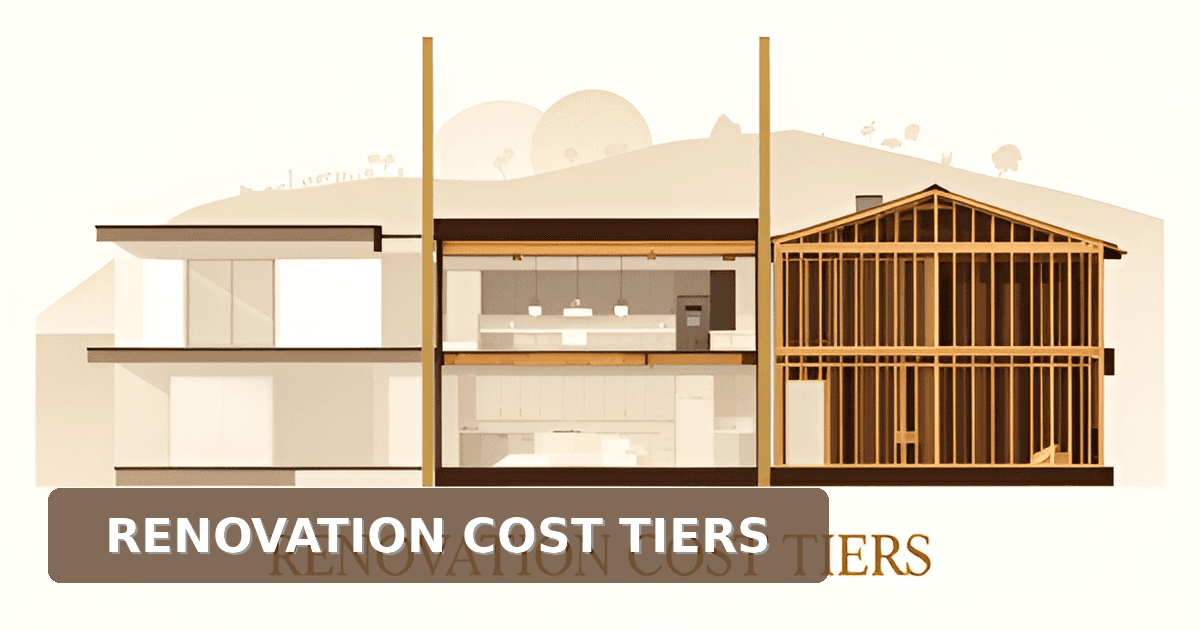
The Three Scope Tiers: What $75K, $150K, and $500K+ Actually Buy
Ask three LA contractors what a whole-home remodel costs and you'll get three different numbers — because the honest answer depends on how deep you go, not how big your house is. The most useful way to price a renovation is by scope tier, and LA project data supports three distinct levels.
Tier 1: Cosmetic and mid-range refresh ($100–$250 psf; $75K–$350K). This tier covers updated finishes, new kitchens and baths, and system touch-ups without moving walls. LA County pricing puts cosmetic updates at $75,000–$150,000 and partial remodels at $150,000–$275,000, according to Bartona Builders' LA County cost calculator. Real first-party data from 17 completed LA remodels shows a median of $150K, with 41% of projects landing under $100K, per Design Onn Point's published project costs. Cosmetic scope is widely described as the best value per dollar of any tier.
Tier 2: Full gut to studs ($250–$400 psf; $425K–$650K+). A gut renovation strips the house to framing — new wiring, plumbing, insulation, and layout throughout. One contractor calls this "effectively new construction inside an existing shell," with timelines running 9–14 months. On a 2,000-square-foot house, this tier translates to roughly $500K–$800K.
Tier 3: Gut plus structural or luxury work ($350–$500+ psf; $500K–$1M+). Add wall removal, foundation work, hillside conditions, or high-end finishes and costs climb fast. Luxury design-build renovations in LA run $1M–$3M for 3,000–6,000 square-foot homes.
Here's the insight most homeowners miss: most people assume they need a full gut, but a reconfiguration scope delivers 90% of the outcome — moving key walls and updating systems room-by-room instead of demolishing everything behind the drywall. That matters especially for Altadena's Craftsman and period homes, where a preserve-first approach renovates rather than demolishes.
A few levers move you between tiers:
- Hidden systems: electrical, plumbing, and HVAC routinely consume a fifth of a whole-home budget, and none of it is visible when finished
- Kitchen and bath finish grade: these rooms take 40–60% of the budget in roughly 20% of the floor area
- Walls kept closed: leaving rooms untouched is the single most effective way to hold a budget down
For 1950s–70s houses, a full gut is sometimes the only honest answer, since wiring, galvanized supply lines, and single-pane windows all reach end-of-life together. For 1920s homes, patching systems room-by-room can cost more over a decade than replacing them once.
The right tier depends on your home's actual condition — not a generic per-square-foot guess. At Altadena Home Remodeling, our free remodel-scoping consultation includes a systems-condition assessment and a before/after concept render, so you can see which tier your house actually needs before committing. Estimates at this stage can vary 20–40%, and permit requirements in unincorporated LA County vary by jurisdiction, so treat these figures as directional ranges — then scope it properly and do it once, do it right.
The Hidden Costs That Break Budgets: Systems, Kitchens, Baths, and Code
Drywall is cheap; what's behind it is not. That warning, from one LA cost guide, captures why two identical houses on the same street can end up $300,000 apart in renovation cost.
Electrical, plumbing, and HVAC together routinely consume a fifth of a whole-home budget — and none of it is visible when the work is finished. Pre-1970s homes across Los Angeles commonly hide knob-and-tube wiring, original lath, galvanized supply lines, and undersized electrical panels, all of which surface the moment walls open.
As one contractor puts it, on 1950s–1970s houses a full gut "is often the only honest answer, because the wiring, the galvanized supply lines and the single-pane windows all reach the end of their lives at the same time." Patching 1920s systems room-by-room can cost more over a decade than replacing them once.
Kitchens and bathrooms typically consume 40–60% of the total project budget while occupying roughly 20% of the floor area. First-party LA project data shows kitchens running $23k–$84k (median $50k) and bathrooms $28k–$105k (median $38k). That concentration makes finish-tier selection in these two rooms the single biggest lever on total price — a spread of up to ~$80,000 per house between stock and custom-grade packages.
Altadena's older housing stock faces regulatory costs that newer suburban remodels never touch. These triggers arrive regardless of finish grade:
- The LA Green Building Code applies to alterations valued over $200,000, pulling energy-compliance work into scope
- Energy-code upgrades — heat-pump HVAC, heat-pump water heaters — typically add $30,000–$55,000 on a mid-tier whole-home
- South Coast AQMD Rule 1403 requires an asbestos survey before demolition in pre-1990 homes, plus EPA lead-safe certification for pre-1978 homes
- "Remodel becomes rebuild" rules can strip grandfathered status once alteration value crosses defined thresholds
Because Altadena sits in unincorporated LA County, permit fees and plan-check timelines differ from LADBS baselines — worth confirming early rather than assuming.
Most contractors recommend a 10–20% contingency, and estimates themselves can vary 20–40% depending on design choices, contractor, and complexity. The most effective budget-holding move, according to one LA guide, is leaving rooms closed — every wall you don't open is a system you don't have to replace.
Altadena Home Remodeling approaches scoping the same way: assess the systems condition first, then the finishes. A free remodel-scoping consultation with a before/after concept render helps you see where a reconfiguration can deliver most of a gut renovation's outcome at a fraction of its cost — scope it, price it, do it once, do it right.
How to Scope It Right: From Budget Ranges to a Real Number for Your House
The difference between a $200,000 remodel and a $500,000 one on the same street usually isn't the house — it's the decisions made before a single wall opens. Here's how to turn a budget range into a real number for your home.
Settle finishes during design, not construction. As one LA contractor puts it, "We settle finishes during design, not during construction" — because late finish decisions move electrical rough-ins, plumbing, and tile crews, and every delay costs money (Green Design & Build). The finish spread alone between stock and custom cabinets and stone can run up to ~$80,000 per house, and kitchens and baths consume 40–60% of the total budget in roughly a fifth of the floor area (LA County pricing data). Choose those rooms' finishes early and hold the line.
Lock in material prices early. With material supply backlogs pushing prices upward, contractors recommend signing early to lock in both material prices and start dates (Sweeten's LA cost guide). Waiting doesn't save money in this market; it usually spends more.
Decide your scope tier honestly. Most homeowners assume they need a full gut, yet one LA contractor's first-party data from 17 completed whole-home remodels — a median of $150,000, with 41% landing under $100k — shows reconfiguration scope often delivers "90% of the outcome" (Design Onn Point's project records). Cosmetic scope is likewise described as the best value per dollar of the four tiers (per scope-tier analysis). Committing to a tier you can actually afford beats drifting into one you can't.
Get a systems-condition assessment behind the drywall. "Drywall is cheap; what is behind it is not" — and electrical, plumbing, and HVAC together routinely take a fifth of a whole-home budget while remaining invisible when the work is done (contractor cost data). Pre-1970s LA homes commonly hide knob-and-tube wiring, galvanized lines, and undersized electrical service (LA renovation cost research). Know what's there before you price what you want.
Four moves that turn a range into a number:
- Pick your scope tier first — cosmetic, reconfiguration, or full gut — before choosing finishes.
- Finalize kitchen and bath finishes during design, since those rooms drive 40–60% of cost.
- Sign early on materials to lock prices amid ongoing supply backlogs.
- Assess hidden systems before budgeting — they can claim a fifth of the total invisibly.
Altadena Home Remodeling offers a free remodel-scoping consultation that pairs a systems-condition walkthrough with a before/after concept render, so your number reflects your house — not a per-square-foot guess. Altadena sits in unincorporated LA County, where permit requirements, plan-check timelines, and thresholds like the LA Green Building Code trigger for alterations over $200,000 differ from city jurisdictions, so we make no timeline or permit guarantees. Our featured builder, JMB Builders LLC (CSLB #1103479, a disclosed paid placement), is an Altadena-based licensed general contractor whose whole-home remodel and rebuild work is documented at jmb-builders.com.
Frequently Asked Questions
How much does a whole-home renovation cost in Los Angeles?
Why did my neighbor's remodel cost so much less than the quotes I'm getting?
Do I really need a full gut renovation, or is that overkill?
What hidden costs should I budget for in an older LA home?
How much of my budget will the kitchen and bathrooms eat up?
How can I keep my renovation budget from spiraling?
Your Number Is Hiding Behind the Drywall — Scope It Before You Sign It
The real story of LA renovation pricing isn't square footage — it's how deep you open the house. A cosmetic refresh runs $100–$175 per square foot, a full gut $250–$400, and gut-plus-structural work $350–$500+, while hidden systems like electrical, plumbing, and HVAC quietly consume a fifth of the budget, per first-party data from 17 completed LA remodels. Kitchens and baths take 40–60% of the total in a fifth of the floor area, making finish grade in those two rooms your biggest controllable lever. Before you commit to a tier, know what's actually behind your drywall and settle finishes during design, not construction. Many Altadena homeowners who assumed a full gut discover a reconfiguration delivers 90% of the outcome at a lower price — the renovate-over-demolish approach we practice at Altadena Home Remodeling. Start with a free remodel-scoping consultation: a systems-condition walkthrough plus a before/after concept render, so your number reflects your house — not a per-foot guess. Scope it, price it, do it once, do it right.