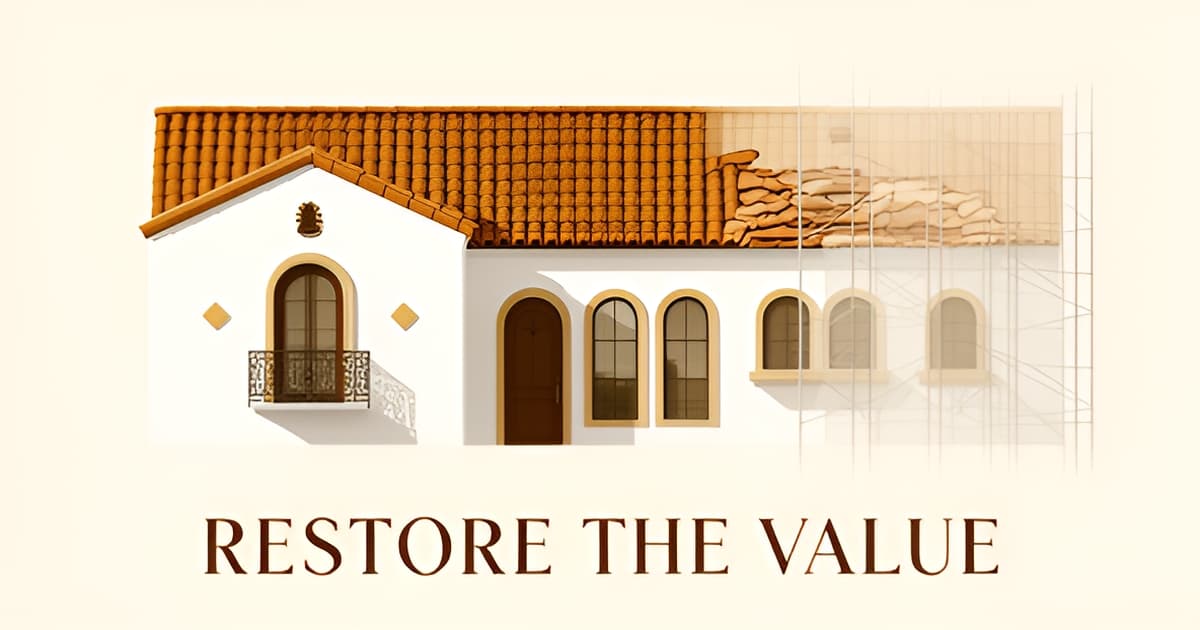
Spanish Revival Home Restoration: Materials and Cost in LA
Key Facts
- Spanish Revival homes in LA sell 30–45% faster than the overall market, per 2025 brokerage data.
- High-quality Spanish Revival restorations honoring original character typically cost $100,000–$300,000 according to market analysis.
- These homes frequently command 2–5% premiums above asking in Hancock Park, Los Feliz, and Windsor Square, brokerage data shows.
- Non-compliant roofing in LA historic districts can require reversal of the work at the homeowner's own expense, roofing suppliers warn.
- Batchelder fireplaces often survive behind later mantels and beams hide above dropped ceilings — details that 'move the price,' says a 24-year real estate veteran.
- Arches that curve only at the top 'feel more French than Spanish'; authentic ones use a continuous radius, per interior designer Lane McNab.
- Mixing Mission Revival and Spanish Revival styles can produce disjointed additions that reduce resale value, LA design-build analysis warns.
Why Your Spanish Revival Is Worth Restoring (Not Renovating Away)
Your 1920s Spanish Revival still has its hand-glazed tile, curved plaster arches, exposed beams, and wrought iron stair rail — and someone just told you it would be easier to gut it and build a white-box modern home. Before you take a sledgehammer to ninety years of craftsmanship, look at what the LA market is telling you.
The numbers are striking. According to LA brokerage market data, Spanish Revival homes sell 30–45% faster than the overall market — 28–35 median days on market versus 55–61 citywide — and they frequently command 2–5% premiums above asking in neighborhoods like Hancock Park, Los Feliz, and Windsor Square. Homes that keep their arched windows, interior arches, and wooden floors while adding modern systems move fastest and fetch the highest premiums.
The expert consensus is blunt: restoring original character returns more value than modernizing it away. As one 24-year architectural real estate veteran puts it, "The value of a Spanish home is in the details a previous owner almost tore out." The buyer who pays top dollar wants the period, not a gut renovation — and the only exception is genuine systems work: roofs, plumbing, and electrical should simply function.
That leads to the framing we use at Altadena Home Remodeling for every historic project: restore the character, modernize only the systems. You keep the tile, plaster, beams, and ironwork that no builder can replicate today, while updating what buyers can't see — wiring, plumbing, HVAC, and structural work — so the home performs like new.
Here's the part most homeowners miss: many Spanish Revivals are hiding their best features behind mid-century "updates."
- A Batchelder fireplace often survives behind a later mantel — one of the most valuable discoveries in any restoration
- Original beams frequently hide above dropped acoustic ceilings, waiting to be re-exposed
- Courtyard fountains are usually capped, not removed, and can often be restored
Those hidden details are exactly what "move the price," per the same expert — uncovering one original feature often returns more than a glossy kitchen renovation. And remember that automated valuation tools can't see any of this: an algorithm reads bedrooms and lot size, but it has no field for original tile. Your Zestimate is blind to the very things that make your home worth the most.
So before you schedule a demo day, find out what's actually behind those walls. A scoping assessment that inventories what you have — and what's hidden — is the first step in doing the project once, and doing it right.
The Materials That Make or Break an Authentic Restoration
The difference between a restoration that adds value and one that erases it comes down to five materials. Get them right, and the house "reads honest to the 1920s" — the quality that, per a 24-year architectural real estate veteran, draws the deepest buyer pool. Get them wrong, and no amount of budget saves the character.
Clay barrel tile is the undisputed gold standard for Spanish Revival roofs in Los Angeles. Original LA clay tiles ranged from warm buff and pale gold to deep burnt orange, so beware replacements that look overly red or suspiciously uniform — they read fake from the street. For partial replacement, order more tile than you need and test new tiles beside the originals in natural outdoor light before committing. One practical warning: clay is heavy, and homes designed around lighter roofing may need a structural evaluation first. In historic districts, the stakes are higher still — non-compliant roofing can require reversal at the homeowner's expense.
Inside, the walls matter as much as the roof. The authentic palette is warm-neutral plaster — and specialty finishes like Moroccan tadelakt, Venetian plaster, and limestone finishes are now far more accessible, since artisans from North Africa and Europe are increasingly represented by American suppliers.
Flooring should follow the same logic. Unglazed terracotta and saltillo tile are defining elements of the style, and their handmade irregularity is part of the point. Uniform, machine-perfect tile undercuts the very texture buyers are paying for.
Wood elements deserve restoration before replacement. Exposed beam ceilings with wood planking and solid mahogany millwork with trimless casings define the interior, and original beams frequently survive hidden above dropped ceilings. As one expert puts it, "original beams hide above a dropped ceiling... Those are the details that move the price." A preserve-first scoping process — the approach we take at Altadena Home Remodeling — starts by finding out what's actually still there.
Finally, geometry. Authentic Spanish arches require a continuous curved shape with a specific radius repeated throughout a space. Arches that curve only at the top "feel more French than Spanish" — a subtle but telling shortcut.
A quick authenticity checklist:
- Clay barrel tile roof, color-matched in natural light — never glossy red or uniform
- Warm-neutral plaster walls (tadelakt, Venetian, or limestone finishes)
- Unglazed terracotta or saltillo flooring with handmade variation
- Restored original beams and mahogany millwork, not new imitation stock
- Continuous-radius arches, repeated consistently through the space
High-quality renovations that honor a home's character while modernizing kitchens, baths, and HVAC typically run $100,000–$300,000 in the LA market, though line-item pricing for tile, plaster, and millwork depends entirely on what your house retains. If you're weighing a Spanish Revival restoration in Altadena, a free remodel-scoping consultation with a before/after concept render — working with featured builder JMB Builders LLC (CSLB #1103479) — is the honest first step: scope it, price it, do it once, do it right.
What Restoration Actually Costs in LA — And Where the Rules Bite
Start with the honest number: a high-quality Spanish Revival renovation that honors the home's character while modernizing the kitchen, bathrooms, and HVAC typically runs $100,000 to $300,000 in Los Angeles, according to 2025 brokerage market analysis. That range covers whole-home work, not a single room — and it's the only reliable cost benchmark published for this housing stock.
Here's the uncomfortable truth: no source publishes line-item pricing for the work that defines these homes. Nobody quotes a per-square-foot rate for restoring Batchelder tile, lime plaster, or original mahogany millwork, because every project depends on what's hiding under later alterations. That's exactly why Altadena Home Remodeling starts with a free scoping consultation — including a before/after concept render — before anyone promises a number. Scope it, price it, do it once, do it right.
The rules matter as much as the budget. If your home sits in a Historic Preservation Overlay Zone, exterior changes require HPOZ board approval before work begins. Roofing is where homeowners get burned: installing non-compliant materials can trigger required reversal of the work at your own expense, per roofing supplier guidance for LA historic homes. Verify with the Department of City Planning before you commit — and note that synthetic tiles, while lightweight, may not be approved in designated districts at all.
Before you count on tax relief, check the fine print. The Mills Act can lower property taxes for designated historic homes in exchange for maintenance commitments, but the City of Los Angeles has not accepted new contracts since 2020. Eligibility must be confirmed locally, not assumed.
One more trap: style identity. Mission Revival and Spanish Revival are frequently confused in LA, and decades of additions have left many homes as hybrids. LA design-build analysis warns that mixing the two produces "disjointed additions that reduce resale value" — Mission homes demand quiet minimalism, while Spanish Revival celebrates drama, texture, and craftsmanship.
A few checks worth running before any exterior commitment:
- Confirm whether your property falls within an HPOZ or carries individual historic designation
- Verify roofing material requirements with City Planning before ordering tile
- Check current Mills Act eligibility rather than relying on outdated guidance
- Get a professional style assessment if your home shows mixed Mission and Spanish elements
None of this argues against restoring — it argues for doing it correctly the first time. Spanish Revival homes sell 30–45% faster than the overall LA market, and that premium only materializes when the work reads honest to the period. In Altadena and LA County's unincorporated areas, permit paths differ from City of LA processes, and no contractor can guarantee timelines or approvals. What a proper scoping consultation can do is map the constraints, identify hidden original features, and price the real work before demolition starts.
How to Scope Your Altadena Spanish Revival Restoration the Right Way
The most expensive mistake in a Spanish Revival restoration isn't overspending — it's scoping the project before you know what the house actually contains. Original Batchelder fireplaces survive behind later mantels, beams hide above dropped ceilings, and courtyard fountains are usually capped rather than removed. As one 24-year architectural real estate veteran puts it, those hidden details are what "move the price," and uncovering an original feature often returns more than a glossy kitchen upgrade.
That's why the right sequence starts with a style and hidden-feature assessment before any design decisions. Mission Revival and Spanish Revival are frequently confused in LA, and mixing the two can produce disjointed additions that reduce resale value. A deep architectural review should come before renovation planning, not after.
From there, separate the work into two tracks:
- Systems work first — roofs, plumbing, and electrical should simply function, per expert consensus on period homes.
- Character restoration second — tile, plaster, woodwork, and wrought iron handled with period-appropriate materials.
- Structural evaluation before any clay barrel tile roof work, since older homes designed around lighter roofing may need reinforcement.
- Permit and preservation verification before committing to exterior work, since non-compliant roofing can require reversal at the homeowner's expense.
That last point matters especially in Altadena, where properties fall under LA County unincorporated processes rather than City of LA departments. Exterior changes in historic districts require board approval, and buyers planning major renovations need to understand constraints before committing. No reputable contractor can promise permit timelines — but verifying the path early prevents costly redesigns.
Finally, price the project once with a full scope rather than piecemealing. The best available benchmark suggests budgeting $100,000–$300,000 for high-quality renovations that honor a home's character while modernizing kitchens, baths, and HVAC. No published source provides itemized pricing for tile, plaster, or woodwork restoration, so project-specific numbers require an actual walkthrough.
That's the purpose of the free remodel-scoping consultation from Altadena Home Remodeling, which includes a before/after concept render so you can see the direction before committing to a budget. For homeowners pursuing a whole-home remodel or Eaton Fire rebuild, featured builder JMB Builders LLC (CSLB #1103479), an Altadena-based licensed general contractor, is disclosed as paid placement in this guide.
Scope it, price it, do it once, do it right — that's the whole philosophy in seven words.
Frequently Asked Questions
Is it worth restoring my Spanish Revival home, or should I just gut it and modernize?
How much does a Spanish Revival restoration cost in Los Angeles?
What roofing material should I use on a Spanish Revival home?
Do I need approval to change the exterior of my historic home in LA?
Can I still get Mills Act property tax relief for my historic home?
What hidden original features should I look for before renovating my Spanish Revival?
Your 1920s Home Is Worth More Than You Can See
The case for restoring your Spanish Revival — not renovating it away — comes down to numbers no algorithm can calculate. These homes sell 30–45% faster than the overall LA market and command 2–5% premiums in neighborhoods like Hancock Park and Los Feliz, per 2025 brokerage market data, because buyers pay for the tile, plaster, beams, and ironwork no builder can replicate today. The strategy is simple: restore the character, modernize only the systems. Get the five materials right — clay barrel tile, warm-neutral plaster, unglazed terracotta, restored woodwork, and true continuous-radius arches — verify HPOZ and roofing rules before any exterior work, and budget $100,000–$300,000 for a whole-home project done properly. Most importantly, find out what's hiding behind your walls before you plan anything: that Batchelder fireplace or capped fountain may be worth more than a new kitchen. Start with a free remodel-scoping consultation from Altadena Home Remodeling, including a before/after concept render — because the smartest restoration is the one you scope, price, and do right the first time.