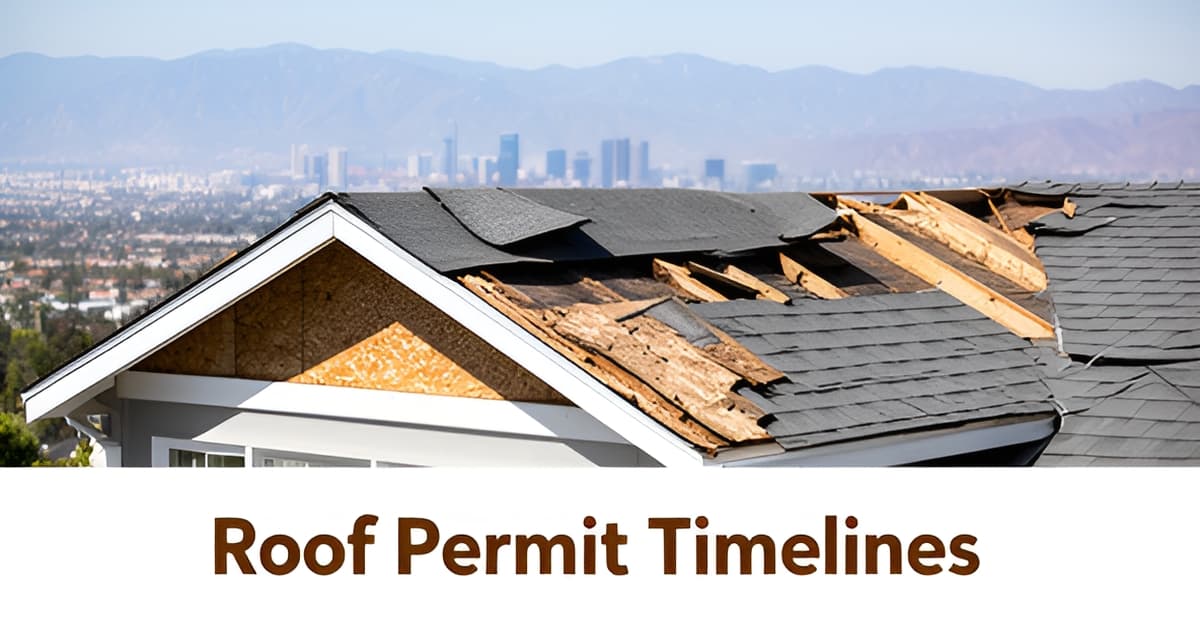
Roof Permit Timelines in California Under the Residential Code
Key Facts
- Straightforward reroof permits in California typically clear in 5 to 15 business days, per contractor-reported timelines.
- Removing more than 25% of an existing roof triggers a permit under California Residential Code rules, according to California roofing guidance.
- California prohibits overlaying a roof that already has two or more existing layers, forcing a full tear-off first, per LA-area permitting guidance.
- LADBS Express Permits cover Class A or B coverings under 6 lbs per square foot, with same-day counter approval possible, according to permitting guidance.
- Unpermitted roof work can cost $2,500–$8,000 in retroactive fees plus fines starting at $100 per day, per contractor accounts.
- Replacing more than 50% of a residential roof triggers Cool Roof Rating Council certification as a permit condition, per LA-area guidance.
- Under AB 130, California residential code updates are frozen until 2031, making 2025 Title 24 the stable baseline, per a 2026 construction law summary.
When Your Reroof Actually Needs a Permit
Most homeowners replacing a roof in California assume the permit question is complicated. It isn't — the California Residential Code draws fairly clear lines, and knowing which side of them your project falls on determines everything that follows.
The CRC (Title 24, Part 2.5), based on the 2024 IRC with California amendments, sets its permit triggers in Chapter 1 and governs roofing through Chapters 8 and 9, as shown on the current code viewer. In practice, your reroof needs a permit when it crosses any of these thresholds:
- A full tear-off or complete replacement — LA-area guidance treats nearly every full replacement as permit-required.
- Removal of more than 25% of the existing roof area, or any structural change to framing, sheathing, or roof shape.
- An overlay on a roof that already has two or more layers of roof covering — California prohibits a third application, so existing layers must come off first.
- A material change, such as switching to a different roof covering type, which typically triggers a re-roof certificate or building permit.
There's also a secondary trigger worth knowing: replacing more than 50% of a residential roof activates Cool Roof Rating Council requirements, meaning your product choice becomes a condition of permit approval, not just a preference.
Now, the exemption you've probably heard about. Many articles cite a 100-square-foot repair exemption — the idea that patching a small leak needs no permit. Sources genuinely conflict here. One California roofing guide repeats the exemption, but LA-specific guidance explicitly warns against relying on it, noting that the building department broadly requires a re-roof certificate whenever an existing roof is replaced or repaired. In Altadena's LA County unincorporated context, the safe assumption is that any work beyond a trivial patch warrants a call to the building department before the first shingle comes off.
The stakes are real. Contractors report that unpermitted work discovered later can bring stop-work orders, fines starting at $100 per day, and retroactive permits at double or triple fees — with total surprise costs of $2,500 to $8,000 in some cases. A permitted project, by contrast, forces hidden problems into the open: one documented 1960s San Fernando Valley reroof revealed roughly 80 square feet of compromised decking mid-project, and the inspection process kept that damage from being quietly covered over.
If you're weighing a reroof as part of a larger renovation — say, restoring a Craftsman home's original character while bringing the envelope up to code — Altadena Home Remodeling can help you scope the whole project, roof included, so permit triggers get identified before plans are drawn, not after.
How Long Approval Really Takes — Ranges, Not Guarantees
Ask five contractors how long a reroof permit takes in California and you'll get five different answers — because the honest answer is a range, not a date. No official government source publishes reroof-specific approval timelines, so everything below reflects contractor-reported experience, not guarantees.
According to one contractor account, straightforward reroof permits typically clear in 5 to 15 business days from application to approval. Qualifying projects can move even faster: LADBS offers an Express Permit track for Class A or B roof coverings under 6 pounds per square foot, available online or at the counter, with same-day over-the-counter approval reported for uncomplicated jobs.
Looking at the full arc of a permitted reroof, the same source breaks the timeline into stages:
- Permit approval: up to 5 business days for straightforward projects
- Roofing work itself: 1 to 3 days
- Final inspection: within 3 to 5 business days of completion
- Structural review or fire-zone plan checks: add 1 to 2 weeks
That puts a full permitted reroof at roughly 2 to 4 weeks end to end — provided nothing unusual surfaces. Complications like damaged sheathing discovered mid-project, documented in a San Fernando Valley 1960s-home case, can add days and thousands of dollars. As that contractor put it, the permit wasn't the problem — it kept the real problem from being hidden.
Here's why scope, not geography, is the real variable. In Altadena and surrounding LA County areas, rebuild permits have averaged about 5 months since the Eaton Fire. That figure applies to whole-home reconstruction — a fundamentally different permit type than a reroof — but it illustrates how a jurisdiction's queue and a project's complexity interact. The same reporting shows pre-approved plan libraries cutting approvals to 30–40 days, roughly a 75–80% reduction.
One caution for fire-zone properties: the consolidated wildfire standards in Title 24, Part 7 may bring stricter plan-check scrutiny of roofing materials and installation details in WUI areas, which can extend review. Altadena Home Remodeling always recommends confirming current timelines directly with your local building department — for unincorporated LA County, that's the county planning office — before scheduling work. Treat every number here as a planning estimate, never a promise.
The Fast Lane: Express Permits and Plan-Check Triggers
Not every reroof in California has to sit in a plan-check queue. The difference between a same-day permit and a multi-week review usually comes down to one thing: what your project actually touches.
The fastest path is LADBS's Express Permit, which covers qualifying re-roofs — Class A or B roof coverings weighing less than 6 lbs per square foot installed over existing or new solid sheathing — without traditional plan check, according to LA-specific permitting guidance. LADBS also runs a two-track online system: ePlanLA for projects requiring plan review, and PermitLA for those that don't, with roofing inspections required before the work gets covered, per the department's official process. Contractor-reported timelines for straightforward reroofs run 5–15 business days, with same-day over-the-counter approval possible for simple projects — figures to treat as typical ranges, not guarantees.
The express lane ends the moment your scope goes beyond a like-for-like covering. Full plan review is triggered by:
- Structural framing modifications or significant weight increases
- Roof shape or pitch changes
- New dormers or large openings
- Nonstandard construction details
Contractors report that structural review or fire-zone plan checks typically add 1–2 weeks to the process, and field accounts show how strict the standards are — one permit was rejected over a shingle with 0.12 solar reflectance versus the 0.20 required, costing roughly three weeks.
Then there's the overlay rule that quietly forces tear-offs. California's residential roofing code prohibits a new roof covering over a property that already has two or more existing roof-covering applications — the existing layers must come off first. That means many homeowners planning a quick overlay discover mid-process that they need a full tear-off permit instead. In Altadena, where many Craftsman-era homes carry decades of layered roofing, this is often the first surprise in a whole-home renovation conversation.
For Altadena Home Remodeling readers weighing a reroof as part of a larger renovation, the practical takeaway is to confirm your layer count and fire-zone status before assuming you qualify for the express path. If you're mapping a full remodel around a new roof, a free remodel-scoping consultation — including a before/after concept render — can help you scope it, price it, and do it once, do it right.
Fire-Zone and Cool-Roof Requirements That Affect Your Permit
In Altadena, the fire rating of your roof covering isn't a design preference — it's a permit condition. If your home sits in a Very High Fire Hazard Severity Zone, your reroof permit will require a Class A fire-rated roof assembly tested under ASTM E108 or UL 790, along with ember-resistant vents under CBC Section R337. Untreated wood shakes are prohibited in these zones, and wood shake or shingle roofs are banned outright in the City of Los Angeles, per LA-area permitting guidance.
The second condition that surprises homeowners is the cool-roof rule. When more than 50% of a residential roof is replaced, the new covering must be a Cool Roof Rating Council-certified product. Since the 2024 Title 24 update, permitted reroofs must meet minimum solar reflectance and thermal emittance values as a condition of approval — steep-slope roofs require a solar reflectance of 0.20 and thermal emittance of 0.75, while low-slope roofs require 0.63 and 0.75 respectively. These ratings must be listed on the permit application, according to 2026 California roofing permit requirements. Getting this wrong has real consequences: one contractor documented a permit rejection and roughly three-week delay caused by a shingle with a 0.12 reflectance where 0.20 was required.
For Altadena homeowners, the timing context matters as much as the requirements themselves. The 2025 Title 24 code applies to all permit applications submitted on or after January 1, 2026. Under AB 130, residential building code updates are frozen until 2031 — with narrow exceptions for emergency, fire, and conservation standards — making the 2025 Title 24 the governing baseline for years to come, according to a 2026 construction law summary. Wildfire-resistant construction standards are also being consolidated into a new standalone Title 24, Part 7, which governs roofing assemblies, vents, and eaves in wildland-urban interface areas and may bring stricter scrutiny of materials and installation details during plan check and inspection.
What this means in practice:
- Class A fire-rated assemblies are mandatory in Very High Fire Hazard Severity Zones — which covers much of Altadena's hillside areas.
- Ember-resistant vents and prohibited materials (untreated shakes) are enforced at permit and inspection stages.
- Cross the 50% replacement threshold and a CRRC-certified cool-roof product becomes a permit condition, not an option.
- Fire-zone upgrades typically add $500 to $2,500 to a permitted reroof, per contractor-reported figures.
Because these requirements are now stable through 2031, planning a compliant reroof in Altadena is more predictable than it has been in years — but verifying your zone, product ratings, and vent details with the LA County building department before applying is still essential. At Altadena Home Remodeling, we factor fire-zone and cool-roof conditions into every remodel-scoping consultation, so your before/after concept render reflects what your permit will actually require. If your project includes reroofing work, our featured builder, JMB Builders LLC (CSLB #1103479), brings licensed experience with Altadena homes, including Eaton Fire rebuilds.
Getting It Done Right: Permits, Contractors, and Next Steps
The permit is the easy part. The hard part is knowing who should hold it — and what happens when nobody does.
A licensed C-39 roofing contractor — or a general contractor managing the project — should pull the permit under their own license. Contractor guidance is clear that owner-builder permits shift responsibility, liability, and inspection obligations onto the homeowner, a position most Altadena homeowners never intend to occupy. California's CSLB also requires every C-39 contractor to carry workers' compensation insurance even with no employees, which protects you if someone falls off your roof. LADBS confirms permits can be obtained by an agent, owner, or contractor — but only one of those parties carries insurance for a living.
Unpermitted roof work rarely saves money for long. According to contractor-reported figures, the consequences compound quickly:
- Stop-work orders and fines starting at $100 per day
- Retroactive permits at double or triple the standard fee, adding $2,500–$8,000
- Possible mandatory tear-off of the finished roof
- Insurance claim denials and failed home sales at escrow
For context, a properly permitted residential reroof runs $150–$600 in permit fees depending on jurisdiction and valuation — a rounding error against the cost of doing it twice. And because the 2025 Title 24 code now applies to all applications submitted on or after January 1, 2026, with residential updates frozen until 2031, the rules you permit under today will be the rules you live with for years.
Permit scope depends on facts you can't see from the driveway: how many existing roof layers sit on the deck (California prohibits overlaying a roof with two or more existing coverings), whether you're in a Very High Fire Hazard Severity Zone requiring Class A assemblies, and whether replacing more than 50% of the roof triggers cool-roof product requirements. A scoping consultation surfaces all of this before a single shingle is ordered — and before a non-compliant product choice derails the permit, as one documented case showed when a shingle with 0.12 reflectance versus the required 0.20 caused rejection and a roughly three-week delay.
That's why Altadena Home Remodeling recommends scoping it, pricing it, and doing it once, the right way. Book a free remodel-scoping consultation and get a before/after concept render of your project. Our featured licensed builder is JMB Builders LLC (CSLB #1103479), an Altadena-based general contractor building custom homes, ADUs, and whole-home remodels, including Eaton Fire rebuilds — see their work at jmb-builders.com. (Paid placement, disclosed.)
Frequently Asked Questions
Do I need a permit to replace my roof in California, or just for repairs?
Is there really a 100-square-foot exemption for small roof repairs?
How long does a roof permit take to get approved in California?
Can I get a roof permit the same day?
What happens if I reroof without a permit in California?
Do fire-zone or cool-roof rules affect my Altadena reroof permit?
Your Roof, Your Rules: Getting the Permit Right the First Time
The pattern across every section of this guide comes down to one idea: your reroof's permit path is determined by scope, not luck. Full tear-offs, removal of more than 25% of the roof, structural changes, two or more existing layers, or a material switch all trigger permitting — and crossing the 50% replacement threshold adds CRRC-certified cool-roof requirements, while Altadena's hillside fire zones mandate Class A assemblies. A straightforward permitted reroof typically runs 5–15 business days for approval and 2–4 weeks end to end, per contractor-reported timelines — treat those as planning ranges, not promises. With the 2025 Title 24 code locked in until 2031, the rules you permit under today are the rules you'll live with for years, which makes now a smart time to get it right. Your next steps are simple: count your roof layers, confirm your fire-hazard zone, verify product ratings before ordering, and let a licensed contractor pull the permit under their own license. If your reroof is part of a bigger renovation, Altadena Home Remodeling can help you scope it, price it, and do it once — book a free remodel-scoping consultation with a before/after concept render, featuring licensed builder JMB Builders LLC (CSLB #1103479).