Remodel Budget Contingency: How Much to Hold Back and Why
Key Facts
- Only 36% of remodeling homeowners hit their budgets, 31% went over, and 29% started with no budget at all, according to a survey of 87,000+ homeowners.
- Practitioners recommend holding 5%–15% of contracted project cost as contingency — $10,000–$30,000 on a $200,000 renovation, per Case Design guidance.
- Designer Andrea Schumacher estimates walls or floors hide surprises roughly 80% of the time, advising a 25%+ buffer on remodels, based on her experience in older homes.
- On cost-plus contracts, homeowners should keep at least 10% of estimated cost available — $50,000 on a $500,000 project — construction finance guidance advises.
- Construction finance writer Bryan Kaplan warns that once clients know extra funds exist, "they will think it's theirs to spend," explaining why contingencies invite scope creep.
- The older the home, the larger the contingency should be — even if it's been renovated before, according to design/build practitioners.
- Contingencies cover builder-side risks like schedule overruns and material price increases; client upgrades and demolition surprises belong in change orders, per construction finance experts.
Why Most Remodel Budgets Fail Before Demolition Day
Most remodel budgets don't break during construction — they break the moment they're written, because they never included room for what nobody can see yet. If you're planning a whole-home renovation in Altadena, the numbers on overrun risk deserve your attention before you pick up a sledgehammer.
According to the 2020 U.S. Houzz & Home survey of more than 87,000 homeowners, only 36% of remodelers actually hit their budgets, 31% went over, and 29% started with no budget at all. In other words, staying on budget is the exception, not the rule. The same survey findings identify the three most common overrun causes:
- Products and services costing more than expected
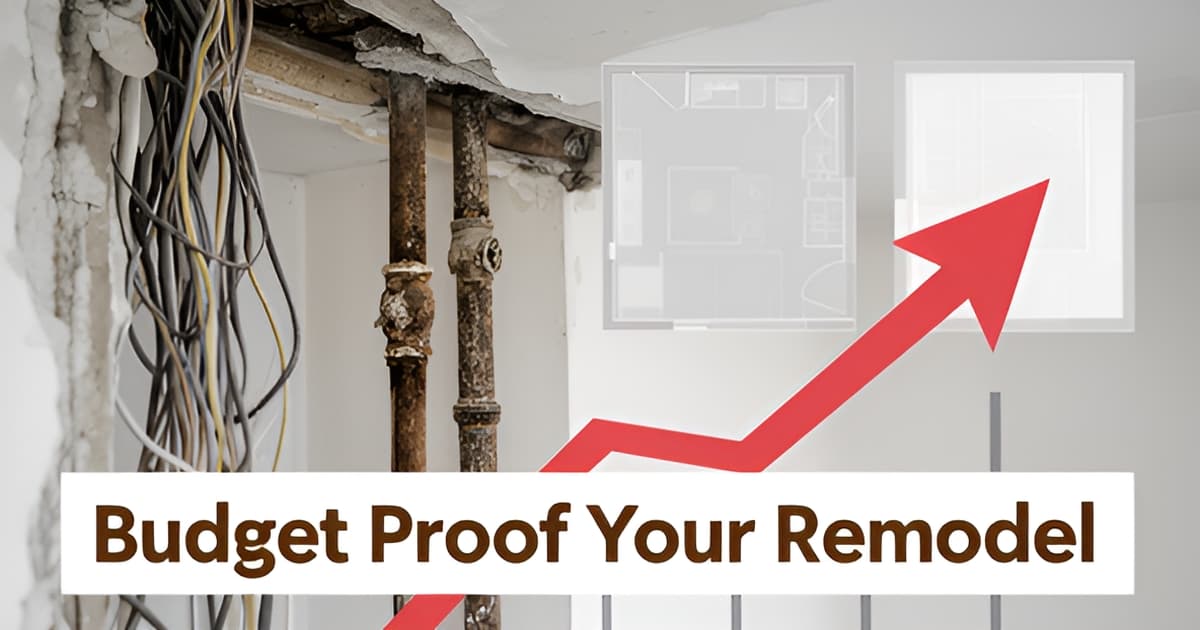
- The project proving more complex than planned — like opening a wall and finding wiring that must be replaced
- Homeowners upgrading to more expensive materials mid-project
Two of those three causes are exactly what a contingency exists to absorb. But here's where Altadena homeowners get into trouble: many treat contingency as spare money rather than a safeguard, then spend it on upgrades before the walls come down. As construction finance writer Bryan Kaplan warns, once clients know additional funds exist, "they will think it's theirs to spend" — and the buffer for genuine surprises is gone.
And Altadena's housing stock makes genuine surprises likely. Designer Andrea Schumacher estimates that roughly 80% of the time, opening walls or floors reveals something unexpected, which is why she advises buffering 25% of costs or more on remodels. That estimate comes from experience in older homes — precisely the Craftsman-period and historic properties common throughout Altadena, where a preserve-first renovation means working with, not around, century-old framing, plumbing, and knob-and-tube remnants.
Design/build guidance from Case Design reinforces the point: the older your home, the larger your contingency should be — even if it's been renovated before. A 1920s bungalow that had a kitchen redone in the 1980s still carries surprises everywhere the 1980s work didn't touch.
The failure, then, happens before demolition day. It happens when a budget is built with no buffer at all, or with a buffer that's mentally earmarked for the nicer tile. Altadena Home Remodeling's scoping conversations start by sizing the buffer to the actual risk in your house — because in this neighborhood, surprises aren't an if, they're a probability worth planning for.
The 5%–15% Rule — and When Altadena Homes Demand More
The right contingency isn't a flat percentage — it's a risk assessment. Practitioners generally converge on holding 5%–15% of contracted project cost as a construction contingency, with the exact figure determined by three factors: how sophisticated your design/build firm is, how thorough the design and due-diligence process was, and how old the home is. An established firm working from months of design meetings, pre-construction walkthroughs, and fixed-price blueprints can justify the low end; a rushed process pushes you toward 15%.
The math is simple to apply. On a $200,000 renovation, a 5%–15% contingency means holding back $10,000–$30,000 — and if you're on a cost-plus contract rather than a fixed price, the reserve sits with you, not the builder. Cost-plus clients should keep at least 10% of the estimated cost available — $20,000 on that same $200,000 project, or $50,000 on a $500,000 one.
Altadena's housing stock changes the calculation. The practitioner guidance is blunt: the older the home, the larger the contingency — even if it's been renovated before. Craftsman-period and historic homes routinely hide outdated wiring, plaster surprises, and framing quirks behind walls that look perfectly fine. For gut renovations and demolition-heavy work, the range widens further. Denver designer Andrea Schumacher advises buffering an additional 25% of costs, "if not more," because she estimates that "eighty percent of the time" opening walls or floors reveals something you didn't know you had to contend with.
- Thorough design process, fixed-price contract, reputable firm: lean toward 5%.
- Mid-century home, moderate scope: plan for 10%–15%.
- Craftsman-period or historic restoration: expect the upper end or beyond.
- Gut renovation with full demolition exposure: Schumacher's 25%+ buffer is defensible.
The data backs the caution. Only 36% of remodeling homeowners hit their budgets in 2019, 31% went over, and 29% had no initial budget at all, per the 2020 U.S. Houzz & Home survey. A contingency isn't a luxury — it's a safeguard, and it's not spare money waiting to be spent on upgrades. Builder-side risks like schedule overruns and material price increases belong in the contingency; client-initiated changes and latent conditions found in demolition belong in change orders.
That's why scoping matters. At Altadena Home Remodeling, our free remodel-scoping consultation includes a before/after concept render and an explicit contingency line, sized to your home's age and demolition exposure — because a thorough design process is exactly what justifies holding the lower end of the range. Scope it, price it, do it once, do it right.
Contingency vs. Change Order: Drawing the Line That Protects Your Budget
Every remodel budget lives or dies on one distinction: what the contingency is for, and what it isn't. Contingencies exist to cover a very specific list of unexpected expenses — schedule overruns, slight material cost increases, take-off miscalculations, and trade price increases. That's it. Everything else is a change order, and treating the two as interchangeable is how budgets unravel.
The list of what does not belong in your contingency is longer than most homeowners expect:
- Client-initiated scope changes, like upgrading fixtures mid-project
- Design changes made after the contract is signed
- Latent conditions uncovered during demolition
- Inspector requirements that trigger rework
- Allowance overspends on finishes or materials
Each of these should be priced, documented, and approved through a signed change order — not silently absorbed by money you set aside for genuine surprises. As one construction finance practitioner puts it, "very often, if a client knows — or thinks there are additional funds for their remodel, they will think it's theirs to spend." That's the core warning: once a contingency is visible, it starts looking like a slush fund. Keep it framed as a safeguard, not spare money.
Tracking discipline makes the boundary real. On cost-plus projects, minor variances — say, an $800 drywall overage — go into a variance log reviewed at each invoicing cycle, while major variances, such as a $3,500 hit, require a signed change order. This structure also protects against what practitioners call "client amnesia": it's usually near the end of a project, when the original estimate is surpassed, that everyone forgets which changes were approved and when. A written log prevents that argument entirely.
The stakes are real. Only 36% of remodeling homeowners hit their budgets in 2019, while 31% went over and 29% started with no budget at all, according to the U.S. Houzz & Home survey. The top causes — products costing more than expected, projects proving more complex than planned, and homeowner upgrades — split neatly across this line: the first two are contingency territory, the third is a change order.
For Altadena homeowners, this discipline matters most in Craftsman-period and historic homes, where demolition frequently reveals latent conditions that belong on change orders, not in the contingency. At Altadena Home Remodeling, we build this boundary into every scoping conversation up front, so expectations are set before walls come open. If you're planning a whole-home renovation and want a budget structured this way from day one, our free remodel-scoping consultation includes a before/after concept render — and an honest conversation about what your contingency should cover. Featured builder JMB Builders LLC (CSLB #1103479) brings licensed whole-home and rebuild experience to projects throughout Altadena.
Putting It to Work: Scoping, Prioritizing, and Defending Your Reserve
Your contingency is only as good as the process behind it. According to Case Design, a thorough design process — months of planning meetings, pre-construction walkthroughs, fixed-price contracts, and complete blueprints — can justify holding just 5% of contracted cost, while a thin process pushes the number toward 15%. That's why scoping matters: the more you know before demolition, the less you need to hide behind.
This is the logic behind a structured scoping consultation. When a builder walks the home before pricing, produces a fixed-price contract, and shows you a before/after concept render of the finished space, surprises shrink. Only 36% of remodeling homeowners hit their budgets, per the 2020 U.S. Houzz & Home survey — and 29% had no budget at all. A documented scope with an explicit contingency line puts you in the disciplined minority.
For whole-home renovations, protect the contingency by spending it where it counts. Interior designer Debbie Travin advises prioritizing common spaces — the living area, kitchen, and great room — plus the primary bedroom and bath, while spending less on guest rooms, kids' rooms, and dining rooms. In an Altadena Craftsman or historic home, that often means directing reserve funds toward the structural and systems work hiding behind kitchen and great-room walls, where opening walls is most likely to reveal wiring, plumbing, or framing that must be addressed.
One more defense: resist the urge to hunt down products yourself. Designer Deana Duffek describes clients who found a cheaper faucet online, only to discover it lacked required valves — costing roughly $200 extra and creating installation and warranty headaches. A builder's sourcing relationships exist precisely to prevent those false economies.
If you're planning a whole-home renovation in Altadena, a free remodel-scoping consultation with a before/after concept render will establish your scope, your fixed price, and your contingency posture — so you can scope it, price it, and do it once, do it right. For readers who want a licensed local reference point, JMB Builders LLC (CSLB #1103479), an Altadena-based general contractor whose work is documented at jmb-builders.com, is a featured (paid-placement) builder in this guide.
Frequently Asked Questions
How much contingency should I set aside for a home remodel?
Do older or historic homes need a bigger remodel contingency?
Isn't my contingency just spare money I can spend on upgrades?
What's the difference between a contingency and a change order?
Do most remodels actually go over budget?
How can I keep my contingency from disappearing on a whole-home renovation?
The Buffer That Keeps Your Altadena Remodel Standing
A contingency isn't spare money — it's the difference between a remodel that finishes and one that stalls. Hold back 5%–15% of contracted cost on a thorough, fixed-price project, and lean toward the upper end — or Schumacher's 25% — for Altadena's Craftsman-period and historic homes, where opening walls reveals surprises an estimated 80% of the time. Then defend that reserve: builder-side risks like material price increases belong in the contingency; client-initiated upgrades, design changes, and latent demolition conditions belong in signed change orders. Remember that only 36% of remodeling homeowners hit their budgets — and most budgets fail before demolition day, not during it. The fix is scoping: a walkthrough, a fixed price, and an explicit contingency line sized to your home's age and demolition exposure. If you're planning a whole-home renovation in Altadena, start with a free remodel-scoping consultation that includes a before/after concept render — scope it, price it, do it once, do it right.