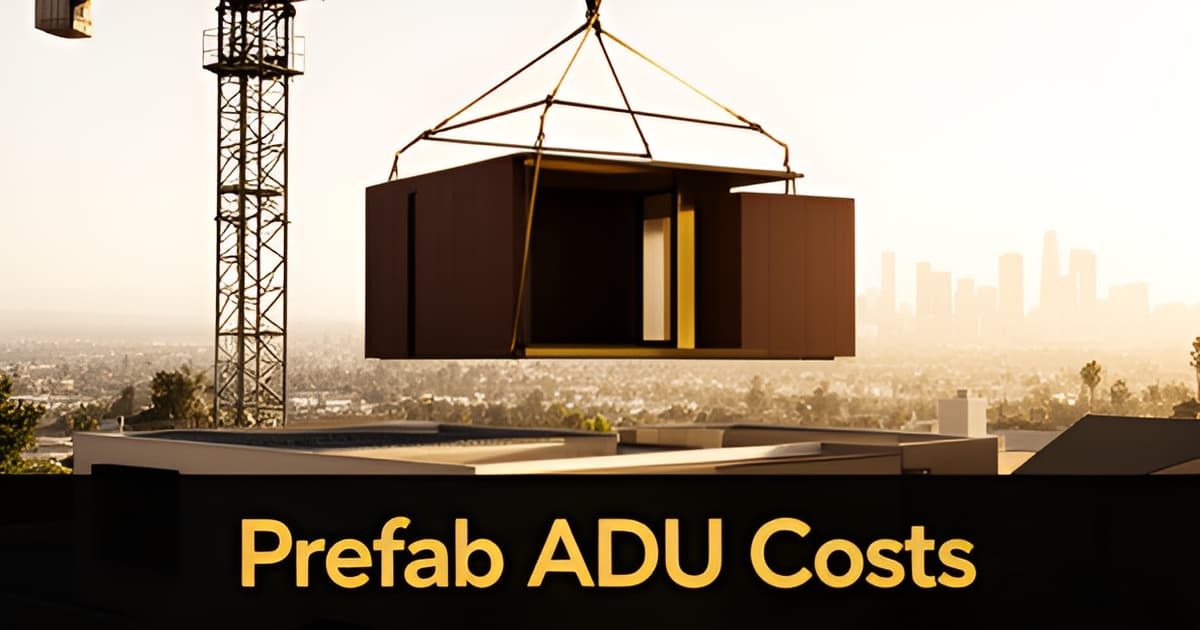
Prefab ADUs in Los Angeles: Delivery, Crane, and Site Costs
Key Facts
- A prefab ADU's final price often runs 2 to 2.5 times the factory quote once site work and utilities are added, per industry cost analysis.
- Analysis of 18,848 LA County ADU permits found prefab ends up 'usually comparable to building from the ground up' all-in, according to LADU.
- One real 550-square-foot LA project totaled $259,000, with plumbing and electrical alone consuming roughly 23% of the budget, per its published line-item budget.
- Soft costs for design, permits, inspections, HVAC, and appliances typically add $20,000 to $40,000 or more on top of construction, per LA permit analysis.
- No prefab ADU company offers two-story models because factory and transport constraints make them impossible, according to Cali ADU.
- Altadena's median ADU permit valuation sits at $160,000, well above the City of LA's $101,000 median, per LA County permit data.
- LA ADU permits surged 30-fold after California's reform laws, reaching one-fifth of all city housing permits by 2018, according to permit data research.
The Sticker Price Trap: What Prefab ADU Quotes Leave Out
That $95,000 prefab ADU quote in your inbox is not your price. It is the factory's price — and the factory is only the beginning.
The most useful number in prefab ADU planning comes from a cost comparison guide that puts the final price at 2 to 2.5 times the factory price once site work and utility connections are included. In practical terms: if your all-in budget is $200,000, your factory unit should cost roughly $80,000–$100,000 — about 40–50% of the total.
LADU's analysis of 18,848 LA County ADU permits reaches a blunt conclusion: once you factor in site preparation, transportation, and installation fees, a prefab ADU is "usually comparable to building from the ground up." The sticker advantage evaporates before the unit ever reaches your lot.
What the quote typically leaves out:
- Site preparation — grading, excavation, foundations, and on hillside lots, retaining walls and structural engineering
- Transportation and crane services, especially in dense neighborhoods like Los Angeles
- Utility connections — electrical, water, and sewer hookups can add "several thousand dollars," particularly on older properties
- Soft costs of $20,000–$40,000+ for design, permits, inspections, HVAC, and appliances
Here is where it gets murkier: the sources contradict each other. A prefab manufacturer claims prefab runs 15–25% cheaper than traditional construction in California, while site-build-focused sources argue the two approaches land at cost parity. They cannot all be true.
Worth noting: every one of these sources is a vendor blog with a commercial stake in the answer. Prefab companies emphasize savings and speed; site-build contractors emphasize durability and flexibility — and some actively steer clients away from prefab. No independent, non-vendor cost data on prefab installation exists for LA.
That is precisely why Altadena Home Remodeling takes an independent-guide approach to ADU planning rather than starting from a product pitch. The honest framing is that prefab trades predictability in the factory for unpredictability on your site — and your site is where most of the budget lives.
Delivery and Crane Costs: Why Site Access Decides Your Budget
That prefab ADU price you saw online covers the unit — not the day it arrives at your curb. In dense Los Angeles neighborhoods, getting a factory-built module from the truck to its foundation often requires cranes and oversized transport, a cost category that varies entirely by property.
No source publishes fixed dollar figures for crane or delivery in LA, and that's the point: these aren't fixed numbers. They're site-access-dependent line items. One prefab industry guide notes that foundation work and crane services are prefab's two main variables after the factory price, with the final price often running 2 to 2.5 times the factory cost once site work and utility connections are included (Tiny House Cottages).
What triggers a crane — and the extra budget that comes with it — comes down to how a truck and module can physically reach your lot:
- Narrow gates or driveways that a delivery truck can't pass through
- Low power lines that block overhead lifting and transport
- Sharp turns on tight streets common in older LA neighborhoods
- Sloped or difficult terrain, which may rule out prefab delivery entirely
The last item deserves emphasis. If delivery trucks can't reach the installation point, a crane may be required — and on some properties, difficult terrain or unreachable access can push a homeowner toward site-built construction instead (same guide). The upside is that crane fees are a one-day expense rather than a prolonged cost, so the hit is concentrated, not ongoing.
Prefab also has hard physical limits worth knowing before you fall in love with a design. According to one LA design-build analysis, no prefab ADU company offers two-story models — factory and transport constraints make it impossible (Cali ADU). If your property calls for a second-story addition, prefab isn't in the running.
The most practical advice across sources is also the simplest: walk your property before you order. Check for narrow gates, low power lines, and sharp turns that could force a crane lift, and be honest about whether a large module can physically reach the pad. This is especially relevant in Altadena, where hillside-adjacent lots already carry premiums for grading, retaining walls, and structural engineering (LADU).
At Altadena Home Remodeling, access evaluation is part of every free remodel-scoping consultation with a before/after concept render — because delivery logistics, like permits, carry no guarantees, and surprises belong in the design phase, not on delivery day. Our featured builder, JMB Builders LLC (CSLB #1103479), a disclosed paid placement, builds custom ADUs and site work across the area and can flag access constraints before they become crane invoices.
The Real Hidden Line Items: Site Prep, Utilities, and Soft Costs
The factory price on a prefab ADU quote is only half the story — and sometimes less. Industry analysis of LA ADU costs finds that once site preparation, transportation, and installation fees are added, a prefab unit typically ends up comparable in price to ground-up construction.
The most transparent evidence comes from a real 550-square-foot ADU project in North Hills, documented in a published line-item budget totaling $259,000. The line items that surprise most homeowners aren't the structure itself — they're what sits beneath and around it.
- Plumbing: $34,500 — including a 75-linear-foot sewer trench and a new water tap
- Electrical: $25,500, bringing utilities to roughly 23% of the total budget
- Site prep and excavation: $6,500
- Design and engineering: $12,500
- Foundation: $23,500 — a cost prefab buyers sometimes assume is included
That's a flat corner lot. Hillside properties — common throughout Altadena and other foothill communities — add grading, excavation, retaining walls, structural engineering, and additional inspections, according to the same LA County cost analysis. Older properties face a second penalty: connecting an ADU to existing water, sewer, gas, and electrical lines "can add several thousand dollars," especially on aging infrastructure.
Beyond the physical work sit the soft costs: design and engineering fees, permits, utility hookups, inspections, HVAC, appliances, and solar. These typically run $20,000 to $40,000 or more on top of construction, with design fees alone reaching $8,000–$25,000+ and city permits adding $5,000–$10,000.
For context, Altadena's median ADU permit valuation sits at $160,000 — higher than the City of LA's $101,000 median — which means unbudgeted site and utility costs here consume a proportionally larger share of the total. Before signing a prefab contract, walk your property, ask where the sewer and water connections actually run, and get utility routing priced in writing. At Altadena Home Remodeling, our free remodel-scoping consultation maps these site-specific costs against your lot before you commit — with a before/after concept render so you can see the finished result first. Scope it, price it, and do it once, do it right.
Prefab vs. Site-Built: An Honest Comparison for Altadena Homeowners
Prefab's appeal is real: factory-built units typically arrive in 3–6 months, roughly half the 6–12 months a ground-up build takes. But speed is only one part of the equation, and the "cheaper" part is where the honest comparison gets complicated.
The savings claims don't agree with each other. One prefab manufacturer argues prefab runs 15–25% less than traditional construction in California, while an analysis of 18,848 LA-area permits concludes that once site prep, transportation, and installation fees are included, prefab's final price is "usually comparable to building from the ground up." All of these sources are commercially interested, so treat any savings percentage as marketing until your own numbers say otherwise.
What most buyers miss is the multiplier. Industry guidance suggests a prefab unit's final price often lands at 2 to 2.5 times the factory price once site work and utility connections are included. That leads to a practical budgeting rule: on a $200,000 all-in budget, target a factory price of roughly $80,000–$100,000 — the unit itself should be about 40–50% of your total spend.
Prefab also has hard limits worth knowing before you fall in love with a catalog model:
- No two-story options exist — factory and transport constraints make them impossible.
- Design flexibility is minimal compared to a custom ground-up build.
- Site access decides everything: narrow gates, low power lines, or sharp turns can require a crane, and sloped or unreachable lots may rule prefab out entirely.
- Cost parity means you're trading design control for speed, not saving money.
For Altadena lots, terrain matters. Hillside properties add grading, retaining walls, and structural engineering costs regardless of construction method, and Altadena's median ADU permit valuation sits at $160,000 — well above the City of LA's $101,000. If your priority is a two-story unit, matching a historic Craftsman, or maximizing a difficult lot, a site-built ADU or garage conversion (which runs roughly $95,000–$225,000) will usually serve you better.
If speed and predictability top your list — say, a rental unit on a flat, accessible lot — prefab can be the smarter path, provided you budget for the site work from day one.
At Altadena Home Remodeling, we help homeowners weigh prefab, ground-up, and conversion options against their specific lot before any money is committed. Book a free remodel-scoping consultation with Altadena Home Remodeling and get a before/after concept render of what your property could support. Our featured builder, JMB Builders LLC (CSLB #1103479, paid placement), builds custom ADUs and whole-home remodels across Altadena — scope it once, price it honestly, do it right.
Your Next Step: Scope Your ADU Project Before You Sign Anything
The gap between a prefab quote and a finished ADU is where budgets break. Once site work and utility connections are included, the final price often runs 2 to 2.5 times the factory price — which is why the smartest money you spend is on scoping, not shopping.
Before you sign a prefab purchase agreement, walk your property the way a delivery crew will. Check for narrow gates, low power lines, and sharp turns that trigger crane requirements. Then measure what no showroom salesperson can see from a brochure: the distance from your ADU pad to existing water, sewer, and electrical lines, which varies lot to lot and drives some of the largest line items. One real LA project required a 75-foot sewer trench, pushing plumbing and electrical to roughly $60,000 — about 23% of a $259,000 budget.
A site-specific scoping should answer three questions:
- Access: Can transport trucks reach the pad, or does your lot require a crane — a one-day expense, but a decisive one?
- Utility distance: How far are water, sewer, gas, and electrical taps, especially on older Altadena properties?
- Terrain: Do slopes or poor soil call for grading, retaining walls, or added engineering — premiums that hillside lots across LA County routinely carry?
Soft costs deserve the same scrutiny. Design, engineering, permits, and utility hookups commonly add $20,000–$40,000 or more on top of construction, per LA permit analysis. Altadena's median ADU permit valuation sits around $160,000, so a scoping that surfaces a five-figure surprise before you commit is cheap insurance.
Altadena Home Remodeling offers a free remodel-scoping consultation that covers exactly this ground: access, utility distances, terrain, and how a prefab or ground-up ADU fits your property — with a before/after concept render so you can see the outcome before spending on it. We can't guarantee timelines or permit outcomes, and no honest guide should — LA County unincorporated permitting runs on its own clock.
Disclosure: our featured builder for ADUs and whole-home remodels in Altadena is JMB Builders LLC (CSLB #1103479), an Altadena-based licensed general contractor whose ADU, custom home, and remodel work is documented at jmb-builders.com. Their placement on this site is paid; our guidance remains independent. Scope it, price it, do it once, do it right — before you sign anything.
Frequently Asked Questions
Is a prefab ADU really cheaper than building one from scratch in Los Angeles?
How much should I budget beyond the factory price of a prefab ADU?
When does a prefab ADU delivery require a crane, and how much does it cost?
What hidden costs do prefab ADU quotes usually leave out?
Can I get a two-story prefab ADU in LA?
Does a hillside lot in Altadena make prefab delivery impossible?
The Bottom Line: Your Lot Writes the Final Price
The real cost of a prefab ADU in Los Angeles isn't on the quote — it's on your lot. Once site prep, crane services, utility connections, and soft costs are added, the all-in price often lands at 2 to 2.5 times the factory price, which is why analysis of 18,848 LA County permits concludes prefab usually ends up cost-comparable to building from the ground up. For Altadena homeowners — where hillside lots, older utility infrastructure, and a $160,000 median permit valuation amplify every hidden line item — the deciding factors are access, utility distance, and terrain, not the brochure. Before you sign anything, walk your property, price the sewer and water routing in writing, and budget the unit at only 40–50% of your total. Altadena Home Remodeling offers a free remodel-scoping consultation with a before/after concept render that maps these site-specific costs against your lot before you commit. Scope it, price it, and do it once, do it right.