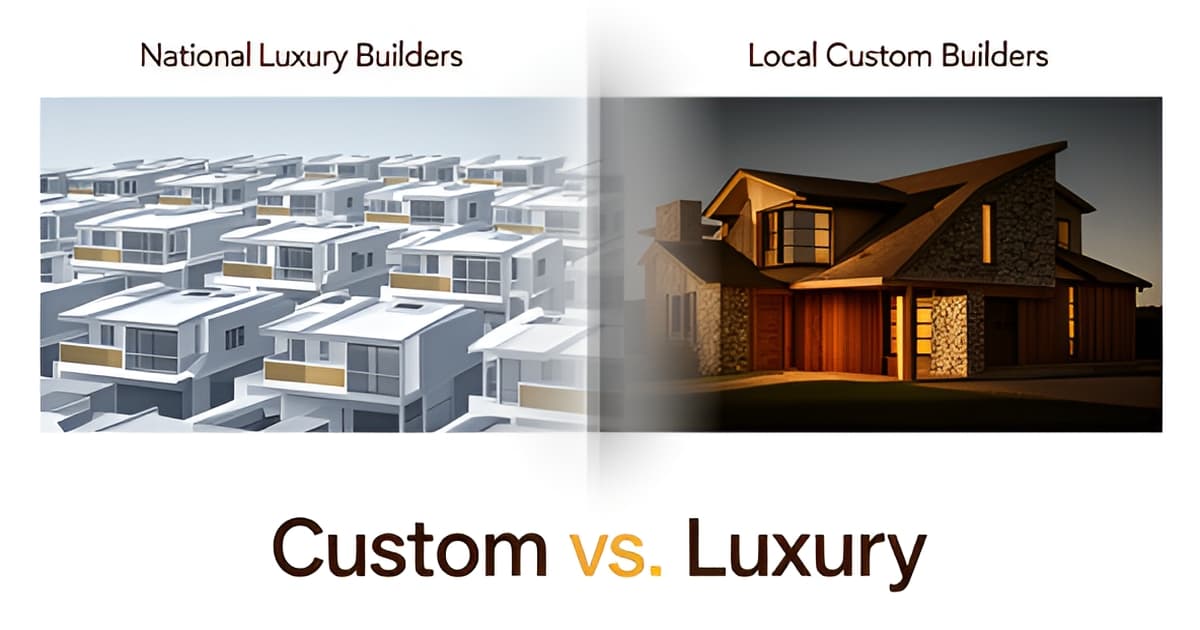
National Luxury Builders vs. Local Custom Builders: Honest Comparison
Key Facts
- D.R. Horton closed 93,311 homes for $33.8 billion in 2024, while even luxury-associated Toll Brothers delivered 10,813, per Builder 100 rankings.
- Custom homes now represent roughly 19–20% of single-family starts — the highest share since 2022 — with 54,000 starts in Q2 2025, per NAHB analysis.
- Custom home building is 'almost universally undertaken by smaller, private home builders,' according to NAHB Chief Economist Dr. Robert Dietz.
- Custom builds cost $300–$600+ per square foot and take 10–13 months, versus $175–$320 and 7–8 months for semi-custom, per industry benchmarks.
- Contractor-built homes on the buyer's land average about 12 months from permit to completion, while homes built for sale average just 7.6 months, per Census data.
- Experts recommend reserving 10–20% above the base estimate for custom projects, since surprises are structural to the process, per industry guidance.
- NAHB advises shopping for your builder 'as carefully as you shop for your home,' starting with local builders' associations.
The Real Difference: Scale Operations vs. True Custom Work
Standing at the crossroads between a nationally recognized luxury builder and the custom firm down the street, you're really choosing between two different business models — not just two different logos on a yard sign. The data makes this distinction clearer than most homeowners expect.
Start with scale. The 2024 Builder 100 rankings show D.R. Horton closing 93,311 homes for $33.8 billion in revenue, with Lennar close behind at 80,210 closings. Even Toll Brothers, the most luxury-associated national on the list, delivered 10,813 closings — nearly matching NVR's revenue on roughly half the volume. These are production machines optimized for throughput, and their value proposition reflects it.
What nationals actually sell is efficiency. According to industry comparisons, large-scale builders offer bundled pricing that reduces surprise change orders, build timelines of 7–8 months versus 10–13 for custom work, in-house design teams, builder-included lots, and affiliated financing incentives like closing-cost credits and rate buydowns. Semi-custom buyers typically choose from 8–15 floor plans — personalization, but within a predefined envelope.
True custom work lives in a different segment entirely. NAHB Chief Economist Dr. Robert Dietz notes that custom home building is "almost universally undertaken by smaller, private home builders" — a structural fact, not a marketing claim. Custom homes now represent roughly 19–20% of single-family starts, the highest share since 2022, with 54,000 starts in Q2 2025 alone, per NAHB analysis.
The practical differences break down like this:
- National builders deliver scale, speed, and predictable bundled pricing — at the cost of design flexibility beyond an upgrade list.
- Custom builders offer full design control and buyer-hired architects, with timelines of 10–13 months and a recommended 10–20% contingency.
- Custom building is less sensitive to mortgage rate cycles but more tied to household wealth, which explains its growth while spec construction declines.
For Altadena homeowners, this segmentation matters. A Craftsman restoration or whole-home remodel in LA County's unincorporated permit territory requires exactly what builder guides emphasize: trusted local sub-trade networks and fluency in local bylaws and permits — strengths that scale operations rarely replicate. As Altadena Home Remodeling often reminds homeowners evaluating contractors, fit depends on the project, not the brand — and a preserve-first renovation of an existing home is a fundamentally different undertaking than a production build.
Where Each Model Wins: Price and Speed vs. Local Knowledge and Accountability
Scale buys speed; proximity buys accountability. That tension sits at the heart of every national-versus-local decision, and the honest answer is that both models win — just on different dimensions.
The national builders' advantages are real and measurable. Large-scale operations deliver semi-custom homes in roughly 7–8 months versus 10–13 months for full custom builds, and their bundled pricing reduces surprise change orders, according to industry cost and timeline benchmarks. Affiliated financing sweetens the deal with closing-cost credits and rate buydowns. The scale is staggering: D.R. Horton alone closed 93,311 homes in 2024, per the Builder 100 rankings.
Local builders counter with strengths that are harder to quantify but no less real:
- Trusted sub-trade networks — "your builder is only as good as the tradespeople they hire," as contractor Mike Holmes puts it, and local firms work with crews they know personally.
- Zoning and permit fluency, which matters enormously in a place like Altadena, where LA County unincorporated rules and historic-review considerations shape what's even buildable.
- A single point of contact rather than a rotating cast of departments and project managers.
- Referral-driven accountability — a local builder's next job depends on what your neighbors hear about the last one.
It's worth noting that true custom work skews structurally local. NAHB's chief economist observes that custom home building is "almost universally undertaken by smaller, private home builders," per NAHB's market analysis — the national luxury builder and the true custom build largely occupy different segments.
What about the complaints you'll read online about national builders — rotating subcontractors, communication breakdowns, material substitutions from bulk purchasing agreements? These appear in builder commentary, but treat them as reported concerns rather than proven facts. That source is a local builder's blog with an obvious stake in the comparison, and no independent defect or satisfaction data backs the specific claims. Notably, the same source concedes that nationals deliver "streamlined processes, lower prices, and fast timelines."
The practical takeaway for an Altadena homeowner weighing a whole-home renovation or Craftsman restoration: speed and predictable pricing favor scale, while deep customization and permit navigation favor a firm that works this terrain daily. If you're unsure which side of that line your project falls on, Altadena Home Remodeling offers a free remodel-scoping consultation with a before/after concept render — a low-pressure way to scope it, price it, and do it once, do it right.
Cost and Timeline Expectations: What Custom Work Actually Requires
Custom work costs more and takes longer — that's not a flaw in the model, it's the price of getting exactly what you want. Before comparing builders, Altadena homeowners deserve honest numbers.
According to industry estimates, custom construction runs $300–$600+ per square foot, compared to $175–$320 for semi-custom. Contractor Mike Holmes offers an even higher ballpark of $450–$900 per square foot, reflecting differing scopes and geographies. Either way, budget at the top of the range, not the bottom.
Timelines tell a similar story. Custom builds take 10–13 months from start to finish, versus 7–8 months for semi-custom, with 2–3 months of pre-construction before a single nail is driven. Census data backs this up: contractor-built homes on the buyer's land average about 12 months, while homes built for sale average just 7.6.
Every credible guide recommends a contingency, and for good reason:
- Reserve **10–20% above the base estimate** for custom projects — surprises are structural to the process, not signs of a bad builder
- Construction loans typically run 12–18 months (up to 24), so your financing should match your build schedule
- Pre-construction alone takes 2–3 months for custom versus about 1 month for semi-custom
- Standard warranties — 1-year workmanship, 2-year systems, 10-year structural — apply regardless of builder size
Why the premium? Deep customization means a buyer-hired architect, full design control, and tradespeople sourced specifically for your project. As one builder quoted in industry coverage put it, full custom homes are for those "unwilling to compromise on their vision and legacy for a home."
In Altadena, that premium buys something specific: the ability to preserve what makes a 1920s Craftsman worth keeping in the first place. Matching original millwork, restoring rather than replacing windows, and navigating LA County's unincorporated permit process all take time and specialized labor that a production timeline simply can't absorb.
Altadena Home Remodeling approaches these projects with a preserve-first philosophy — scope it, price it, do it once, do it right. No one can guarantee timelines or permit outcomes, but a realistic budget and an honest contingency plan beat an optimistic estimate that falls apart in month four. If you're weighing a whole-home renovation, gut remodel, or historic restoration, a free remodel-scoping consultation — including a before/after concept render — is the practical first step toward numbers you can actually plan around.
Why Local Knowledge Decides the Outcome in Altadena
A national builder's project manager might juggle dozens of homes across three states. In Altadena, the project that matters is yours — and it sits in one of the most permit-sensitive, history-rich pockets of Los Angeles County. That reality changes which builder actually wins the comparison.
Altadena is unincorporated, which means permits and plan checks run through LA County's building department rather than a city's. Mike Holmes puts it plainly: bylaws and permits directly shape what you can build, expand, or renovate, and a builder who knows the local rules is worth more than one with a national logo. A firm that has walked Altadena's Craftsman-era houses through county review — or through fire-rebuild processes after the Eaton Fire — simply moves faster and makes fewer costly assumptions.
The numbers back this up structurally. Custom homes now represent roughly 19–20% of single-family starts, the highest share since 2022, and NAHB's chief economist notes this work is "almost universally undertaken by smaller, private home builders." Even the biggest luxury-associated national, Toll Brothers, closed 10,813 homes in 2024 — a scale that optimizes for production repeatability, not for one county's historic-preservation quirks.
Even NAHB's own consumer guidance tells buyers to start with local builders' associations when choosing a contractor. That advice is telling: the industry's own playbook treats local familiarity as the starting point, not a nice-to-have.
What local knowledge buys you in Altadena specifically:
- County permit fluency — navigating unincorporated LA County requirements, and fire-rebuild pathways, without a learning curve billed to you.
- Trusted sub-trades — Holmes notes your builder is only as good as the tradespeople they hire, and area-specific crews they trust.
- Preserve-first judgment — knowing which Craftsman details to restore rather than replace, which matters when the goal is renovation over demolition.
Reported complaints about national builders — rotating subcontractors, departmental communication gaps, no single point of contact — appear repeatedly in homeowner accounts, though these are common themes rather than proven patterns. In a town where every lot, setback, and heritage detail is different, the honest conclusion is that familiarity with Altadena itself — not builder size — decides the outcome.
If you're weighing a whole-home renovation, kitchen or bath remodel, or a gut renovation of an older Altadena house, Altadena Home Remodeling offers a free remodel-scoping consultation with a before/after concept render — so you can scope it, price it, and do it once, do it right.
How to Vet Any Builder: The Size-Agnostic Checklist
Whether you're considering a national firm or a local contractor, the vetting process is identical — and it matters more than the size of the company. Both NAHB consumer guidance and contractor Mike Holmes agree that professionalism markers, not brand scale, determine whether your project succeeds.
NAHB advises shopping for your builder "as carefully as you shop for your home," and its framework applies to any candidate. Start with these size-agnostic checks:
- Written contract and detailed estimate. Demand line-item transparency on scope, materials, and allowances, and plan a 10–20% contingency above the base estimate for custom work.
- Licensing and insurance verification. In California, confirm the contractor's license status directly through the CSLB before signing anything.
- References offered unprompted. Holmes puts it plainly: "A good builder should offer you references even before you ask for them." NAHB calls references non-negotiable — if a builder can't provide them, walk away.
- Longevity and local presence. NAHB notes that years in business signal financial stability and that warranty support will still exist when you need it.
- Trusted sub-trades and permit fluency. Holmes stresses that builders are only as good as the tradespeople they hire, and that bylaws and permits directly affect what can be built and at what cost.
That last point carries extra weight in Altadena, where LA County unincorporated permit requirements and Craftsman-period restoration work reward contractors who know the area's review processes and preserve-first building culture firsthand.
If you're scoping a whole-home renovation, kitchen or bath remodel, or gut renovation in Altadena, Altadena Home Remodeling offers a free remodel-scoping consultation that includes a before/after concept render — a low-commitment way to see how a builder communicates, estimates, and plans before you commit to anything.
As a disclosed example of a vetted local firm: JMB Builders LLC is an Altadena-based licensed general contractor (CSLB #1103479) that builds custom homes, ADUs, and whole-home remodels, including Eaton Fire rebuilds. Its paid placement is disclosed here, and its project work and service areas are documented on jmb-builders.com — verify the license, review the portfolio, and apply the same checklist you would to any builder, national or local.
Frequently Asked Questions
Are national luxury builders actually better quality than local custom builders?
How much faster can a national builder finish my home compared to a local custom builder?
How much more does a custom home cost per square foot than a semi-custom build?
Is it true that national builders have more problems with quality and communication?
Why does local knowledge matter so much for building or renovating in Altadena?
How should I vet a home builder regardless of whether they're national or local?
The Verdict: Fit Beats Brand Every Time
So who wins — the national luxury builder or the local custom firm? The honest answer: neither, universally. Nationals deliver real advantages in speed (7–8 months vs. 10–13), bundled pricing, and financing incentives, while true custom work — now 19–20% of single-family starts — remains almost universally the domain of smaller, private builders who know their sub-trades by name and their county's permit process by heart. What actually decides your project's outcome isn't the logo on the yard sign; it's fit, vetting, and fluency with your specific terrain. For Altadena homeowners, that terrain includes LA County's unincorporated permit requirements, Craftsman-era restoration judgment, and a preserve-first philosophy that production timelines can't absorb. Whatever you decide, demand line-item estimates, verify CSLB licensing, budget a 10–20% contingency, and treat references as non-negotiable. If you're weighing a whole-home renovation or historic restoration, Altadena Home Remodeling offers a free remodel-scoping consultation with a before/after concept render — a low-pressure way to scope it, price it, and do it once, do it right.