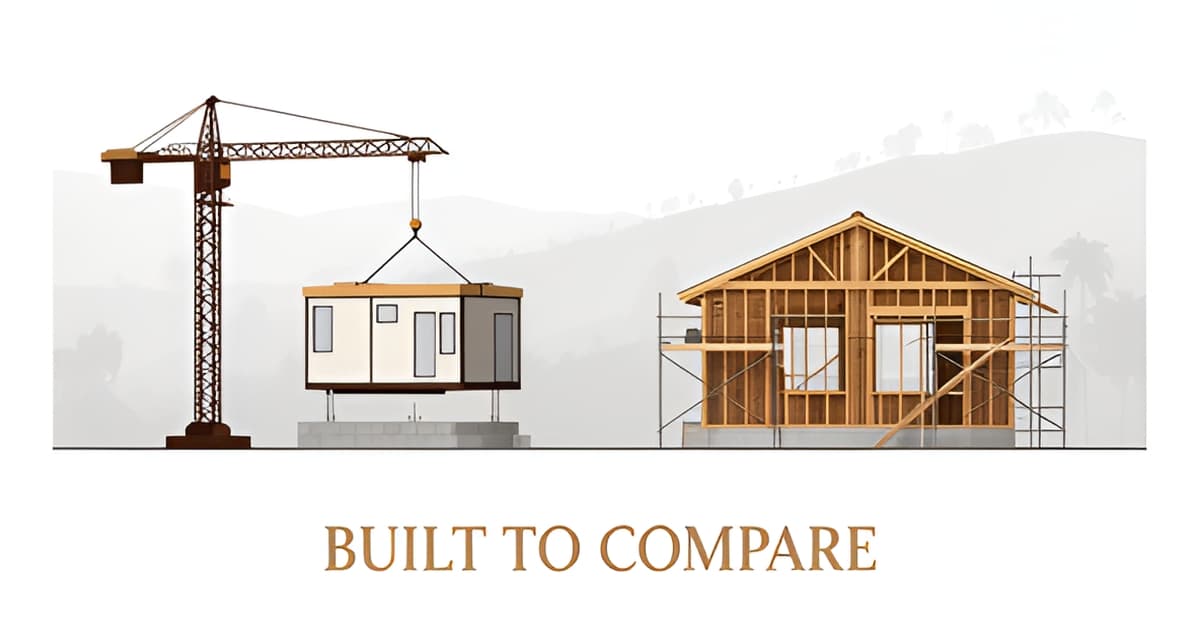
Modular ADU vs Site-Built: Durability and Cost Compared
Key Facts
- Modular ADUs now hold 55–58% of the market, with roughly 55% of 2025's new ADUs built using factory methods.
- Prefab ADUs complete in 3–4 months versus 7–15 months for traditional site builds.
- The claimed 10–25% modular cost savings comes from a modular vendor — no neutral cost-per-square-foot comparison exists.
- About 40% of potential ADU buyers face loan limitations because traditional mortgages weren't designed for secondary units.
- Modular draw schedules can create a funding gap while units sit in the factory, per expert-reviewed lender analysis.
- Appraisers value ADUs on demand, rental income, and comparables — not construction method — with permitted status driving appeal.
- California ADU permits surged 1,421% after streamlined approvals, reaching 26,924 units in 2023.
The Real Trade-Off: Speed and Cost vs. Design Fit
If you're weighing an ADU in Altadena, the core tension comes down to this: modular builders promise speed and savings, while site-built construction promises a unit that actually matches your 1910s Craftsman. The market has already voted with its feet — but the vote is split.
Modular construction now leads the ADU market, holding a 55–58% share depending on which report you trust, with roughly 55% of newly built ADUs in 2025 using factory methods. The appeal is straightforward: prefab units complete in 3–4 months versus 7–15 months for traditional builds, and one vendor statistics roundup claims modular costs 10–25% less than conventional construction. That vendor figure deserves scrutiny, though — the most specific cost comparisons in the research come from modular manufacturers themselves, and no neutral cost-per-square-foot comparison exists anywhere in the data.
Site-built ADUs still command 42–45% of the market for good reason. Roughly half of site-built buyers cite customization, design flexibility, and compatibility with existing homes as their deciding factors. Market analysts note that non-modular construction remains essential for property-specific designs, unique architectural styles, and conversions of existing structures like garages and basements.
For Altadena homeowners, that second column matters more than it might elsewhere. Much of the town's housing stock is historic or Craftsman-period, where a factory-standard unit can clash with the original architecture — and where the preserve-first ethos favors additions that read as if they've always belonged. In LA County's unincorporated permit context, design fit isn't just aesthetic; it shapes what gets approved and what adds lasting value.
Before choosing a path, weigh what the research actually supports:
- Speed: modular's 3–4 month timeline is a documented advantage over 7–15 months site-built.
- Cost: the 10–25% savings claim is vendor-sourced, not independently verified.
- Durability: no head-to-head testing exists; both paths can meet code.
- Resale: appraisers value permitted status, income history, and comparables — not construction method.
That last point is worth repeating. Appraisers evaluate ADUs on local demand, rental income potential, and comparable sales, and a fully permitted unit with independent utilities is what drives market appeal, according to California valuation analysis. Construction method barely registers.
Financing adds another wrinkle. About 40% of potential ADU buyers face loan limitations, and traditional draw schedules — which release funds after site inspections — can leave modular buyers short while units are still in the factory, a mismatch explained in detail by expert-reviewed lender analysis.
At Altadena Home Remodeling, we help homeowners scope both paths honestly — including what a site-built ADU would take to match a historic facade. If you want a free remodel-scoping consultation with a before/after concept render, we'll map the trade-offs for your specific property, with JMB Builders LLC (CSLB #1103479) available as a featured local builder for the construction itself.
Durability: What the Evidence Actually Shows (and What It Doesn't)
Every modular ADU brochure promises a building that outlasts its site-built rival — but when you dig into the actual evidence, the durability story gets more complicated, and more interesting, than the marketing suggests.
The strongest genuine advantage modular construction holds is quality control. According to vendor-published research, factory production enables systematic inspections at every production stage, "versus site construction where critical work often gets covered before inspectors arrive." That's a real structural difference: a site-built wall closed up before the inspector visits hides whatever lies behind the drywall. In a factory, the wiring and plumbing get checked before the finishes ever go on.
Durability, however, depends less on where a building is assembled than on what it's assembled from. A modular ADU market analysis finds the material palette matters most:
- Steel framing offers superior strength, fire resistance, and longevity compared to traditional wood, with less pest and moisture deterioration.
- Concrete provides thermal mass, noise insulation, and minimal maintenance over decades of use.
- Engineered wood products like CLT and SIPs deliver enhanced structural performance and fire resistance.
These materials are available on both sides of the modular/site-built divide, which undercuts any blanket claim that one method produces a tougher building.
Vendor claims deserve particular scrutiny. One modular manufacturer advertises 180 mph wind ratings meeting High Velocity Hurricane Zone requirements, qualifying for 20–55% insurance discounts. That's an impressive spec — but it comes from a company selling the product, and wind ratings reflect engineering choices, not factory assembly itself. A site builder using the same materials could pursue the same rating.
Here's the honest bottom line: no independent head-to-head durability testing exists comparing modular and site-built ADUs. The most confident durability claims trace back to modular vendors with clear commercial bias, while neutral sources are notably silent. Even a prefab-focused California valuation source skips construction comparisons entirely, focusing instead on permitted status and use cases.
What this means for Altadena homeowners is straightforward: durability is a property of the builder and the materials, not the delivery method. A meticulous site builder with a documented track record — like the custom ADU and rebuild work JMB Builders LLC performs locally — can outperform a careless factory, and vice versa. Ask for inspection records, material specifications, and references before assuming either path wins.
For a Craftsman-era property, that evaluation matters twice over. Altadena Home Remodeling approaches every addition with a preserve-first lens — the question isn't just "will it last?" but "will it belong?" If you're weighing an ADU against your historic home's character, book a free remodel-scoping consultation and get a before/after concept render that shows both.
The Financing Gap Most Modular Buyers Don't See Coming
The sticker price on a modular ADU can look like the deal of the decade — right up until the moment your lender asks why you need $80,000 before anything has touched your foundation. That moment is where many modular buyers discover the financing gap.
Traditional construction loans release funds in draws tied to on-site milestones: foundation, framing, mechanicals, each verified by inspection before the next check clears. According to expert-reviewed mortgage analysis, a payment schedule designed for site-built construction "can create a funding gap if it does not release enough money while the modules are being produced."
Modular manufacturers invert that logic. They need substantial payment while your unit is still on the factory floor, months before an inspector could ever verify a milestone in your backyard. The same analysis notes this mismatch can discourage builders from using modular methods or force them to secure separate financing — a cost and complexity that quietly erodes the 10–25% savings modular vendors advertise.
The scale of the problem is significant: roughly 40% of potential ADU buyers face limitations accessing suitable construction loans, per market research, because traditional mortgage products simply weren't designed for secondary residential units.
Before you shop lenders, get the terminology straight, because it changes what you can borrow:
- Modular homes are built to state and local codes and, once installed, are treated as real estate — typically financed through construction or construction-to-permanent loans.
- Manufactured homes follow federal HUD standards and may be titled as personal property, meaning chattel loans with different rates and terms.
- The distinction matters for resale too: real estate financing and appraisal treatment follow the modular path, not the chattel path.
The 21st Century ROAD to Housing Act addresses this gap directly. HUD must review FHA construction financing barriers to modular building and report within one year of enactment, then begin rulemaking within 120 days on alternative draw schedules that match factory production. The law also adds ADU construction to FHA Title I property-improvement activities — though HUD still needs to set loan amounts and issue guidance, and as the financing analysis cautions, the Act "does not establish a new modular mortgage program by itself."
For Altadena homeowners, the practical takeaway is simple: whichever path you choose, scope the financing before you sign a factory contract. Altadena Home Remodeling helps homeowners price out ADU and addition projects against real lender requirements — including the draw schedules your builder will actually have to live with — so the numbers you compare are the numbers you'll pay.
Resale Value: Permitted Status Beats Construction Method
If you've read that an ADU adds a "35% resale premium" to your home, you should know where that number comes from: a modular ADU vendor's own statistics page — not an appraisal study. A separate blog claims "up to 30%," attributed to a National Association of Home Builders study that isn't linked or detailed. Treat both as marketing claims, not valuation data.
What appraisers actually weigh looks quite different. According to a California ADU builder's valuation guide, appraisers evaluate an ADU based on local market demand, rental income potential, and comparable sales — not construction method. A legally permitted ADU creates additional "highest and best use" categories that can positively influence valuation, regardless of whether it rolled out of a factory or went up stick by stick on your lot.
The features that genuinely move market appeal are concrete and verifiable:
- Fully permitted status — permitted ADUs dramatically increase market appeal, while unpermitted space often adds little at appraisal time
- Independent utility connections and separate entrances, in compliance with California ADU regulations
- Documented rental income history, which adds valuation weight even when modest
- Local comparable sales of ADU-equipped properties — Freddie Mac data shows 70,000 ADU-equipped properties sold in 2019 alone, with ADU listings growing 8.6% annually from 2009 to 2019
Notably, the California valuation source never claims prefab ADUs are worth more or less than site-built ones — it focuses entirely on permitted status and use cases. That silence is telling. For Altadena homeowners in LA County's unincorporated areas, where permits run through County channels rather than a city hall, getting the ADU fully permitted and documented matters far more to resale than the construction method you choose.
The momentum behind ADUs makes this compliance work worthwhile. California permits surged 1,421% after streamlined approvals, with 26,924 units permitted in 2023, and the state accounts for 32% of the 2.8 million ADU permits issued nationwide. A growing pool of ADU comparables means appraisers increasingly have real data to work with — but only for ADUs that were built legally.
At Altadena Home Remodeling, we advise homeowners to plan the ADU around permit compliance and design compatibility with the existing home first, then choose the construction method that fits the timeline and budget. If you're weighing an ADU addition and want a clear-eyed view of what it means for your property's value, our free remodel-scoping consultation includes a before/after concept render — and our featured builder, JMB Builders LLC (CSLB #1103479), can walk you through what permitting in unincorporated LA County actually requires.
Choosing Your Path: A Decision Framework for Your Altadena Property
For Altadena homeowners, the modular-vs-site-built question usually answers itself once you look honestly at your property. If you own a Craftsman or historic home and want an addition that reads as if it's always been there, site-built construction wins on design compatibility. Roughly half of site-built ADU customers choose that path specifically for customization and compatibility with existing homes, and non-modular construction remains essential for garage conversions and property-specific designs that a factory unit can't replicate.
Modular, by contrast, is the right call when speed and cost predictability dominate. Modular units typically complete in 3–4 months versus 7–15 months for traditional builds, and one vendor claims 10–25% cost savings from bulk purchasing and reduced waste — figures worth treating as vendor claims, since no neutral cost-per-square-foot comparison exists. With modular now holding roughly 55–58% of the ADU market, the factory path is well proven; it just isn't the only rational choice.
Before committing to either path, scope your project with these steps:
- Verify your contractor's license through the CSLB — for Altadena projects, JMB Builders LLC (CSLB #1103479) is a licensed general contractor whose ADU and whole-home remodel work is documented at jmb-builders.com.
- Plan financing around the draw-schedule gap. Traditional construction loans release funds after foundation and framing inspections, but modular manufacturers need substantial payment while units are still in the factory — a mismatch that can require separate financing.
- Prioritize full permitting. Appraisers value ADUs based on local demand, rental income, and comparables — not construction method — and a fully permitted unit with independent utilities is what drives resale appeal in California's market.
- Confirm design fit with your existing structure, especially if you're in one of Altadena's historic neighborhoods where preserve-first renovation matters more than fastest-possible occupancy.
Financing deserves extra attention either way. About 40% of potential ADU buyers face loan limitations because traditional mortgage products weren't designed for secondary units, though the 21st Century ROAD to Housing Act adds ADU construction to FHA Title I financing and directs HUD to address modular draw-schedule barriers. None of this changes the fundamentals: budget for the full project, not just the factory or framing phase.
California's momentum works in your favor — the state has issued more than 80,000 ADU permits since reforms, accounting for 32% of national ADU permits, with the 2026 housing framework continuing to streamline approvals. But permits and market share don't decide your project; your lot, your home's architecture, and your timeline do.
If you're weighing an ADU against a garage conversion, second-story addition, or gut renovation, Altadena Home Remodeling offers a free remodel-scoping consultation with a before/after concept render so you can see the options on your actual property before committing. Scope it, price it, and do it once, do it right — no timeline or permit guarantees, just a clear-eyed plan built around your home.
ctaText: Schedule your free remodel-scoping consultation and see a before/after concept render for your Altadena property.
socialProofText: Featuring JMB Builders LLC (CSLB #1103479), an Altadena-based licensed general contractor building custom homes, ADUs, and Eaton Fire rebuilds — disclosed paid placement.
Frequently Asked Questions
Is a modular ADU really 10–25% cheaper than building one on-site?
Are modular ADUs actually more durable than site-built ones?
How much faster is a modular ADU compared to a traditional build?
Does a modular ADU hurt or help my home's resale value compared to site-built?
Why is financing harder for a modular ADU?
Which should I choose for an older Altadena home — modular or site-built?
The Right ADU Is the One That Fits Your Lot, Your Home, and Your Timeline
Modular ADUs win on speed — 3–4 months versus 7–15 site-built — while site-built wins on design fit, especially for Altadena's Craftsman and historic homes. The honest verdict from the research: durability claims trace back to vendors, the 10–25% cost savings are unverified, and appraisers reward permitted status, rental income history, and comparable sales — not construction method. Add the financing gap that catches modular buyers off guard, and the decision becomes less about factory versus jobsite and more about your property, your budget, and your lender's draw schedule. That's exactly the trade-off Altadena Home Remodeling helps homeowners map. Our free remodel-scoping consultation includes a before/after concept render for your actual lot, and JMB Builders LLC (CSLB #1103479) — a licensed local general contractor handling ADUs and Eaton Fire rebuilds — is available as a featured builder for the work itself. Scope it, price it, and do it once, do it right: schedule your free consultation and see both paths rendered on your property before you commit to either.