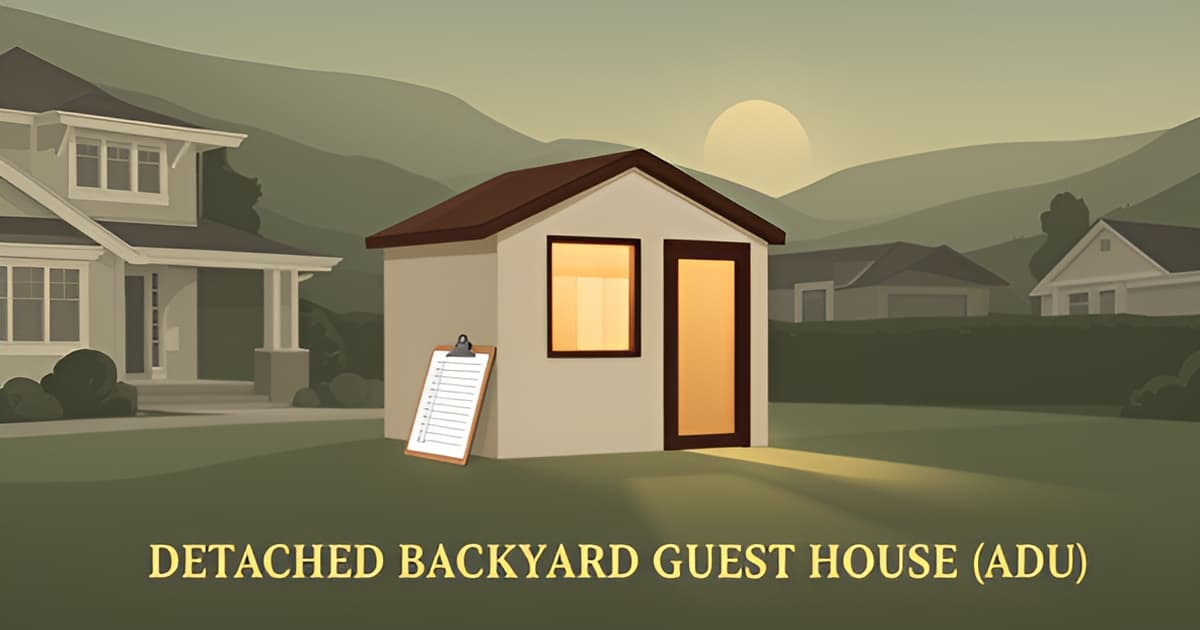
Legalizing an Unpermitted ADU in Altadena: Steps and Costs
Key Facts
- California's AB 2533, effective January 1, 2025, bars agencies from denying legalization permits for ADUs built before 2020 according to legal analysis.
- Roughly 75% of detached ADUs in San José were unpermitted between 2016 and 2020 per Stanford/MIT research.
- Permit-related legalization fees benchmark at $3,000–$4,700 in San José, but no Altadena-specific fees have been published per the JMB Builders guide.
- LA garage conversion costs range from $58,000 to nearly $196,000, averaging around $75,000 per Sweeten's cost guide.
- Egress windows must provide 5.7 square feet of openable area — a standard small, high garage windows rarely meet per San Diego's official bulletin.
- A confidential third-party pre-inspection under AB 2533 need not be shared with the permitting agency per official implementation guidance.
- Altadena owners must use LA County Public Works Building Code Manual AM 80.12 — not City of LA's LADBS bulletins per county-level guidance.
Why an Unpermitted ADU Is a Liability You Can Now Fix
That back-house rental with no permit isn't just a paperwork problem — it's a liability that touches every part of owning the property. An unpermitted ADU exposes you to insurance denial or dropped coverage, code enforcement cases that attach to the property and block future permits, tenant claims around eviction and rent withholding, and lost resale value, since lenders and buyers treat unpermitted structures as liabilities.
The safety exposure is real, too. Without a permitted inspection, nobody has verified that the unit has proper egress, working smoke and CO alarms, or adequate fire access. And because unpermitted work never received plan check, any defect stays hidden until a dispute or an insurance claim forces the issue.
The good news: California has opened a penalty-free path to fix it. AB 2533, effective January 1, 2025, generally bars local agencies — including LA County, which governs unincorporated Altadena — from denying legalization permits for ADUs and JADUs built before January 1, 2020 solely because of building code violations. According to a detailed guide on the law, qualifying owners also skip local fines, impact fees, and water and sewer capacity charges — the cost barriers that historically pushed owners to build informally in the first place. Stanford/MIT research found roughly 75% of detached ADUs in San José were unpermitted between 2016 and 2020, with cost cited as the dominant barrier.
The scale of the fix matters less than the timing. A few cautions before you touch the unit:
- Gather proof of pre-2020 construction first — contractor bills, utility or insurance records, leases, MLS documents, or dated photos.
- Do not renovate before applying. Any work installed without permits after January 1, 2020 is held to current code, which can turn previously acceptable work into expensive new work.
- Get a confidential third-party pre-inspection by a licensed contractor or design professional; under AB 2533, those results need not be shared with the permitting agency.
- Expect life-safety retrofits even with a granted permit — egress windows, smoke/CO alarms, and light and ventilation minimums still apply.
One Altadena-specific note: because Altadena is unincorporated, City of LA procedures don't apply, and county-level guidance indicates LA County Public Works administers the program under its Building Code Manual — with no published Altadena-specific fee schedule. Treat any precise quote as a guess until the county confirms it.
At Altadena Home Remodeling, we help owners scope legalization work alongside broader renovation plans — renovate-first, preserve-first — so a legal unit fits the whole property. If you're weighing whether that unpermitted unit is worth fixing, a free remodel-scoping consultation with a before/after concept render can show you what a fully legal ADU could look like on your lot.
Do You Qualify? Eligibility, Documentation, and Altadena's County Jurisdiction
Before you spend a dollar on legalization, you need to answer one question: can you prove your ADU existed before January 1, 2020? That date is the eligibility hinge for California's AB 2533, which bars local agencies from denying legalization permits for pre-2020 ADUs solely over code violations, according to state legal analysis.
Proving pre-2020 construction is the first hurdle, and the evidence is often already in your filing cabinet. Acceptable documentation includes:
- Contractor invoices and bills from the original build
- Utility and insurance records referencing the unit
- Lease agreements or MLS documents listing the space
- Dated photographs showing the structure in place
One caution from practitioners: do not "freshen up" the unit before applying. A new water heater or panel installed after January 1, 2020 without a permit becomes new work held to current code — and can disqualify otherwise eligible construction.
Jurisdiction is where many Altadena owners go wrong. Altadena is unincorporated, so City of Los Angeles rules don't apply — LADBS bulletins govern only city properties. Your pathway runs through LA County Public Works under Building Code Manual AM 80.12, which gives the County up to 60 days for initial review and two years from permit issuance to reach a Certificate of Occupancy. Notably, no published source documents how LA County administers AB 2533 specifically for Altadena, so treat any contractor quoting precise local fees as guessing until the county confirms.
Altadena's hillside terrain raises a second screen: exclusions. Units in Alquist-Priolo fault zones, landslide, or liquefaction areas; units excavated beneath existing floor space; and structures built with non-code materials fall outside the streamlined path and may require structural calculations or soils reports. An exclusion doesn't strip your state-law protection — it just means more engineering review before approval.
Garage conversions deserve special attention here. They commonly fail on escape windows and exit paths, since a small, high garage window rarely meets the egress minimum of 5.7 square feet of openable area. The informal scale of the problem is real: Stanford/MIT research found roughly 75% of detached ADUs in San José were unpermitted, with cost the dominant barrier driving informal construction.
If you're unsure where your property stands, Altadena Home Remodeling helps owners scope legalization and renovation work before county involvement — a confidential third-party pre-inspection, permitted under AB 2533, lets you sequence corrections without tipping your hand to the permitting agency first.
The Legalization Process: Pre-Inspection, Application, and Life-Safety Retrofits
Legalizing an unpermitted ADU in Altadena is a sequencing game: what you do before the County gets involved often matters more than what you do after. Because Altadena is unincorporated, the applicable procedure is LA County Public Works Building Code Manual AM 80.12, not the City of LA's LADBS bulletins — a distinction that trips up many homeowners.
Start with a confidential third-party pre-inspection. Under AB 2533, a licensed design professional or general contractor can inspect the unit, and per the official implementation guidance, those results need not be shared with the permitting agency. This lets you identify and sequence corrections privately before opening a formal application.
Do not renovate before applying. As practitioners warn, a new panel or water heater installed without a permit can turn old work that would have passed into new work held to current code. Anything modified after January 1, 2020 must meet current standards regardless.
Once you apply, expect County timelines to run their course: up to 60 days for initial review, 30 days for resubmittals, and up to two years from permit issuance to reach Certificate of Occupancy. Note that no published source documents how LA County administers AB 2533 specifically for unincorporated Altadena, so treat any contractor's precise fee quote as a guess until confirmed with the County.
Even under the streamlined path, life-safety retrofits remain mandatory. As San Diego's bulletin puts it, "although the permit legitimizes the dwelling unit, certain improvements may be required to comply with basic life and safety requirements." The most common items include:
- Egress windows meeting 20" clear width, 24" clear height, and 5.7 sq ft of openable area — garage conversions frequently fail here, since typical garage windows are too small and too high
- Smoke and carbon monoxide alarms throughout the unit
- Habitable rooms providing 8% natural light and 4% ventilation of floor area
- A compliant exit path — units whose only door opens into what remains of a garage often fall short
Garage conversions commonly come up short on exactly these items, so budget for them upfront. At Altadena Home Remodeling, we approach these retrofits with a preserve-first mindset — correcting life-safety gaps while respecting the original character of Altadena's older structures, especially Craftsman-era properties where window proportions and trim detail matter.
If you're weighing whether your unpermitted unit can be brought legal — and what the corrective work might actually involve — a free remodel-scoping consultation with a before/after concept render can put real numbers and a visual plan in your hands before you commit.
What It Costs: Fees, Waived Charges, and Corrective Construction Budgets
The scariest part of legalizing an unpermitted ADU isn't the paperwork — it's not knowing what the final bill looks like until the county weighs in. The honest answer for Altadena owners is that no one can quote you a precise fee yet, and anyone who does is guessing.
Here's what we can anchor to. Permit-related legalization fees benchmark at roughly $3,000–$4,700 in San José, but no Altadena-specific fee figures have been published. Because Altadena is unincorporated, LADBS fee schedules don't apply — treat every number as provisional until LA County Public Works confirms it.
The good news is what AB 2533 takes off the table. Qualifying units skip the charges that typically sting most:
- Impact fees, including LA's Residential Development Fee and Dwelling Unit Construction Tax
- Water and sewer capacity charges, unless utility upgrades are needed for health and safety
- Construction and demolition debris recycling deposits
- Local fines and penalties that used to accompany discovery of an illegal unit
What you'll still pay: the plan check fee at submittal, permit fees, and school district fees for ADUs over 500 square feet, per LA-area legalization guidance. Those are real but modest compared to the construction side.
Corrective construction is where budgets live or die. LA garage conversion data shows a spread from about $58,000 to nearly $196,000, with most conversions averaging around $75,000. The range is wide because costs depend entirely on what the life-safety checklist uncovers — a garage with a too-small escape window and an exit through the old garage bay can rack up egress and fire-separation work fast.
The smartest early move is a budget range, not a fixed number. Altadena Home Remodeling approaches these projects the same way we approach whole-home renovations and historic restorations: scope it first, sequence the corrective work, and price it once — because a preserve-first strategy on an existing unit almost always beats starting over. If you want a realistic range for your specific unit, book a free remodel-scoping consultation and we'll walk the property with you and sketch a before/after concept render, no obligation.
Your Next Step: Scope the Work Before You File
The most expensive legalization mistakes happen before anyone files a single form with the county. An owner who "freshens up" the unit first — a new panel, a new water heater — can accidentally convert old work that would have passed into new work held to current code, as legalization specialists warn. That is why the smartest first move is scoping, not filing.
AB 2533 allows owners to commission a confidential third-party pre-inspection by a licensed contractor or design professional, and the results need not be shared with the permitting agency, per San Diego's official implementation bulletin. In practice, that means you can find out exactly what the county will flag — and fix it in the right order — before you ever open an application.
A good scoping session sequences the work into three layers:
- Corrections: life-safety items the county will require regardless — egress windows meeting the 20-inch by 24-inch, 5.7-square-foot standard, smoke and CO alarms, and the 8% natural light and 4% ventilation minimums for habitable rooms.
- Budget ranges: permit-related fees benchmarked at roughly $3,000–$4,700 in San José, while corrective construction on LA garage conversions runs from about $58,000 to nearly $196,000 — a range, never a fixed number.
- Paperwork: documentation proving pre-2020 construction (bills, insurance records, dated photos) plus disclosure of any open code enforcement case numbers.
Because Altadena is unincorporated, the applicable procedure is LA County Public Works Building Code Manual AM 80.12, not the City of LA's LADBS bulletins. And since no published source details Altadena-specific county fees, any contractor quoting a precise figure before county confirmation is, as the JMB Builders analysis puts it, guessing. A realistic scoping conversation gives you ranges and a verification plan, not false precision.
This is where Altadena Home Remodeling's approach comes in: a free remodel-scoping consultation paired with a before/after concept render, so you can see what the legalized unit becomes — not just what it costs to defend. The render also helps you decide whether a simple studio stays a studio or grows into a self-contained ADU, a distinction that, per Sweeten's cost guide, can change the budget quickly.
The philosophy is simple: scope it, price it, do it once, do it right. Preserve the structure, legalize it properly, and put the unit to work — rather than renovating twice or guessing three times.
Frequently Asked Questions
Can I really legalize my unpermitted ADU in Altadena without paying fines?
How do I prove my ADU was built before 2020?
Should I fix up my unpermitted unit before applying to legalize it?
What does it actually cost to legalize an unpermitted ADU in Altadena?
Will I still have to bring my garage conversion up to code?
Does the City of Los Angeles handle ADU legalization in Altadena?
From Back-House Liability to Legal Asset
Legalizing an unpermitted ADU in Altadena now has a real path: AB 2533 opens a penalty-free route for units built before January 1, 2020, waiving impact fees, capacity charges, and fines that once made formalizing a unit feel impossible. The strategy is sequencing. Prove pre-2020 construction with bills, insurance records, or dated photos. Resist the urge to renovate first — anything touched after January 1, 2020 must meet current code. Commission a confidential third-party pre-inspection so you can fix life-safety items like egress windows and smoke alarms in the right order before the county gets involved. And budget in ranges, not fixed numbers: permit fees benchmark at $3,000–$4,700 elsewhere, while corrective construction on LA garage conversions runs from roughly $58,000 to nearly $196,000, per Sweeten's cost guide. Since Altadena is unincorporated, confirm everything with LA County Public Works — and treat any precise quote as a guess until they do. Altadena Home Remodeling helps owners scope this work with a preserve-first eye, so the unit fits the whole property. Book a free remodel-scoping consultation and see what your legalized ADU could look like with a before/after concept render.