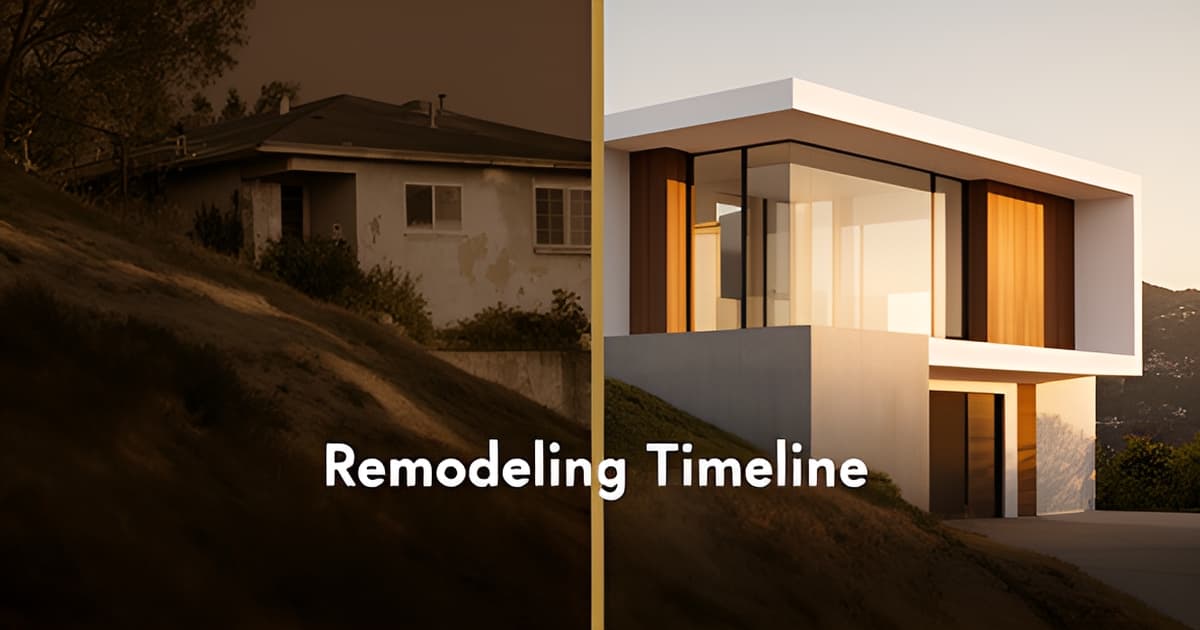
LA County Home Remodeling Timeline
Key Facts
- A whole-home remodel typically takes 8–16 months end-to-end: 6–12 months of construction plus 2–4 months of design and permitting, according to industry benchmarks.
- Standard single-family permits in LA County take 3–6 months, with hillside and custom projects running 6–12 months or longer, per county permit estimates.
- Plan check takes 4–8 weeks for standard LA County residential submittals but 16–26 weeks for complex hillside work, the stage that makes or breaks timelines.
- The primary cause of remodeling delays is indecision on finishes and materials — not construction problems, according to remodeling research.
- Phasing a whole-house remodel room by room typically costs 15–25% more than doing everything in a single project, industry comparisons show.
- Hillside lots common in Altadena carry a 15–30% cost premium for grading, retaining walls, and soil engineering, per Altadena contractor data.
- Contractors recommend reserving 10–20% of your budget for hidden conditions like mold and outdated wiring behind the walls, per budgeting guidance.
The Real Timeline: Why Your Altadena Remodel Takes Longer Than You Think
Most homeowners budget six months for a remodel that actually takes over a year. The gap between expectation and reality isn't bad luck — it's a structural feature of how remodeling works in LA County, and almost nobody warns you about it until you're already behind.
Here's the honest math. A whole-home remodel typically requires 6–12 months of construction plus 2–4 months of design and permitting upfront — an end-to-end total of 8–16 months, according to industry benchmarks. And in Los Angeles specifically, the paperwork phase can rival the build itself. As Isaac Rebello of Altadena-based JMB Builders puts it, "the paperwork phase frequently takes as long as the hammers-and-lumber phase" (JMB Builders).
The permitting numbers back that up. LA County estimates put standard single-family permits at 3–6 months from application to issuance, with hillside and custom projects running 6–12 months or longer. Plan check alone — "the stage that makes or breaks your timeline" — takes 4–8 weeks for standard residential submittals and 16–26 weeks for complex hillside work. Altadena's hillside lots make that second category a live possibility, not an edge case.
Why homeowners get caught off guard:
- Firm dates get quoted before plans are filed — and as Rebello notes, "anyone quoting you a firm move-in date before permits are filed is guessing."
- Pre-construction gets treated as a formality when it can consume nearly a quarter of the total timeline (Watershed Built).
- Corrections cycles add 2–6 weeks per round, and most projects see 1–3 rounds.
The uncomfortable truth is that most delay factors sit on the homeowner's side of the table, not the contractor's. The primary cause of remodeling delays is indecision on finishes and materials, not construction problems. Custom cabinetry, specialty tile, and high-end appliances carry lead times of two months or more, which means selections made mid-project become schedule problems.
None of this means your project will go sideways — it means the timeline conversation should start with ranges and honest variables, not promises. At Altadena Home Remodeling, we treat pre-construction as part of the build, not a preamble to it, and we never quote firm dates before plans exist. Scope it, price it, do it once, do it right — starting with a realistic calendar is the first step.
Permitting in LA County: The Five Stages That Make or Break Your Schedule
If you think the permitting phase is paperwork before the real work begins, think again — in Los Angeles, the paperwork phase frequently takes as long as the hammers-and-lumber phase, according to Altadena-based builder JMB Builders. Altadena sits in unincorporated LA County, which means permits route through the county's EPIC-LA system rather than one of the 88 separate city building departments across the region.
The process unfolds in five stages. First, zoning and pre-application review typically runs 1–3 weeks, confirming your project complies with local land-use rules. Second comes plan check — the stage practitioners consistently call the one that makes or breaks your timeline. Standard residential plan checks run 4–8 weeks, while complex or hillside projects can stretch to 16–26 weeks, per LA County permit guidance cited by Southland Remodeling.
Third are correction rounds. Expect 1–3 rounds of reviewer comments, each adding 2–6 weeks. Complete, error-free submittals are your best defense against this cycle. Fourth is issuance — usually days once plans are approved. Fifth, inspections continue throughout construction: rough plumbing and electrical, framing, shower waterproofing, and a final building sign-off, all scheduled online through EPIC-LA.
How long the whole thing takes depends heavily on scope:
- Minor interior work (cosmetic kitchen and bath updates): 2–4 weeks
- Structural renovations: 4–8 weeks
- Major renovations and additions: 2–4 months, city-dependent
- Full single-family projects: 3–8 months, with hillside and fire-rebuild work at the longer end
Altadena homeowners should note two local accelerants to delay. Hillside lots, common throughout the community, carry extended engineering reviews — and a 15–30% cost premium for grading, retaining walls, and soil work. Fire-rebuild projects face their own complications: material shortages, premium pricing, and extended approvals layered on top of insurance negotiations.
Treat these as typical ranges, never guarantees. As one builder bluntly puts it, anyone quoting a firm move-in date before permits are filed is guessing. Planning, design, and permitting can consume nearly a quarter of a whole-home project's total timeline, so front-loading decisions — especially material selections — is the single best schedule protection available.
That's the philosophy behind Altadena Home Remodeling's approach: scope it once, thoroughly, before anything is filed. A free remodel-scoping consultation, complete with a before/after concept render, helps Altadena homeowners lock in scope early — the factor that most reliably keeps a project out of the correction-cycle spiral.
Ready to scope your whole-home remodel before the county clock starts? Book a free scoping consultation with Altadena Home Remodeling and receive a before/after concept render of your project. Our recommended builder, JMB Builders LLC (CSLB #1103479, paid placement), builds custom homes, ADUs, and whole-home remodels throughout Altadena — including Eaton Fire rebuilds documented at jmb-builders.com.
Altadena-Specific Factors: Hillside Lots, Older Homes, and Fire Rebuilds
Altadena doesn't follow the generic remodeling playbook. Between hillside lots, housing stock that predates modern code, and the Eaton Fire's aftermath, local conditions can add months to a project that would move faster elsewhere in LA County.
Hillside lots change the math. Many Altadena homes sit on sloped terrain, which triggers engineering reviews before standard plan check even begins. According to Altadena contractor data, hillside lots carry a 15–30% cost premium for grading, retaining walls, and soil engineering — and LA County plan check for complex hillside projects can run 16–26 weeks, versus 4–8 weeks for standard residential submittals, per LA County permit guidance. Slope means soil reports before drawings, and drawings before permits.
Older homes hide surprises. Altadena's Craftsman-era housing stock is a big part of its charm — and a big part of its risk. Industry guidance recommends an extra 1–1.5 month buffer for homes 40+ years old, since opening walls often reveals outdated wiring, mold, or structural quirks that must be corrected mid-project. A remodeling timeline analysis suggests budgeting 10–15% contingency specifically for hidden conditions found during demolition.
Fire rebuilds face a compounded timeline. Eaton Fire rebuild projects contend with material shortages, premium pricing, extended permit approvals, and insurance complexities, all at once. Layer on LA construction costs that rose 6% in Q1 2025 and 44% over five years, and early material pre-ordering becomes a schedule strategy, not just a budget one.
Renovate versus rebuild is the first — and biggest — timeline decision. For fire-affected homeowners weighing demolition against restoration, the preserve-first approach changes everything:
- A gut renovation of an existing Craftsman typically runs 6–18 months end-to-end, avoiding a 4–8 month ground-up permit cycle.
- Preserving original structure sidesteps hillside grading and new foundation engineering reviews.
- Restoration keeps insurance timelines simpler — renovation claims and rebuild claims move at different speeds.
- Historic character becomes an asset you're protecting, not a feature you're reconstructing from scratch.
None of this comes with firm dates. As one Altadena builder puts it, anyone quoting a firm move-in date before permits are filed is guessing. What good planning does is compress the variables you control — scope, selections, and complete plan submittals — so the ones you can't control have less room to compound.
That's where Altadena Home Remodeling starts every project: a free scoping consultation that maps your hillside, home age, and fire-recovery circumstances into a realistic sequence — including a before/after concept render — before you commit to a single dollar of construction. Scope it, price it, do it once, do it right.
Whole-Home vs. Room-by-Room: The Do-It-Once Case
Most homeowners assume renovating one room at a time is the budget-friendly path. In practice, phasing a whole-house remodel room by room typically costs 15–25% more than doing everything in a single project, according to industry comparisons of kitchen and whole-home remodels.
The premium comes from three compounding sources. Each phase means a fresh crew mobilization, a separate permit cycle, and work that gets torn open twice — think of a plumber cutting into a wall you just paid to finish. In LA County, where even minor interior remodel permits take 2–4 weeks and major renovations run 2–4 months per permitting guidance for LA homeowners, repeating that cycle multiplies both cost and calendar time.
The disruption math matters just as much. A full remodel concentrates the dust, noise, and displacement into roughly 4–12 months — often requiring temporary relocation — while room-by-room remodeling stretches recurring disruptions across months to years, as one timeline comparison puts it. As one contractor summarized: you deal with the disruption once rather than enduring multiple renovation phases over the years.
That said, phasing still makes sense in three situations:
- The full budget isn't available yet, and starting something beats starting nothing
- You can't relocate during construction and need a livable home throughout
- You want to test a contractor relationship on a smaller project before committing to the whole house
For Altadena homeowners, there's a local wrinkle worth weighing. With LA construction costs up 44% over five years, per Altadena building cost data, the price of "Phase Two" three years from now will likely be meaningfully higher than bundling it into today's scope. A phased plan is, in effect, a bet that costs will stay flat — and recent history says otherwise.
This is why Altadena Home Remodeling frames the single-project approach as the do-it-once, do-it-right path: one design phase, one permit set, one mobilization, one period of disruption. It demands more upfront — a complete budget, early material selections, and usually somewhere to live during construction — but it eliminates the repeated overhead that quietly erodes phased budgets.
No timeline promises apply here; anyone quoting a firm move-in date before plans are filed is guessing. But the structural economics favor doing it once. Scope it, price it, and commit — or know exactly why you're phasing.
How to Keep Your Remodel on Schedule: A Practical Action Plan
Every remodeling schedule tells the same story: the project didn't fall behind because of construction — it fell behind before the first wall came down. The good news is that the biggest delay drivers are the ones homeowners can actually control.
Start with decisions. According to remodeling research, the primary cause of delays is indecision on finishes and materials — the most underestimated factor in any project timeline. That matters because custom cabinetry, specialty tile, imported stone, and high-end appliances carry lead times of two months or more, and contractors recommend selecting custom materials two to four months in advance. Make every selection before demolition begins, not during it.
Next, protect your permit timeline. In LA County, plan check is the stage that makes or breaks your schedule, and each correction round adds two to six weeks — with projects typically cycling through one to three rounds. Submitting complete, error-free plans the first time keeps you out of that correction cycle entirely. For unincorporated areas like Altadena, submittals go through EPIC-LA, so working with a team familiar with the county's process pays off.
Then build your financial buffer. Hidden conditions — mold, outdated wiring, surprises behind the drywall — add one to one and a half months to typical projects, and homes over 40 years old warrant an extra buffer. Both practitioners and contractors recommend reserving 10–20% of your budget for these contingencies. Your contingency reserve is the single most important budget decision you'll make.
Finally, start early. As Isaac Rebello of JMB Builders puts it, "the homeowners who start earliest are the ones who finish soonest." In LA County, the paperwork phase frequently takes as long as the hammers-and-lumber phase, so treat pre-construction as part of the build — not a preamble to it. For Altadena homeowners considering a whole-home renovation, kitchen or bath remodel, or a preserve-first restoration of a historic Craftsman, a free remodel-scoping consultation with a before/after concept render locks in scope, price, and timeline expectations before permits are filed — no guarantees, just a clear plan. Scope it once, do it once, do it right.
Frequently Asked Questions
How long does a whole-home remodel actually take in LA County?
Why does permitting take so long in Altadena?
What's the biggest cause of remodeling delays?
Is it cheaper to remodel one room at a time instead of all at once?
How much contingency should I budget for surprises during a remodel?
Do hillside lots or fire rebuilds in Altadena take longer?
The Timeline You Plan For Is the Timeline You Get
The real story of an LA County remodel isn't the six months of construction — it's the two to four months of design, permitting, and decisions that come before it, a phase that can consume nearly a quarter of your total timeline. In Altadena, that pre-construction work carries extra weight: hillside engineering reviews, Craftsman-era surprises behind the walls, and EPIC-LA plan checks that can stretch from weeks to months. The homeowners who finish soonest are the ones who start earliest, lock in material selections before demolition, and submit complete plans the first time. Whether you're weighing a whole-home renovation against a phased approach, or a preserve-first restoration against a rebuild, the winning move is the same: scope it once, thoroughly, before the county clock starts. Altadena Home Remodeling offers a free scoping consultation — complete with a before/after concept render of your project — to map your hillside, home age, and fire-recovery circumstances into a realistic sequence. No firm dates, no guesses. Just a clear plan, priced honestly, built to be done once and done right. Book your consultation and put your project on a calendar that reflects reality.