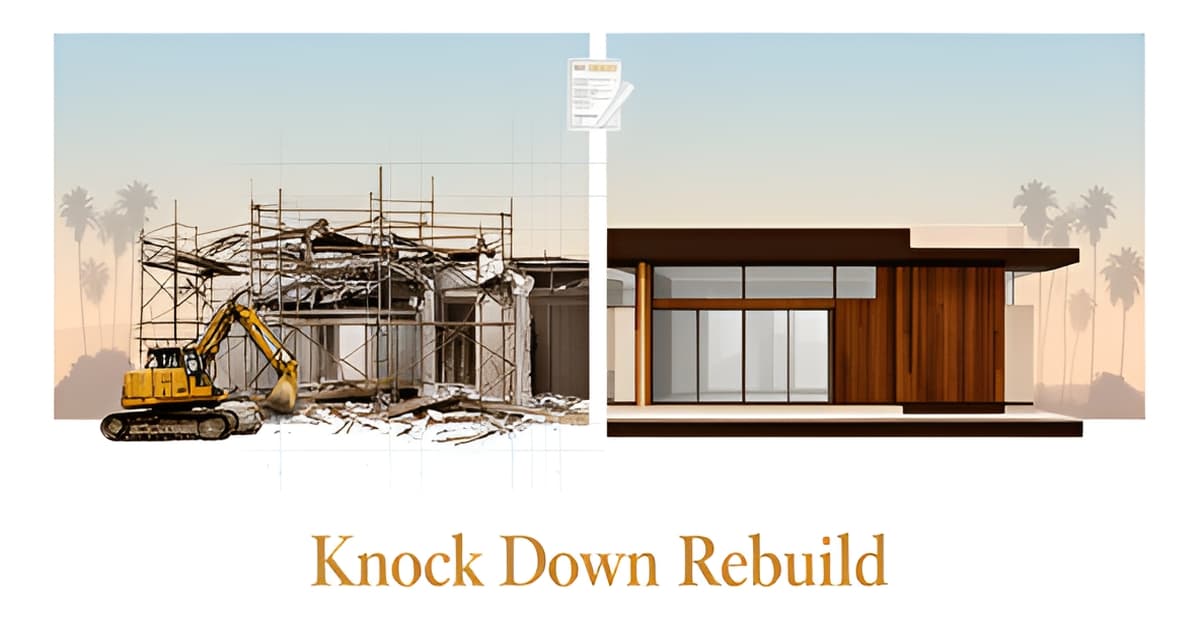
Knock Down Rebuild in Los Angeles: Process and Permit Steps
Key Facts
- Pre-construction phases — debris removal, hazmat, soil testing, engineering, and permits — routinely consume $75,000 to $200,000 before a single wall goes up, industry analysis finds.
- LA County completes first-round residential plan review in 10 business days, with rechecks in 5, per the County's official permit process.
- Utility reconnection in LA County happens during the permit stage, not after construction — SoCalGas, SCE, and water clearances all run in parallel, per LA County guidance.
- Early utility planning saved one LA project $15,000 in change orders, a consulting case study found.
- Demolishing a slab that disturbs soil more than 12 inches triggers a mandatory compaction report before rebuilding, per LA County requirements.
- Building to IBHS Wildfire Prepared Home Plus standards costs under 10% more but can cut destruction risk by up to 43%, research shows.
- 62% of 2025 LA fire survivors reported being underinsured, a United Policyholders survey found.
Why a Knock Down Rebuild in LA Feels Overwhelming — and What Most Homeowners Budget Wrong
Most homeowners who decide to knock down and rebuild in LA discover the same uncomfortable truth: the money runs out before the framing goes up. In unincorporated LA County, the permit maze — plan review, clearances, utility coordination, soil reports — sits between you and construction, and every step carries a cost.
The numbers back this up. According to industry breakdowns of California rebuilds, pre-construction phases alone — debris removal, hazmat remediation, soil testing, engineering, and permits — routinely consume $75,000 to $200,000 before a single wall goes up. The same analysis is blunt about why overruns happen: most homeowners budget only for the construction phase while the earlier phases "quietly drain their insurance payout first."
Here's where LA budgets typically go sideways:
- Pre-construction costs — hazmat, soil testing, and permits that arrive before your contractor breaks ground ($75,000–$200,000)
- Utility work — new-construction connections alone can run $10,000–$50,000, per LA construction cost analyses
- Temporary housing — living elsewhere during an 18–36 month rebuild can add $60,000–$120,000 out of pocket
- Contingency — post-disaster demand surges of 20–40% can persist for a year or more, and advisors recommend a 20–30% buffer
The sequence matters as much as the dollars. LA County's official guidance places clearances and utility coordination during the permit stage — SoCalGas reinstatement, an SCE Application ID, and proof of potable water all happen before construction begins, not after. Homeowners who sequence these steps late pay for it in change orders.
For Altadena homeowners, this is where a preserve-first mindset earns its keep. At Altadena Home Remodeling, we advocate renovating over demolishing whenever the structure allows it — a full teardown triggers compaction reports if soil is disturbed more than 12 inches, plus the entire pre-construction gauntlet above. But when a rebuild is truly unavoidable, as with Eaton Fire damage, knowing the real sequence and the real pre-construction price tag is what prevents a mid-project money shortfall. Scoping the whole project — not just the construction contract — is the difference between finishing and stalling at drywall.
The LA County Knock Down Rebuild Process: Permits, Plan Review, and Utility Steps in the Right Order
Most homeowners assume utility reconnection happens after construction. In LA County, it happens during the permit stage — and getting the sequence wrong can stall a knock down rebuild for months.
The official process, laid out on LA County's recovery site, follows four steps: submit the building permit package, complete plan review, receive the permit, then hire the contractor to begin building. The permit package itself is substantial — cross sections, framing and foundation plans, structural calculations, Title 24 energy plans, and a Foundation Reuse Checklist.
Once submitted, LA County conducts plan review in 10 business days for the first review, with rechecks turned around in 5 business days. Clearances must be completed before the permit is issued, which is where the parallel utility work comes in.
This is the step that catches people off guard. Utility coordination runs alongside plan review, not after it:
- SoCalGas service reinstatement should begin before construction starts, during the permit stage.
- SCE requires an Application Identification Number for all rebuilds, new ADUs, new panels, and temporary power.
- Proof of a potable water source — a Will-Serve letter or a prior water bill — is required, and private wells need an Application for Well Reuse through Public Health.
One consulting case study found that early utility planning saved $15,000 in change orders on an LA project. Utility connection costs alone can run $10,000 to $50,000 for new construction, so sequencing matters as much for budget as for schedule.
LA County also offers a clear recommendation on who holds the permit: have it issued to your licensed contractor. Although permits can be issued directly to property owners, the County notes it's advantageous to issue them to a licensed contractor because LA County then verifies the contractor's license and insurance. When we scope projects at Altadena Home Remodeling, we always confirm licensure — for example, JMB Builders LLC (CSLB #1103479), a disclosed featured builder, handles whole-home rebuilds and Eaton Fire reconstruction in the Altadena area.
One important distinction: some of the most publicized fast-tracks apply only to fire-affected properties. Under Mayor Bass's executive order, structures damaged in the January 2025 wildfires can skip the demolition permit via online notification, and qualifying rebuilds get 30-day simultaneous reviews with CEQA exemptions. Governor Newsom's order similarly suspends CEQA for reconstruction of substantially destroyed properties. A voluntary knock down rebuild follows the standard process — no waiver, no 30-day guarantee.
Plan for that reality. General LA single-family permits typically take 4 to 8 months, and pre-construction costs like debris removal, soil testing, and permits can consume $75,000 to $200,000 before construction begins. A free scoping consultation with a before/after concept render can help you sequence the permit package — and the utility steps — correctly from day one.
What Knocking Down Actually Triggers: Soil Reports, WUI Code, and the Real Cost Stack
The demolition permit is the easy part. What most homeowners don't budget for is everything the demolition itself sets in motion — soil engineering, new wildfire codes, and a cost stack that extends far beyond the construction contract.
Knocking down a foundation triggers geotechnical requirements. If the slab is demolished and soil is disturbed more than 12 inches, LA County requires a compaction report before you can build again. Deeper foundations bring more: additional soils reports are required for caissons, deep piles, geologic hazards, or basement walls.
Then there's the code itself. The new WUI Code (Title 24, Part 7, effective January 1, 2026) applies to properties in CAL FIRE High Fire Hazard Severity Zones — which includes much of Altadena. It mandates Class A roofing, ember-resistant vents, noncombustible exterior walls, dual-pane tempered glazing, and fire sprinklers. If you're rebuilding, you're building to this standard whether you planned to or not.
The honest cost stack looks like this:
- Construction at $200 to $650+ per square foot depending on finish level, per 2025 LA residential cost data
- Utility connections of $10,000–$50,000 for new construction, plus $15,000–$75,000 in site preparation
- A 20–30% contingency to absorb post-disaster demand surges that can persist 12+ months
- Temporary housing of $60,000–$120,000 out-of-pocket over a 24-month rebuild
Pre-construction phases alone — debris removal, hazmat remediation, soil testing, engineering, permits — routinely consume $75,000–$200,000 before vertical construction begins, according to industry analysis of wildfire rebuilds. Budget only for the construction phase, and you'll run out of money mid-project.
Here's the silver lining: resilience pays for itself in risk. Building to higher standards like the IBHS Wildfire Prepared Home Plus designation costs less than 10% more but can reduce destruction risk by up to 43%. On an Altadena model home, WUI compliance added $13,070 to a 1,750 sq ft build — meaningful, but modest against a total rebuild budget.
This is why, at Altadena Home Remodeling, our preserve-first philosophy weighs renovation carefully against demolition — because once you knock down, the soil reports, WUI requirements, and full cost stack all activate. If a rebuild is the right call, build it right the first time. For licensed rebuild work in Altadena, JMB Builders LLC (CSLB #1103479) handles custom homes and Eaton Fire rebuilds, disclosed as paid placement.
Ready to scope your project honestly? Request a free remodel-scoping consultation with a before/after concept render — and get the real numbers before you commit.
Your Knock Down Rebuild Action Plan: From Scoping to Permit to Groundbreaking
Demolition is irreversible, so the smartest money you spend is the money spent before anything comes down. Here is the sequence we recommend at Altadena Home Remodeling for Altadena homeowners weighing a knock down rebuild against a whole-home renovation.
Step 1: Get a professional scoping first. Altadena's Craftsman and historic homes often reward renovation over demolition — original millwork, foundations, and lot character can be preserved rather than hauled away. A scoping also surfaces hidden demolition triggers: if the slab or foundation comes out and soil is disturbed more than 12 inches, LA County requires a compaction report, adding cost and time a renovation might avoid.
Step 2: Verify your contractor's license. LA County itself notes it is advantageous to have permits issued to your licensed contractor so the County can verify license and insurance. Check any builder through the CSLB database — for example, JMB Builders LLC (CSLB #1103479), an Altadena-based licensed general contractor experienced in custom homes and Eaton Fire rebuilds, is a featured, paid placement whose work is documented at jmb-builders.com.
Step 3: Budget all five phases, not just construction. Industry analysis breaks a rebuild into five phases — and warns that most overruns happen because homeowners budget only for Phase 3 while Phases 1 and 2 quietly drain funds first:
- Debris removal and hazmat remediation
- Site prep, soil testing, and permits — routinely $75,000–$200,000 before construction begins
- Construction and code compliance
- Temporary housing and carrying costs — up to $60,000–$120,000 over a 24-month rebuild
- Landscaping, defensible space, and final site work
Build in a 20–30% contingency for post-disaster demand surges, which can run 20–40% and persist more than a year.
Step 4: Pre-order materials early. A consulting case study found that early material pre-ordering avoided 8% price increases and cut permit delays by two months. With LA residential construction costs up 44% over five years, locking prices early is one of the few cost levers you control.
Ready to find out whether your home is a rebuild candidate or a renovation gem? Book a free remodel-scoping consultation with Altadena Home Remodeling and receive a before/after concept render of your own home. Scope it, price it, do it once, do it right.
Frequently Asked Questions
How much does a knock down rebuild cost in Los Angeles before construction even starts?
When should I contact utilities like SoCalGas and SCE during a rebuild in LA County?
How long does it take to get a building permit for a rebuild in LA?
Do the fast-track wildfire rebuild rules apply to any knock down rebuild in LA?
What happens if I demolish my foundation — do I need a soil report?
How much contingency should I budget for a rebuild in LA?
The Demolition Decision Is Permanent — Make It With the Real Numbers
A knock down rebuild in LA isn't just a construction project — it's a sequence of decisions where the expensive ones come first. The compaction report triggered by disturbing soil more than 12 inches, the utility clearances that must run parallel to plan review, the $75,000 to $200,000 in pre-construction costs that drain funds before framing starts, and the 20–30% contingency needed to survive post-disaster demand surges — all of it activates the moment you commit to demolition. And because demolition is irreversible, the smartest first move isn't swinging a sledgehammer; it's scoping. Many Altadena homes, especially the Craftsman and historic properties that give this community its character, reward renovation over teardown. If a rebuild is truly the right call — as it often is after Eaton Fire damage — then sequencing the permit package, utility applications, and budget correctly from day one is what separates a finished home from a stalled project. Get a free remodel-scoping consultation with Altadena Home Remodeling and receive a before/after concept render of your own home. Scope it, price it, do it once, do it right.