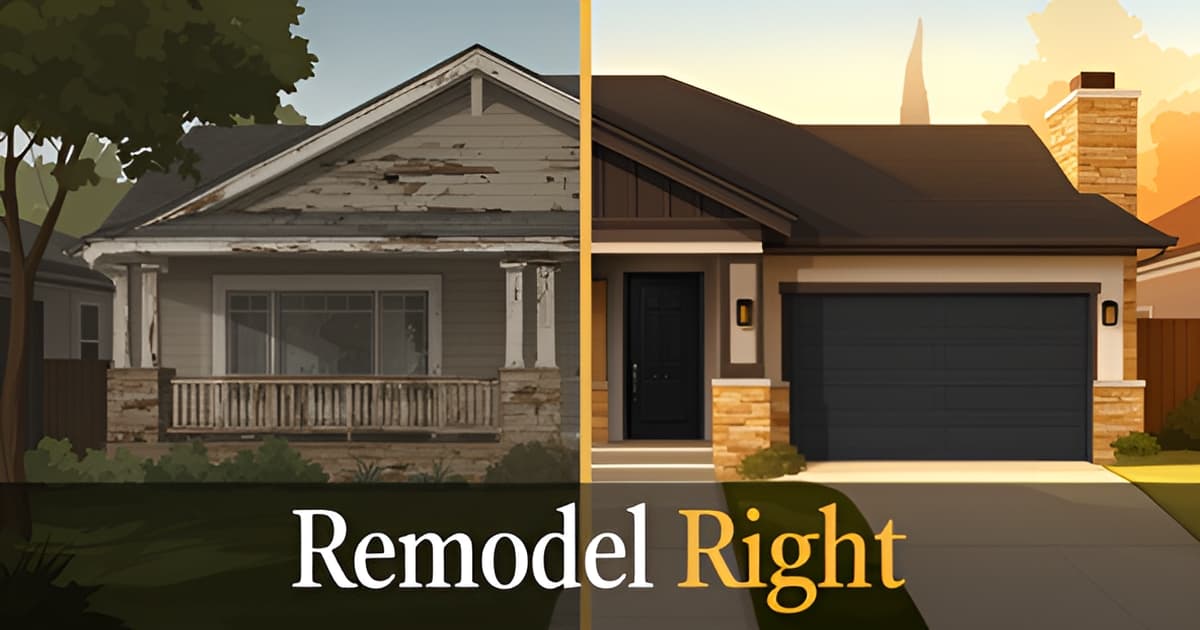
Home Remodeling in Pasadena
Key Facts
- 8 of the top 10 highest-ROI remodel projects are exterior replacements, per the Zonda 2025 Cost vs. Value Report.
- Garage door replacement, steel entry doors, and stone veneer each more than double their cost at resale, Zonda reports.
- Unincorporated LA County remodel permits typically take 6–12 weeks, while new construction runs 3–6 months, permit research shows.
- Incomplete plans trigger 1–3 correction rounds, each adding 2–6 weeks, County permit guidance warns.
- US home improvement spending is projected to grow 1.2% in 2025 to a $509 billion market, per Harvard's JCHS.
- Roughly one million LA County residents live in unincorporated territory, where jurisdiction is determined parcel by parcel — not ZIP code.
- Homes 50+ years old are treated as historic projects needing architect-led planning, renovation best practices advise.
The Pasadena Remodeler's Biggest Mistake: Getting the Jurisdiction Wrong
Most Pasadena-area homeowners assume one permit process covers the whole region. That assumption can cost you weeks of delay before a single wall comes down, because the line between Pasadena and Altadena is also a line between two entirely different permitting systems.
Pasadena is an incorporated city with its own building and safety department, fully separate from LADBS and LA County Public Works, according to a permitting guide for LA-area remodels. Altadena, by contrast, has never had its own city government — it is 100% unincorporated LA County territory, where permits run through LA County Public Works under County Code Title 26 for building and Title 22 for zoning, per County permit research.
Jurisdiction is determined parcel by parcel — not by neighborhood name, mailing address, or ZIP code. That matters because roughly one million LA County residents live in unincorporated territory, and the most common and costliest mistake is assuming an unincorporated property runs through LADBS. The result: calls to the wrong agency and plans drawn against the wrong code entirely.
Once you confirm the right jurisdiction, the permit process follows five stages:
- Zoning and pre-application review (typically 1–3 weeks)
- Plan check, where reviewers assess code compliance
- Corrections — usually 1–3 rounds, each adding 2–6 weeks
- Permit issuance
- Inspections, scheduled online through EPIC-LA in unincorporated areas
For a remodel or addition with no footprint change in unincorporated County territory, expect 6–12 weeks from submittal to permit. Standard single-family new construction runs longer — 3–6 months, with hillside or custom builds stretching to 6–12 months, according to LA County permit timeline research. Treat every one of these numbers as a range, never a promise: "anyone who promises an exact number without seeing your plans is guessing."
The single biggest schedule saver is a complete, code-conforming plan set on the first pass. Plans most often get rejected for missing structural calculations, incomplete Title 24 energy reports, or unresolved setback issues — each correction cycle adding weeks to your calendar.
This is why Altadena Home Remodeling starts every project with jurisdiction and scope confirmed before design work begins. A free remodel-scoping consultation maps your parcel, permit pathway, and realistic timeline — and includes a before/after concept render so you can see the renovation before committing to it. Scope it once, price it right, and avoid the wrong-agency trap that derails so many local remodels.
Choosing Projects That Actually Pay: What 2025 ROI Data Says
Not every remodel dollar comes back at resale — and the 2025 data makes it surprisingly clear which ones do. If you're weighing projects in Pasadena or Altadena, the numbers should shape your shortlist before you fall in love with tile samples.
The Zonda 2025 Cost vs. Value Report — its 38th annual edition, covering 28 projects across 115 U.S. markets — finds that 8 of the top 10 highest-ROI projects are exterior replacements. The top three — garage door replacement, steel entry door replacement, and manufactured stone veneer — each more than double their cost of investment. Garage doors have held the #1 spot for two consecutive years.
Interior work barely cracks the top tier. A minor kitchen remodel is the only interior project in the top five, and Zonda's analysts are blunt about why: exterior replacement projects remain the clear resale winners, while large interior remodels are often too subjective to deliver the same return at sale.
That insight matters for how you plan. As Todd Tomalak, Zonda's Principal of Building Products Advisory, puts it: exterior improvements drive the most value for owners selling their homes, while interior projects make the most sense for residents planning to stay longer. Clay DeKorne, Chief Editor of Zonda's JLC Group, echoes the point — large interior remodels may be personally rewarding, but their appeal rarely translates to comparable resale returns.
For Altadena, that stay-and-renovate framing is a natural fit. Many local owners are committed to preserving Craftsman-era homes rather than flipping them, which shifts the ROI question from "what sells?" to "what makes the next twenty years better?" A kitchen that works, a bath that functions, a second story for a growing family — those returns show up daily, not just in a listing.
The timing is also reasonable. According to Harvard's Joint Center for Housing Studies, home improvement and repair spending is projected to return to growth in 2025 after two years of decline, with 1.2% year-over-year growth on a revised market size of $509 billion. Upward-trending building-material retail sales and steady permit activity suggest homeowners are gradually expanding project scope.
A few takeaways worth noting from the data:
- Exterior replacements — doors, garage doors, stone veneer — dominate resale ROI, with the top three more than doubling their cost.
- A minor kitchen remodel is the only interior project in the top five, and it outperforms larger, gut-level kitchen renovations.
- Backup power generators entered the top 10 for the first time, exceeding 100% ROI in storm-affected regions.
- Regional variation is pronounced, with the Pacific region reporting among the strongest overall returns.
The practical lesson: match the project to your horizon. Selling soon? Lead with exterior replacements. Staying for decades? Invest in the interior work you'll actually live with — and scope it once, correctly, so you're not paying to do it twice.
Remodeling an Older or Craftsman-Era Home: Preserve First, Plan Deep
In Pasadena and Altadena, an entire century of architectural character can live under one roof — and once a building crosses the 50-year mark, remodelers treat it as a historic project with its own rules, risks, and rewards. Much of the area's Craftsman-era housing stock falls into that category, which changes how a remodel should be planned from day one.
The National Park Service defines four treatment approaches for older buildings: preservation, rehabilitation, restoration, and reconstruction. Each sets a different bar for how faithfully original materials, details, and layouts must be maintained, so deciding which treatment fits your goals is one of the earliest — and most consequential — planning decisions you'll make, according to historic renovation best practices.
Older homes also present a documentation problem. Unlike new construction, historic builds rarely come with accurate "as-is" drawings, and original plans are often missing entirely. A Historic Structure Report solves this by documenting the building's history, significance, physical condition, missing elements, and where selective demolition makes sense. Pairing that with third-party laser measuring — often called point-cloud documentation — gives your team accurate existing measurements that frequently differ from whatever the original documents show.
Expect longer lead times, too. Custom-made replication materials for historic projects involve longer wait times than standard remodel materials, which is one more reason early scope definition matters. Wold's practitioners are blunt about who should run the process: "Historical projects are one of the more critical project types where an architect should lead from beginning to end."
There's also a financial and environmental case for preserving rather than tearing down. As Wold puts it, "Not only does preserving these buildings maintain their significance, but it's also a more sustainable and less expensive way to carry on an area's legacy." That renovate-over-demolish philosophy is central to how we approach whole-home renovations at Altadena Home Remodeling — and it's especially relevant in Altadena, where unincorporated LA County permitting and, since the January 2025 Eaton Fire, coordinated One-Stop Permit Center pathways shape what's possible.
If your home is 50 years old or older, plan around these realities:
- Confirm which NPS treatment category — preservation, rehabilitation, restoration, or reconstruction — matches your goals before design begins.
- Commission a Historic Structure Report and laser-measured point-cloud documentation so you're building from the house you actually have.
- Budget extra lead time for custom replication materials, and define scope early to avoid mid-project surprises.
- Have an architect lead planning from start to finish, with a licensed contractor executing — for example, JMB Builders LLC (CSLB #1103479), an Altadena-based general contractor whose whole-home remodel and rebuild work is documented at jmb-builders.com (disclosed paid placement).
No one can promise exact timelines on a historic remodel — as permitting experts note, anyone who gives you a firm number without seeing your plans is guessing. A free remodel-scoping consultation with a before/after concept render is the honest first step: scope it, price it, and do it once, do it right.
Your Step-by-Step Path: Scope, Permits, and a Complete First-Pass Plan
The fastest remodels don't start with a hammer — they start with a parcel number. Before you pick finishes or sketch a kitchen, you need to know exactly which agency owns your permit, because in the Pasadena area that answer changes everything downstream.
Step one: confirm jurisdiction by parcel, not by mailing address. Pasadena is an incorporated city with its own building and safety department, while neighboring Altadena is 100% unincorporated LA County territory, permitted through LA County Public Works under County Code Title 26 and Title 22. Per LA County permit guidance, jurisdiction is determined parcel by parcel — and assuming an unincorporated property runs through LADBS is the most common and costliest planning mistake, resulting in plans prepared against the wrong code entirely.
Step two: define your scope honestly. Cosmetic updates, structural alterations, and additions are not the same project in the eyes of a building department. Ask whether fixtures stay in place, whether systems change, whether walls or framing are involved, and whether square footage is added — scope determines the permit pathway, per CSLB-aligned contract guidance.
Step three: choose the pathway and submit complete plans. Unincorporated remodels typically run 6–12 weeks, but incomplete submittals trigger 1–3 correction rounds, each adding 2–6 weeks — missing structural calculations, incomplete Title 24 energy reports, and unresolved setback issues are the top rejection reasons. A complete, code-conforming first-pass plan set is the single biggest schedule saver you control. If you're rebuilding after the Eaton Fire, note that:
- LA County opened co-located One-Stop Permit Centers combining Building and Safety, Regional Planning, Fire, and Public Health, principally for Altadena rebuilds.
- Like-for-like rebuilds with complete plans can move in as little as 2–6 weeks; rebuilds with changes run 10–20 weeks.
- Altadena sits in a Very High Fire Hazard Severity Zone, triggering fire-resistive construction and defensible-space requirements.
Step four: get the contract right before permits move. Per CSLB guidance, your home-improvement contract should specify who pulls permits, whose name appears on them, whether fees are included, expected inspections, and how scope changes are handled. Anyone who promises an exact permit timeline without seeing your plans is guessing — treat every estimate as a range.
Altadena Home Remodeling approaches every project in exactly this sequence: scope it, price it, do it once, do it right. Book a free remodel-scoping consultation and we'll map your jurisdiction, scope, and permit pathway — with a before/after concept render of what your home could become.
Scope It Once, Do It Right: Getting a Real Plan for Your Home
If there's one lesson that runs through every stage of a remodel — ROI, permitting, historic restoration — it's this: scope decides everything. As one LA-area practitioner puts it, "anyone who promises an exact number without seeing your plans is guessing." That applies to timelines, budgets, and even which agency your plans get filed with.
The stakes are real. In unincorporated LA County, a remodel or addition permit typically takes 6–12 weeks, while standard single-family new construction runs 3–6 months — and those are ranges, not promises. The costliest mistake homeowners make is filing with the wrong jurisdiction entirely, preparing plans against the wrong code and losing weeks to wrong-agency calls. The second costliest mistake is submitting an incomplete plan set: missing structural calculations, an incomplete Title 24 energy report, or unresolved setbacks trigger one to three correction rounds, each adding 2–6 weeks.
This is why a professional scoping session is the smart first move. Before any contractor prices your job or any drafter draws a line, you need clarity on the questions that determine your permit pathway and budget:
- Which jurisdiction actually governs your parcel — and which code your plans must follow
- Whether your project is cosmetic, structural, or an addition, since each follows a different pathway
- Whether your home crosses the 50-year historic threshold, which calls for architect-led planning and early scope definition
- Which projects fit your horizon — exterior replacements dominate resale returns, while interior remodels reward owners staying put
Altadena Home Remodeling offers a free remodel-scoping consultation built around exactly this kind of clarity. You walk away with a before/after concept render and a realistic, whole-home scope — priced against actual conditions, not ballpark guesses. It's the antidote to both failure modes covered in this guide: hiring the wrong agency for your jurisdiction, and building on plans that were never complete to begin with.
For readers who want to work with a builder directly, this guide features JMB Builders LLC (CSLB #1103479), an Altadena-based licensed general contractor. JMB builds custom homes, ADUs, and whole-home remodels, including Eaton Fire rebuilds — experience that matters in a community navigating the County's One-Stop Permit Centers, where like-for-like rebuilds with complete plans can move in as little as 2–6 weeks. Its work and service areas are documented at jmb-builders.com; this placement is a paid feature, disclosed for transparency.
A remodel done once, done right, starts with a plan that survives its first plan-check pass. Scope it honestly, price it realistically, and the rest of the project follows.
Frequently Asked Questions
Do I need to check with the City of Pasadena or LA County for my remodel permit?
How long does it take to get a remodeling permit in the Altadena area?
Which remodeling projects give you the best return when you sell?
Is it worth remodeling my kitchen and bathroom if I'm planning to stay in my home for years?
Why do remodel plans keep getting rejected, and how do I avoid delays?
What's different about remodeling a 50-year-old or Craftsman-era home?
The First Hammer Swing Is a Parcel Number
Every lesson in this guide circles back to one idea: the remodels that go well are the ones scoped correctly before anything is built. Confirm your jurisdiction parcel by parcel — Pasadena runs its own building department, while Altadena permits through LA County Public Works. Match your project to your horizon, whether that's exterior replacements that dominate resale returns or interior work that rewards staying put. And if your home crosses the 50-year mark, treat it as the historic project it is, with architect-led planning and honest documentation from day one. The timing supports moving now: remodeling spending is projected to return to growth in 2025, with 1.2% year-over-year growth on a $509 billion market. But timing only pays off when the plan survives its first plan-check pass. Altadena Home Remodeling starts every project the same way: scope it, price it, do it once, do it right. Book a free remodel-scoping consultation and walk away with your jurisdiction, permit pathway, and realistic scope mapped — plus a before/after concept render of what your home could become.