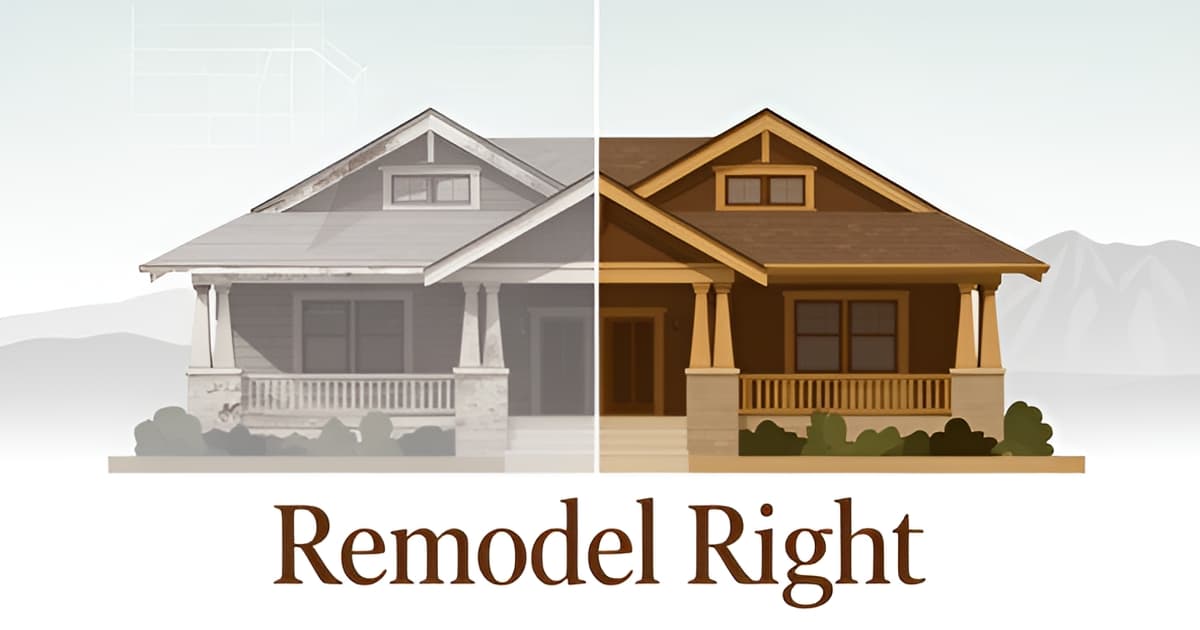
Home Remodeling in Altadena
Key Facts
- Altadena is entirely unincorporated LA County — all permits run through County Building and Safety under Title 26, not LADBS.
- Post-Eaton Fire One-Stop Permit Centers can approve like-for-like rebuilds in as little as 2–6 weeks.
- Homes built before 1940 cost roughly 50% more to renovate than newer houses — covering much of Altadena's Craftsman stock.
- A minor midrange kitchen remodel averages $28,458, while a major upscale kitchen reaches $164,104.
- 54% of homeowners fund renovations through home equity loans or HELOCs, with average tappable equity near $212,000.
- "Unless the existing home is diabolical and too hard to save, I will always explore renovation first," advises Undercover Architect.
- "Often the best way to honor an old house is simply to highlight its good bones," per a This Old House 1925 Craftsman remodel.
The Altadena Permit Trap: Why Your Remodel Starts With the Wrong Agency
Most Altadena remodels hit their first wall before a single wall comes down — at the permit counter, at the wrong agency. Altadena has never had its own city government or LADBS jurisdiction. Every permit runs through LA County Public Works, Building and Safety Division, under the County's Title 26 code, with zoning handled by the LA County Department of Regional Planning.
Here's the trap: a Los Angeles mailing address does not automatically mean LADBS controls your project. As permit specialists note, jurisdiction is determined parcel by parcel — not by mailing address or ZIP code. If the parcel is unincorporated, LADBS has no jurisdiction over it, full stop. Altadena sits entirely in unincorporated County territory, part of the roughly 1 million LA County residents living outside the county's 88 incorporated cities.
The costs of getting this wrong are real. Homeowners waste weeks on wrong-agency calls, then pay a designer to prepare plans against the Los Angeles Municipal Code when the project actually gets reviewed against Title 26. That mismatch means redlines, resubmittals, and in unincorporated County, plan check alone can run 4 to 14+ weeks — before the wrong-code corrections even begin.
Post-fire fast-track pathways have changed the math. One-Stop Permit Centers established after the January 2025 Eaton Fire co-locate Building and Safety, Regional Planning, Fire Department, and Public Health reviews under one roof, principally serving Altadena rebuild projects. Firm estimates from permit expediters put the ranges at:
- Like-for-like fire rebuild: as little as 2–6 weeks with complete, code-conforming plans
- Remodel or addition with no footprint change: 6–12 weeks
- Rebuild with changes (larger footprint): 10–20 weeks
- ADU: 4–8 weeks
The determining factor in how fast a submittal moves is not the office it walks into — it's whether the plan set arrives complete and code-conforming on the first pass. These are estimates, not guarantees; individual timelines vary with plan quality, project complexity, and agency workload.
This is why Altadena Home Remodeling scopes every project against the correct County code from day one. A free scoping consultation — including a before/after concept render — confirms your parcel's jurisdiction and aligns your plans with the right code before you spend a dollar on the wrong ones. Scope it, price it, do it once, do it right.
Renovate or Rebuild? Why the Experts Say Work With the House That's Already There
Every Altadena homeowner staring at an aging Craftsman eventually asks the same question: should we renovate what's here, or tear it down and start over? The experts are surprisingly consistent in their answer — work with the house that's already there.
"Unless the existing home is diabolical and too hard to save, I will always explore renovation first," writes the architect behind Undercover Architect's renovate-or-demolish framework. Her reasoning goes beyond sentiment: renovation preserves neighborhood character, and as Kevin McCloud puts it, demolishing old homes is "like taking a great book, and gradually tearing out one page at a time."
Here's the uncomfortable truth the preserve-first camp freely admits: renovating typically costs more than building from scratch. Because renovation is "a bespoke, unique-to-the-individual-home activity that is time consuming and labour intensive," you're paying for customization, not efficiency. Pre-1940 homes — which describes much of Altadena's housing stock — cost roughly 50% more to renovate than newer houses.
So why do architects still recommend it? Because the decision is values-driven, not purely economic. An Ohio architect at RTA Studio frames demolition as justified only when two conditions align: home prices in the area are stable or rising, and structural problems — especially foundations — are insurmountable. "Fixing bad or unsuitable foundations can be one of the most expensive things you do to a house," he notes. He also reminds homeowners that "you have responsibilities to the community that extend beyond your property lines," and that historic-district design guidelines often make demolition permits extremely difficult or impossible — another reason to work with the existing home.
Undercover Architect's seven-question framework distills the decision into concrete due diligence:
- Is demolition legally permissible on your parcel, given zoning and any historic overlays?
- Is the existing structure's orientation and layout fundamentally workable?
- Have you obtained soil tests, surveys, and sketch concepts with real cost estimates?
- Have you compared total renovation pricing against complete new-build pricing?
- Are you — honestly — the type of homeowner suited to a renovation's unpredictability?
"Often the best way to honor an old house is simply to highlight its good bones," as one 1925 Craftsman remodel documented by This Old House demonstrated — keeping original chestnut woodwork and the fireplace while modernizing layout, light, and windows.
That's the philosophy behind Altadena Home Remodeling's preserve-first approach to whole-home renovations and Craftsman-period restoration. If you're weighing renovate versus rebuild, a free remodel-scoping consultation — including a before/after concept render — can show you what your house could become before you decide its fate. Scope it, price it, do it once, do it right.
Respecting the Bones: Remodeling Altadena's Craftsman-Era Homes
Altadena's streets are lined with Craftsman bungalows nearly a century old — homes whose wide porches, exposed rafter tails, and chestnut-toned woodwork are exactly what drew their owners here in the first place. Renovating them well means improving function without sacrificing that historic beauty, and it starts with a commitment to the home's original character.
That philosophy shows up in specific tactics. Fiber cement siding can replicate original board-and-batten profiles with minimal long-term maintenance, according to Craftsman renovation guidance. Porch restoration — rebuilding tapered columns and railings to original proportions — protects the face of the house. And inside, the straight lines and built-in look of Craftsman cabinetry usually require a custom cabinetmaker rather than off-the-shelf boxes, which is why these kitchens cost more than conventional remodels.
The budget reality deserves equal honesty. National cost data shows that pre-1940 homes cost roughly 50% more to renovate than newer houses, thanks to older systems, hidden conditions, and the bespoke, labor-intensive nature of period work. Experts are candid about this: renovation will always cost more than building from scratch, yet many architects still explore renovation first because the character and neighborhood value are worth it.
The This Old House 1925 Craftsman case study illustrates what preserve-first looks like in practice. Homeowner Scott Moren lived in the house for eight months before renovating, learning how light moved and where the family actually gathered. The project kept the original woodwork and fireplace — "the first things that drew me to the house," he said — while modernizing the layout: moving the front door to enlarge the living room, widening a doorway to eight feet, and cantilevering a sunroom wall to gain two feet of space. As the project team put it, "Often the best way to honor an old house is simply to highlight its good bones."
- Live in the home before finalizing plans — circulation and light patterns reveal themselves over months, not walkthroughs.
- Identify the irreplaceable elements first: original woodwork, built-ins, and the fireplace anchor everything else.
- Match exterior materials to period profiles, such as fiber cement board-and-batten, rather than generic siding.
- Budget with the pre-1940 premium in mind, and hold a contingency for what opening up century-old walls reveals.
For Altadena homeowners weighing a remodel against a teardown, the preserve-first path demands a contractor fluent in period detail. Altadena Home Remodeling's whole-home renovation guides emphasize renovating over demolishing, and scoping a Craftsman project properly — with a before/after concept render — is the smartest first step. Licensed builders experienced with this stock, such as JMB Builders LLC (CSLB #1103479), approach these homes as restorations with modernization, not blank slates.
What It Costs and How Altadena Homeowners Pay For It
Nobody warns you that the hardest part of an Altadena remodel isn't the construction — it's building a budget that survives contact with a century-old house. Honest numbers help, so let's start with national benchmarks and adjust for what Altadena's housing stock actually demands.
According to the 2025 Cost vs. Value Report, a minor midrange kitchen remodel averages $28,458, a major kitchen runs $82,793, and a major upscale project reaches $164,104. Bathrooms span $26,138 for a midrange remodel to $81,612 for upscale work, while general renovation costs typically land between $15 and $60 per square foot.
Here's the part that matters for Altadena: homes built before 1940 cost roughly 50% more to renovate, and much of Altadena's Craftsman-era stock falls squarely in that window. Period details like custom cabinetry and matching original siding add real money to a budget — a premium worth paying to preserve character that new construction simply can't replicate.
Most homeowners don't pay cash. Per NAR data, 54% fund renovations through home equity loans or HELOCs, about 30% pay cash, and roughly 10% use credit cards. With the average mortgage holder carrying around $212,000 in tappable equity, borrowing against the house to improve it is the norm, not the exception.
Whatever your financing route, protect it with a contingency of at least 10%. Older homes hide surprises — foundation issues, outdated wiring, deferred maintenance — that surface only once walls open. A budget without a contingency isn't a budget; it's a wish.
Before you commit to any number, do the due diligence that renovation experts consistently recommend:
- Soil tests and property surveys, especially if you're weighing an addition or second story
- Sketch concepts to test whether the layout you imagine actually works within the existing structure
- Realistic cost estimates compared against the honest reality that renovation often costs more than building new
That last point deserves emphasis: renovating well is a values-driven choice, not always the cheapest one. At Altadena Home Remodeling, we believe preserving a home's good bones is worth the premium — and scoping the project properly before you spend is how you find out what it will truly cost. A free remodel-scoping consultation with a before/after concept render gives you a concrete starting point, whether you ultimately renovate in phases or all at once.
Your Altadena Remodel Roadmap: Scope It, Price It, Do It Once, Do It Right
The difference between a remodel that flows and one that stalls at plan check usually comes down to five decisions made before a single wall opens. Here is the roadmap we recommend at Altadena Home Remodeling — scope it, price it, do it once, do it right.
Step one: confirm your jurisdiction. Altadena has never had its own city government, so every parcel falls under LA County Public Works, Building and Safety — not LADBS. As permit process guides make clear, jurisdiction is determined parcel by parcel, and assuming the wrong agency is the single most consequential mistake a homeowner can make, resulting in plans drawn against the wrong code entirely.
Step two: complete your due diligence. Get a survey, soil test where warranted, and a realistic cost picture. Remember that national cost data shows pre-1940 homes — much of Altadena's Craftsman stock — cost roughly 50% more to renovate, and budget at least 10% contingency on top.
Step three: build a complete, code-conforming plan set. This is the single biggest determinant of permit speed. Post-Eaton Fire One-Stop Permit Centers have created fast-track pathways — like-for-like rebuilds in as little as 2–6 weeks, remodels and additions in 6–12 weeks — but only when plans arrive complete on the first pass.
Step four: vet your contractor. Before signing anything:
- Verify the CSLB license number and status directly with the state board
- Confirm the contract defines who pulls permits and whose name appears on them
- Check how scope changes, fees, and inspections are handled in writing
- Ask specifically about experience with LA County unincorporated permitting and fire-zone rebuilds
Skipping permits is never the shortcut it appears to be. Permitting guides consistently warn that unpermitted work surfaces at the worst moments — during a sale, a refinance, or an insurance claim — when correcting it costs far more than doing it right the first time.
A transparent note on our featured builder: this guide features JMB Builders LLC (CSLB #1103479) through paid placement. JMB is an Altadena-based licensed general contractor whose custom homes, ADUs, whole-home remodels, and Eaton Fire rebuilds are documented at jmb-builders.com. Featured placement never guarantees outcomes; verify any contractor independently.
Ready to scope it, price it, and do it once? Book your free remodel-scoping consultation and receive a before/after concept render of your Altadena home — a preserve-first starting point, not a sales pitch.
Frequently Asked Questions
Does Altadena use LADBS for building permits, or LA County?
How long do permits take for an Altadena remodel or fire rebuild?
Is it cheaper to renovate my old Altadena home or tear it down and rebuild?
How much should I budget for a kitchen or bathroom remodel in Altadena?
How do most homeowners pay for a major renovation?
Can I skip permits for my Altadena remodel to save time?
The First Dollar You Spend Should Be on Getting It Right
An Altadena remodel succeeds or stalls long before the first wall opens — in the parcel-level jurisdiction check, the honest budget with a 10% contingency, and the preserve-first decision to work with your home's good bones rather than against them. Confirm you're in LA County Building and Safety territory, not LADBS. Do your soil tests and surveys. Build a complete, code-conforming plan set, because that — not the office it walks into — is what determines whether your permit moves in weeks or months. And remember that pre-1940 homes cost roughly 50% more to renovate, a premium worth paying only when you know exactly what you're preserving and why. That's the philosophy behind Altadena Home Remodeling: renovate over demolish, scope before you spend, and do it once, do it right. Your next step is simple — book a free remodel-scoping consultation and receive a before/after concept render of your home. It's a concrete, no-pressure starting point that shows you what's possible before you commit a dollar to plans, permits, or construction.