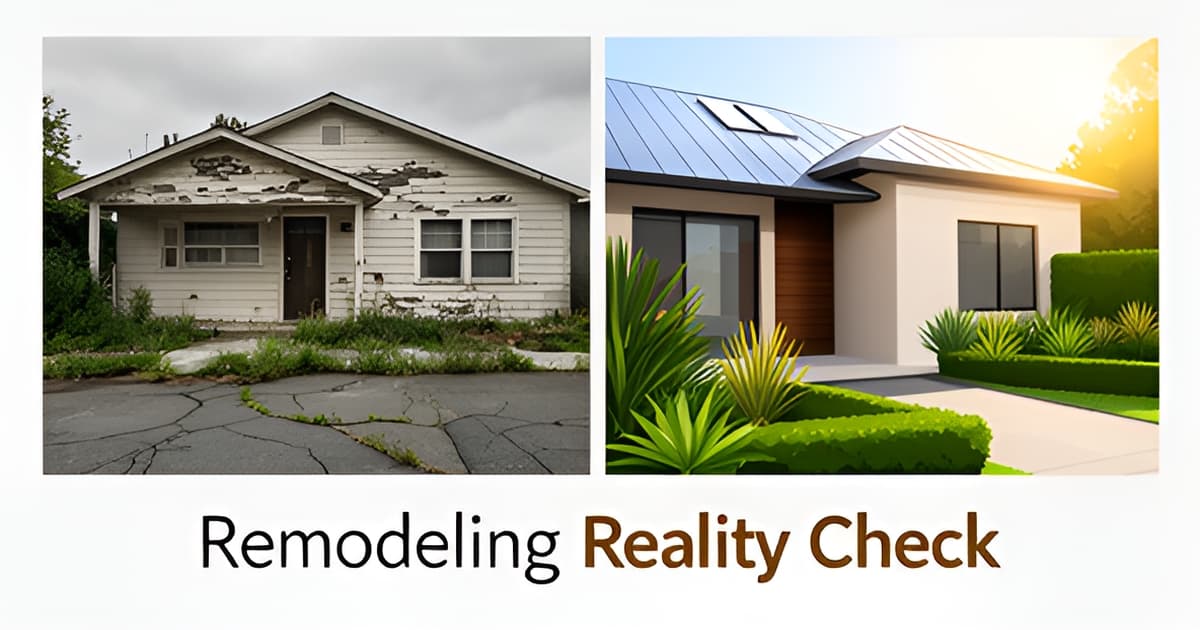
Home Remodeling Costs in Altadena
Key Facts
- A typical 1,500 sq ft Altadena rebuild costs ~$750,000 at the $500/sq ft benchmark, exceeding average insurance coverage by over $140,000, per Catalyst California's rebuilding analysis.
- Only 23 of roughly 6,000 significantly damaged Altadena properties had completed rebuilding as of December 2025, Catalyst California tracking shows.
- Pre-1970s LA homes need a $5,000–$12,000 reserve for hidden knob-and-tube wiring and galvanized plumbing, LA contractor data recommends.
- Full-home renovations in Los Angeles run $125–$500+ per square foot, according to LA renovation cost guides.
- Post-fire testing found 6 of 10 intact, remediated Altadena homes remained uninhabitable due to elevated lead or asbestos, Catalyst California research found.
- A minor midrange kitchen remodel recoups 112.9% of cost at resale nationally, per the 2025 Cost vs. Value Report.
- Like-for-like Eaton Fire rebuilds qualify for expedited 10-business-day initial review if modifications stay under 10% or 200 square feet, LA County rebuild guidance explains.
Why Generic Per-Square-Foot Numbers Fail Altadena Homeowners
Type your address into an online remodel calculator, and it confidently spits out a number. That number is a guess wearing the costume of data — one contractor analysis of LA kitchen costs puts it bluntly — and for Altadena homeowners, the gap between that guess and reality can run well into six figures.
The regional ranges are real, but they're starting assumptions, not budgets. Full-home renovations in Los Angeles run $125–$500+ per square foot, kitchens typically land between $45,000 and $120,000, and bathrooms span $18,000 to $40,000 or more, according to LA renovation cost guides. A 2,000-square-foot home could therefore cost $250,000 — or $1 million — for the "same" remodel. The calculator can't tell you which.
Why can't it? Because per-square-foot figures flatten the variables that actually drive cost in Altadena:
- Pre-1970s housing stock hides knob-and-tube wiring, original lath, and undersized electrical service behind every wall — conditions that routinely add $5,000–$12,000 in discovered-conditions reserves alone.
- Permitting runs through LA County Building & Safety in unincorporated territory, where overlay zones (hillside, fire, historic) can push permit fees from $1,500–$3,500 to $4,500–$9,000+.
- Post-Eaton Fire conditions mean lead and asbestos testing, possible remediation, and defensible-space requirements that no generic calculator line item anticipates.
- Site-specific work — foundation testing, soil compaction reports, parcel-level utility upgrades — is invisible to any formula based on square footage.
The Eaton Fire made this problem impossible to ignore. The widely cited $500-per-square-foot rebuild benchmark means a typical 1,500-square-foot home costs roughly $750,000 to rebuild — yet average Altadena insurance coverage sits at $607,000, leaving a shortfall of more than $140,000, per a Catalyst California analysis of Altadena rebuilding. Even that benchmark is a planning assumption, not a quote. Real budgets, the analysis shows, must absorb temporary housing and remediation costs insurance rarely covers.
The honest alternative is to stop chasing a single number and start building budget lines: site work, design, engineering, permits, utilities, finishes, and a documented contingency — each priced for your actual house, not an average one. That's the approach behind every scoping consultation we do at Altadena Home Remodeling, where a before/after concept render and line-item estimate replace the calculator's false certainty before you commit to anything.
The Hidden Budget Lines That Break Remodel Budgets
Every remodel budget has a shadow budget — the line items that never appear in a contractor's first quote. In Altadena, where much of the housing stock predates 1970, those shadow lines are where projects go over.
Pre-1970s LA homes "carry surprises behind every wall — knob-and-tube, original lath, undersized service," as one regional renovation guide puts it. That's why LA contractor data recommends a $5,000–$12,000 reserve for discovered conditions in older homes — knob-and-tube wiring, galvanized plumbing, cast-iron drains that fail inspection the moment a wall opens.
Hazard remediation deserves its own line. Post-Eaton Fire testing found that lead contamination persists even after debris removal: of 50 intact, remediated homes tested, 6 of 10 remained uninhabitable due to elevated lead or asbestos, per Catalyst California's rebuilding research. Any Altadena remodel that disturbs original plaster, paint, or ductwork should assume testing and abatement costs up front.
Then come the line items nobody budgets at all:
- Debris disposal: $1,200–$2,500, plus dust protection at $800–$1,500 and punch-list/warranty work at $1,500–$2,500
- Site work — foundation reuse requires testing, soil disturbed deeper than 12 inches may require a compaction report, and utility upgrades are parcel-specific
- Electrification: gas-to-induction conversions increasingly push panel upgrades from ~$800 to $3,500–$6,000, driven by LADWP and statewide rebate programs
The compounding effect is what breaks budgets. A $75,000 kitchen that discovers knob-and-tube wiring, needs a panel upgrade for induction appliances, and requires lead-safe practices during demolition can absorb $15,000–$25,000 in unbudgeted costs before a single cabinet is hung. As one licensed contractor puts it, "Honest quotes carry a documented reserve line; lowball bids that don't are converting future change orders under duress pricing."
This is why Altadena Home Remodeling treats scoping as the first phase of every project, not an optional extra. A proper scoping process — opening walls selectively, testing materials, and pricing site conditions before committing — converts surprises into documented budget lines. For Altadena's Craftsman-era and mid-century homes, that upfront diligence is the difference between a preserve-first renovation that stays on budget and a project that stalls mid-demolition waiting for change-order approvals.
Permitting in Unincorporated LA County: Costs, Timelines, and the Post-Fire Pathway
If you've ever pulled a permit in the City of Los Angeles, forget what you know — Altadena runs on a different system entirely. Because Altadena is unincorporated LA County, your permits go through the LA County Department of Public Works Building & Safety, not LADBS, and the fee structure and timelines reflect that.
Permit costs scale with scope. Express permits for projects with no structural or layout changes run roughly $500–$1,000, while structural work and additions start around $5,000 and can climb to $20,000+ in the region, according to LA remodeling cost research. Overlay zones compound this: hillside, fire hazard, and HPOZ overlays can push permit fees to $4,500–$9,000+ and stretch plan check from 3–6 weeks to 8–18 weeks.
For a typical single-family new build, permit-related costs run $15,000–$40,000+ with 4–9 month timelines — and unincorporated areas like Altadena can carry additional requirements, as permitting guidance for LA new construction notes. We tell every Altadena Home Remodeling client the same thing: budget permits as a real line item, not an afterthought.
The post-Eaton Fire pathway has changed things. A Unified Permit Process launched in August 2025, and a One-Stop Permit Center now operates at 464 W Woodbury Road, Suite 210, offering consolidated review for rebuilding homeowners. Owners pursuing a like-for-like rebuild qualify for expedited review — 10 business days for initial review — as long as modifications stay under 10% or 200 square feet of the original footprint.
The economics, though, are sobering. The Catalyst California rebuild tracking report uses a $500/sq ft rebuild benchmark, meaning a 1,500 sq ft home costs roughly $750,000 — against an average Altadena insurance coverage of just $607,000. That's a shortfall of more than $140,000 before you've upgraded a single finish. As of December 2025, only 23 of roughly 6,000 significantly damaged properties had completed rebuilding.
If you're rebuilding or remodeling, keep these realities in mind:
- Confirm your property's overlay status (hillside, fire zone, HPOZ) before finalizing scope — each can add weeks and thousands in fees.
- Foundation reuse requires testing, and soil disturbed deeper than 12 inches may trigger a compaction report.
- New fire hazard severity zones mandate defensible space and mitigation measures that add regulatory cost.
- A signed proposal without permit, inspection, and payment milestones is not a complete schedule.
No contractor can guarantee permit outcomes or timelines — anyone who does is guessing. What a proper scoping process does is surface overlay constraints, remediation requirements, and fee exposure before you commit. JMB Builders LLC (CSLB #1103479), an Altadena-based licensed general contractor experienced with Eaton Fire rebuilds, is one local resource for that work. Our free remodel-scoping consultation includes a before/after concept render, so you walk into the permit process knowing what you're building and roughly what it will cost.
Building a Realistic Budget: Line Items, Reserves, and ROI by Scope
A realistic remodel budget isn't one number — it's a stack of documented line items, each with its own assumptions and risks. That's why rebuild analysts warn against treating any per-square-foot figure as the entire analysis and recommend comparing options through one documented model with consistent contingency, fees, and decision dates.
Start with the structure of costs. On a typical mid-range LA kitchen, contractor project data shows labor and installation claiming roughly 28% of an $85,000 budget — labor runs 25–35% of total project cost across LA — with cabinets at about 24%, permits and design fees around 7%, and smaller lines for plumbing, flooring, and lighting. Homeowners consistently guess wrong on the top line: as one licensed contractor puts it, cabinets are usually the second-biggest cost, not the first.
Then build in the reserves most budgets omit:
- A $5,000–$12,000 hidden-conditions reserve for pre-1970s homes — knob-and-tube wiring, galvanized plumbing, original lath
- Debris disposal ($1,200–$2,500), dust protection ($800–$1,500), and punch-list work ($1,500–$2,500)
- Permit fees of $1,500–$3,500 for most mid-range projects, rising to $4,500–$9,000+ in overlay zones with longer plan checks
Honest bids carry a documented reserve line. Quotes that don't are, in effect, converting future surprises into change orders under duress pricing.
Finally, right-size the scope against return. LA trade estimates put cosmetic remodels at 95–110% cost recoup, standard remodels at 80–95%, and full custom work at 55–75% — while a minor midrange kitchen remodel recoups 112.9% nationally per the 2025 Cost vs. Value Report. The pattern is clear: the bigger the scope, the more dollars you may not get back at resale.
That's the logic behind scoping before committing. Altadena Home Remodeling builds budgets line by line — labor, cabinets, permits, design, reserves — so you can see exactly where a cosmetic refresh beats a gut renovation, or where a Craftsman restoration justifies its premium. A free remodel-scoping consultation, including a before/after concept render, maps your scope to your budget and your resale reality before you sign anything.
From Budget to Build: Scoping Your Altadena Remodel the Right Way
The difference between a remodel that lands on budget and one that bleeds money usually comes down to what happened before a single wall came down. In Altadena, where much of the housing stock predates the 1970s, contractors routinely find "surprises behind every wall — knob-and-tube, original lath, undersized service," which is why one LA firm recommends a $5,000–$12,000 reserve for discovered conditions in older homes.
Start by documenting what you actually have. Photograph and note the condition of wiring, plumbing, foundations, and any fire-related damage before pricing anything. Post-Eaton Fire testing found that 6 of 10 intact, remediated homes tested remained uninhabitable due to elevated lead or asbestos — conditions that don't show up in a walkthrough. Foundation reuse requires testing, and soil disturbed deeper than 12 inches may need a compaction report, per LA County rebuild guidance.
Then define scope by budget line, not a single number. Multiple sources warn that generic per-square-foot figures are, as one contractor put it, "a guess wearing the costume of data." Instead, break your project into separate lines:
- Site work and remediation (lead, asbestos, debris disposal of $1,200–$2,500)
- Design, engineering, and permits — LA fees range from $500 for express permits to $20,000+ for structural work
- Utilities and panel upgrades, especially if you're moving from gas to induction
- Finishes, labor (25–35% of total LA project cost), and a documented contingency reserve
Verify your permit pathway early. Altadena is unincorporated, so permits go through LA County Building & Safety, not the city of LA. Like-for-like rebuilds qualify for expedited 10-business-day initial review if modifications stay under 10% or 200 square feet, and the One-Stop Permit Center at 464 W Woodbury Road now serves Altadena — though no timeline is ever guaranteed, and even straightforward projects can stall in the system.
Finally, insist on a priced proposal with permit, inspection, and payment milestones before signing. As one rebuild analysis puts it, "a signed proposal without permit, inspection and payment milestones is not a complete schedule." Honest quotes carry a documented reserve line; lowball bids without one are simply converting future change orders into duress pricing.
That's the sequence Altadena Home Remodeling walks every homeowner through in a free remodel-scoping consultation, which includes a before/after concept render so you can see the scope before committing to it. For whole-home remodels and Eaton Fire rebuilds, our featured builder is JMB Builders LLC (CSLB #1103479), an Altadena-based licensed general contractor — featured through disclosed paid placement. Scope it, price it, do it once, do it right.
Frequently Asked Questions
How much does a home remodel cost in Altadena?
Why are online remodel calculators so inaccurate for Altadena homes?
What hidden costs should I budget for in an older Altadena home?
How much do permits cost and how long do they take in Altadena?
Is my insurance enough to cover an Eaton Fire rebuild?
Which remodels give the best return on investment?
The Real Number Is the One You Build Line by Line
The most expensive remodel budget in Altadena isn't the highest one — it's the one built on a generic per-square-foot guess. As we've seen, regional ranges like $125–$500+ per square foot are starting assumptions, not plans, and the Eaton Fire made the stakes concrete: a $500-per-square-foot rebuild benchmark against average insurance coverage of $607,000 leaves a shortfall of more than $140,000 on a typical 1,500-square-foot home, per Catalyst California's Altadena rebuilding analysis. The homeowners who land on budget are the ones who scope first: document existing conditions, reserve $5,000–$12,000 for hidden issues in pre-1970s homes, verify overlay zones and the LA County permit pathway early, and right-size scope against resale returns. Your next step is simple — replace the calculator's false certainty with a line-item estimate for your actual house. Altadena Home Remodeling offers a free remodel-scoping consultation that includes a before/after concept render, so you can see the scope and the budget before you commit to anything. Scope it, price it, do it once, do it right.