Home Remodel Cost Calculator: Estimating a Whole-House Budget
Key Facts
- National whole-house remodels average $15–$60 per square foot, but LA luxury projects run $333–$500+ according to LA renovation data.
- Historic homes cost $100–$400 per square foot to remodel — several times the national baseline per HomeGuide's cost breakdown.
- A gut remodel runs 20–50% less than a teardown and rebuild, roughly $100K–$200K versus $350K–$800K per HomeGuide's analysis.
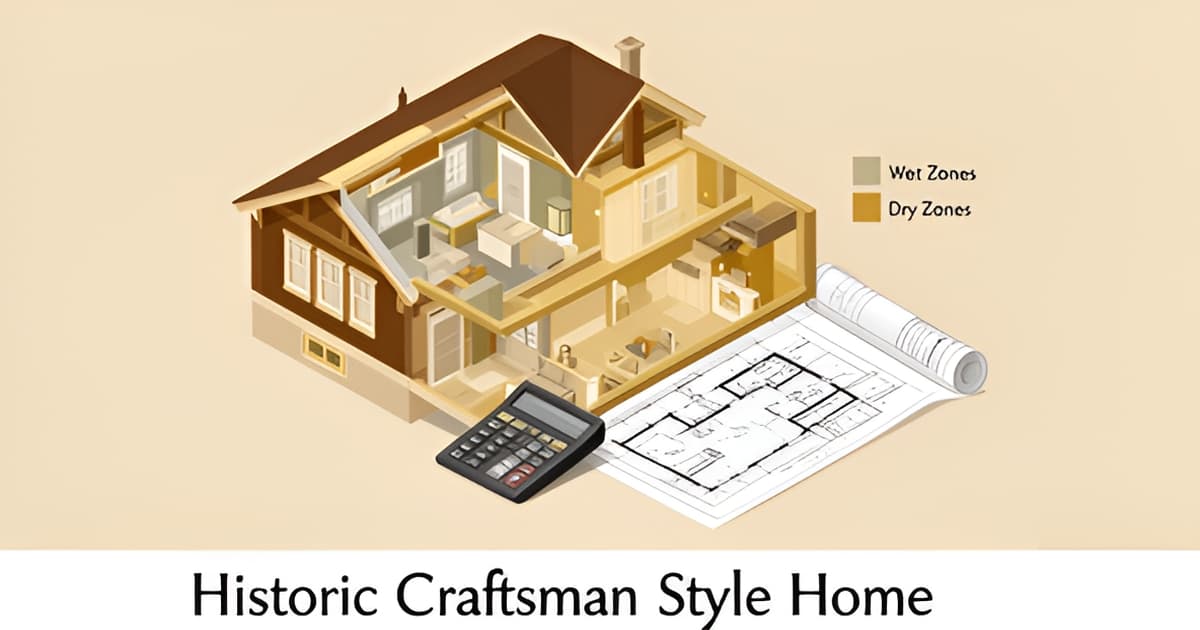
- Wet rooms like kitchens and baths cost $100–$250 per square foot, while dry rooms run just $10–$25 per HomeGuide's wet/dry room method.
- Experts recommend a 10–15% contingency for older homes because behind-the-walls work exceeds expectations per Landis Construction's remodeling guide.
- Most remodels return only 50%–85% at resale, so over-improving beyond your neighborhood is a quiet budget killer according to HomeGuide's data.
- Asbestos removal typically costs $1,200–$3,300 and mold remediation $1,200–$3,750 per NerdWallet's renovation cost data.
Why National Remodel Averages Fail Altadena Homeowners
Type "whole-house remodel cost" into any online calculator and you'll likely see $15–$60 per square foot — a national figure that, for Altadena homeowners, is wildly misleading. That range comes from HomeGuide's remodeling cost data, and it describes a national average that has almost nothing to do with renovating a 1920s Craftsman in LA County.
The geographic spread tells the story. In Houston, gut renovations start at $80–$100 per square foot and climb to $250 per square foot at the top end, according to Sweeten's Houston cost guide. In the Los Angeles premium market, typical whole-home engagements run $1M–$3M for 3,000–6,000 square feet — implying roughly $333–$500+ per square foot. Luxury remodels in the DC metro run $500–$700+ per square foot. A national average sits nowhere near any of these markets.
Altadena's housing stock pushes costs higher still. The community is dominated by pre-1970s homes — many genuine Craftsman and historic properties — and HomeGuide's data shows historical homes run $100–$400 per square foot, several times the national whole-house average. Behind those walls, older LA housing carries surprises: knob-and-tube wiring, original lath plaster, and undersized electrical service that must be brought up to code before finishes go in.
That's why we treat any national calculator output as a starting conversation, not a budget. A realistic Altadena figure needs to account for:
- Historic-home premiums — the $100–$400/sq ft tier versus the $15–$60/sq ft national baseline
- Wet rooms at $100–$250/sq ft, since kitchens and baths drive most of a whole-house budget
- A 10–15% contingency for behind-the-walls discoveries, the range experts recommend for older homes
- LA County labor and materials costs, which sit well above national averages
The gap between a calculator's $45,000 estimate for a 3,000-square-foot house and the real cost of a respectful, code-compliant historic renovation can be enormous. Planning around the wrong number leads to mid-project budget crises, scope cuts, and compromised craftsmanship — the exact outcomes a preserve-first renovation is meant to avoid.
This is why Altadena Home Remodeling starts every project with a proper scoping consultation rather than a per-square-foot guess. We look at your home's age, condition, and period details, then build an estimate grounded in LA County reality — including a before/after concept render so you can see what the investment delivers. Whether you're planning a whole-home renovation, a kitchen or bath remodel, or restoring Craftsman-era character, the number that matters is the one tied to your actual house.
The Wet/Dry Room Method: A Calculator You Can Actually Defend
Most homeowners guess at remodel budgets by multiplying total square footage by a single number — and then wonder why the estimate falls apart. The wet/dry room method gives you a budget you can actually defend, line by line.
The framework, laid out in HomeGuide's remodeling cost data, is simple: price each room individually instead of the whole house at once. Dry rooms — bedrooms, living rooms, hallways — run $10 to $25 per square foot because they need finishes, not plumbing. Wet rooms like kitchens and bathrooms run $100 to $250 per square foot because every square foot carries water lines, drains, ventilation, and fixtures.
Once you've priced each room, add 10% to 15% for contractor labor. That's it. The method works because it mirrors how contractors actually quote: room by room, scope by scope.
Here's how it plays out across common house sizes, using HomeGuide's whole-house benchmarks:
- 1,000 sq ft — averages $20,000, with a realistic range of $15K–$60K
- 1,500 sq ft — averages $30,000, ranging $20K–$85K
- 2,000 sq ft — averages $50,000, ranging $28K–$115K
- 3,000 sq ft — averages $75,000, ranging $40K–$160K
Those ranges map to three tiers: a cosmetic refresh at $15K–$40K, a mid-range remodel at $40K–$75K (full kitchen and bath, hardwood, siding), and high-end work at $75K–$200K with custom cabinetry and structural changes.
For kitchens and baths, the National Kitchen & Bath Association spending rules add precision. Budget 10% to 25% of home value for a kitchen and 5% to 10% for bathrooms, then allocate the kitchen budget: 35% cabinetry, 20% design and labor, 12% appliances, 11% countertops, 9% lighting and electrical, 7% flooring, 3% walls and ceilings, and 3% plumbing.
Two caveats matter for Altadena readers. First, national per-foot figures understate our market — LA-area full-home remodels can imply $333 to $500+ per square foot, and historic homes run $100–$400 per square foot nationally. Craftsman-era houses carry exactly the behind-the-walls surprises — original lath, undersized electrical service — that inflate real numbers.
Second, always hold a 10–15% contingency. Altadena Home Remodeling builds this into every scoping conversation because older homes almost always cost more once walls open.
Want your own room-by-room estimate? Book a free remodel-scoping consultation and we'll price your house with this method — including a before/after concept render.
Building In the Older-Home Premium and Contingency
The number that sinks most whole-house budgets isn't the one you can see — it's the one hiding behind the plaster. Altadena's housing stock skews old, and old walls keep expensive secrets.
LA contractors describe pre-1970s housing as carrying "surprises behind every wall — knob-and-tube, original lath, undersized service" (per one LA renovation guide). Any of these can turn a cosmetic refresh into a systems-level project the moment a wall opens.
Environmental remediation is a line item, not a footnote. Asbestos removal typically runs about $1,200–$3,300, and mold remediation about $1,200–$3,750, according to NerdWallet's renovation cost data. Pre-1978 homes in particular warrant testing before demo begins.
Beyond remediation, major-system line items deserve their own rows in your estimate. HomeGuide's remodeling cost breakdown puts typical ranges at:
- Electrical work: $2,000–$9,000
- Replumbing: $2,500–$6,000
- HVAC replacement: $4,800–$12,400
- Permits: $200–$3,000 (LA County unincorporated permit specifics weren't covered in these sources, so get figures for your actual scope early)
This is why every Altadena estimate should carry a 10–15% contingency minimum — and more for pre-1970s homes. DC-area remodeler Landis Construction recommends that same 10–15% buffer specifically because older homes "often require more of this kind of behind-the-walls work than homeowners initially anticipate" (per their whole-home remodel pricing guide). The logic transfers directly to Altadena's Craftsman-era housing.
The preserve-first math still holds even when walls hide problems. A gut remodel runs 20–50% less than a teardown and rebuild, per NerdWallet — with the main exception being homes with foundation damage or failing major systems. Discovering knob-and-tube wiring rarely changes that equation; it just changes your timeline and your contingency draw.
Altadena Home Remodeling builds older-home premiums into scoping conversations from day one, because a budget that ignores what's behind the walls isn't a budget — it's a wish list. Scope it, price it, and give the surprises a line of their own before a single wall comes open.
Renovate, Don't Rebuild: The Preserve-First Cost Math
Before you price a demolition dumpster, run the numbers both ways. A gut remodel can run 20% to 50% less expensive than tearing down and rebuilding — roughly $100K–$200K for a full remodel versus $350K–$800K for new construction, according to HomeGuide's cost analysis. NerdWallet reaches the same conclusion, noting that gut remodels consistently beat teardowns on total cost.
That math matters even more in a market like Altadena. National whole-house remodel benchmarks of $15–$60 per square foot already climb sharply in coastal metros — LA luxury full-gut projects commonly imply $333–$500+ per square foot — but rebuilding from scratch means paying new-construction rates on every square foot, not just the rooms that need work.
There's one clear exception. If a home has foundation damage or failing major systems, HomeGuide flags rebuild as the more rational path. The same logic applies after a structure has been destroyed or compromised, which is why Eaton Fire rebuilds are a distinct category — and why experienced local contractors like JMB Builders LLC (CSLB #1103479), a featured builder on this site, approach them differently than standard renovations.
For everything else, the preserve-first approach wins on three fronts:
- Cost: Keeping the structure, layout, and major systems intact avoids the $350K–$800K new-build price tag entirely.
- Contingency control: Older homes carry behind-the-walls surprises — knob-and-tube wiring, original lath, undersized electrical service — so budget a 10–15% contingency either way. But a remodel scopes those risks room by room instead of betting the whole project on them.
- Character: Altadena's historic Craftsman stock is irreplaceable. HomeGuide pegs historical-home remodels at $100–$400 per square foot, reflecting the care period detailing demands — but that investment preserves neighborhood fabric a teardown erases.
The economics reinforce the ethics. A thoughtful gut renovation lets you replace kitchens, baths, and systems while keeping the bones, the batch-built street rhythm, and the wood details that make these houses worth saving. When Altadena Home Remodeling scopes a whole-house project, the first question is always what's worth keeping — because the answer usually saves money and the neighborhood's character at the same time.
If you're weighing remodel versus rebuild for your own home, a free scoping consultation with a before/after concept render can show you exactly what preservation would cost — and what it would protect.
Five Cost-Control Levers to Lock Your Budget Before Work Starts
A defensible budget isn't built by finding the cheapest contractor — it's built by making five decisions before a single wall opens. These levers, drawn from contractor case studies and cost research, consistently separate projects that land on budget from those that quietly inflate.
First, preserve your kitchen and bath layouts. Wet rooms already run $100–$250 per square foot, and relocating plumbing, gas, and electrical lines pushes that higher, according to contractor guidance. In a 1920s Altadena Craftsman, keeping the sink where the sink has always lived is often the single biggest line-item saving available.
Second, bundle the project. Per-square-foot costs drop as project size grows — a full gut at once beats renovating room by room, as Sweeten's Houston data shows. Mobilization, permits, and design fees amortize across the whole house instead of being paid twice.
Third, lock your plans early. One documented case: an $80,000 kitchen whose final costs inflated because "the plans were changed several times," which "lost buying power and time, which cost money." Every change order ripples through materials pricing, subcontractor schedules, and permit revisions — especially in LA County's unincorporated permit environment.
Fourth, shop with budget filters. Set your finish allowances first, then filter to items within them — never fall in love with a fixture outside the number and negotiate the budget around it afterward.
Fifth, benchmark against your neighborhood:
- Check what comparable Altadena homes have sold for after recent remodels
- Match your finish level to the block, not the magazine — most remodels return only 50%–85% at resale per HomeGuide's data
- If it's your forever home, personalize freely — but know which dollars you won't recover
Over-improving is the quiet budget killer: a $250/sq ft remodel in a $150/sq ft neighborhood still appraises like the neighborhood.
Finally, hold a 10–15% contingency for older homes. Pre-1970s LA housing "carries surprises behind every wall — knob-and-tube, original lath, undersized service," as one LA cost guide puts it.
These levers only work when applied to a real, whole-house scope. Altadena Home Remodeling offers a free remodel-scoping consultation that delivers a defensible whole-house number and a before/after concept render — before you commit to anything. Scope it, price it, do it once, do it right.
Frequently Asked Questions
How much does it cost to remodel a whole house?
Why are online remodel calculators so inaccurate for older homes?
How much contingency should I budget for remodeling an older home?
Is it cheaper to remodel or tear down and rebuild?
How can I keep my remodel budget from ballooning?
Will a remodel increase my home's value?
Your Real Number Starts With Your Actual House
A whole-house remodel budget is only as good as the assumptions behind it. National calculators quoting $15–$60 per square foot tell you almost nothing about renovating a 1920s Craftsman in LA County, where historic homes run $100–$400 per square foot and wet rooms alone can hit $100–$250 per square foot. The defensible approach is the one contractors actually use: price each room individually, add 10–15% for labor, hold a 10–15% contingency for what's hiding behind the lath plaster, and remember that a gut remodel typically runs 20–50% less than a teardown — according to NerdWallet's renovation cost data. Then pull the five cost-control levers before any wall opens: preserve layouts, bundle the project, lock plans early, shop with budget filters, and benchmark against your block. The gap between a calculator's guess and a code-compliant, character-preserving renovation is where budgets die. Altadena Home Remodeling starts every project with a free remodel-scoping consultation — a real number for your actual house, plus a before/after concept render. Scope it, price it, do it once, do it right.