Home Addition Design Ideas
Key Facts
- Wood deck additions recoup 95% of their cost at resale — the strongest-performing addition project, per the 2025 Cost vs. Value Report.
- Midrange primary suite additions recoup 32% of cost versus just 18% for upscale versions, according to 2025 cost-vs-value data.
- A basement remodel recoups 71% of its $52,012 cost, outperforming nearly every ground-up addition, per the 2025 Cost vs. Value Report.
- Harvard's Joint Center for Housing Studies revised its 2025 remodeling market projection upward by $30 billion to $509 billion, signaling renewed homeowner confidence.
- Homeowners increasingly expect photorealistic 3D renders before approving addition budgets in the $75,000–$150,000 range, because curb appeal drives approvals.
- Eight of the top ten highest-ROI renovation projects are exterior replacements, according to Zonda's 2025 Cost vs. Value analysis.
- Most U.S. Craftsman homes were built between 1900 and 1940, making period-appropriate additions essential to preserving Altadena's irreplaceable housing stock.
Why Altadena Homeowners Are Adding On Instead of Moving Up
The math of moving rarely adds up anymore. Rising home prices and limited inventory are pushing homeowners to expand the houses they already own rather than trade up — a shift that lands with particular weight in Altadena, where so many beloved Craftsman-era homes are simply irreplaceable.
The broader market reflects this. Harvard's Joint Center for Housing Studies projects that remodeling and repair spending will return to growth in 2025 after two years of decline, with year-over-year gains of about 1.2%. The center also revised its 2025 market projection upward by $30 billion — a 6.4% increase — to a $509 billion remodeling market, signaling renewed homeowner confidence in investing where they live.
For Altadena homeowners, the decision often comes down to character. Most American Craftsman homes were built between 1900 and 1940, and the surviving examples — with their broad trim, shaped brackets, and built-in window seats — are exactly the details buyers can't get back once they're gone. That's why a preserve-first approach, renovating rather than demolishing, has become the guiding ethos here.
The good news: expanding an existing home doesn't have to compromise its character. Architects specializing in Craftsman work have documented second-story additions guided by original proportions, partial second floors created by steepening the roofline and adding dormers, and master suites and home offices tucked into small upstairs additions. Done well, the new work feels like "a natural extension of the original house rather than an afterthought."
Before committing to a project, it helps to understand how different additions perform in value. The 2025 Cost vs. Value Report shows:
- Wood deck additions recoup 95% of their cost — the strongest-performing addition type
- Midrange bathroom additions recoup 53%, versus just 36% for upscale versions
- Midrange primary suite additions recoup 32%, while upscale versions recoup only 18%
- Converting existing space, like a basement remodel, recoups 71% — outperforming most new construction
The pattern is clear: midrange specifications and thoughtful scale beat oversized luxury when it comes to resale value. For homeowners planning to stay long-term, interior projects make the most sense; for those weighing a future sale, exterior improvements drive the most value.
Visualization matters, too. Homeowners increasingly expect photorealistic 3D renders before approving addition budgets in the $75,000–$150,000 range, since curb appeal and massing drive many approvals. That's why Altadena Home Remodeling offers a free remodel-scoping consultation with a before/after concept render — so you can see how a second story or suite addition sits against your home's original rooflines before committing.
Featured builder JMB Builders LLC (CSLB #1103479), an Altadena-based licensed general contractor, brings this preserve-first mindset to custom homes, ADUs, whole-home remodels, and Eaton Fire rebuilds. Whether you're expanding a 1920s bungalow or rebuilding after loss, the goal is the same: do it once, do it right, and keep the character that made the house worth keeping.
If you're weighing an addition against a move, start with a scoping conversation — it costs nothing and clarifies what's possible within your home's existing footprint and Altadena's LA County permit context.
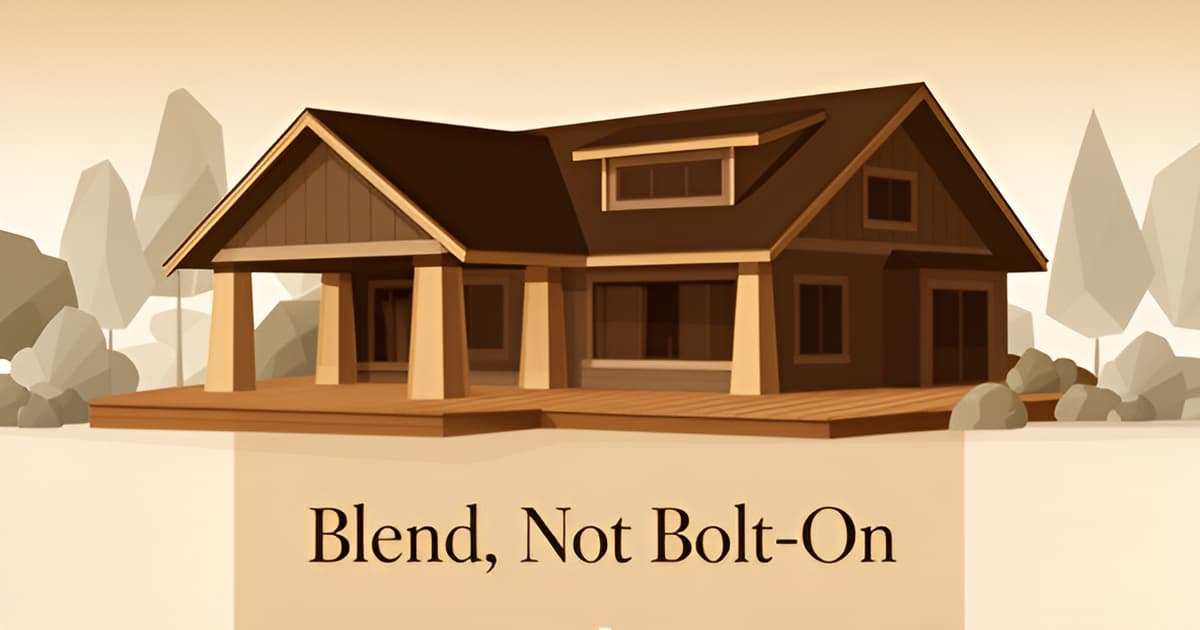
The Golden Rule of Additions: Blend, Don't Bolt On
Walk down any street in Altadena and you can spot them instantly: the houses where an addition was clearly bolted on as an afterthought. The best builders and architects agree on one core principle — a successful addition should feel like a natural extension of the original house, not a separate structure sharing a wall according to design guidance from experienced builders.
Scale is where most additions go wrong. An addition that is significantly taller, wider, or visually heavier than the original structure can look disconnected and awkward. The fix starts at the roofline: matching the pitch, eave depth, and gable orientation of the existing roof makes new massing read as part of the original design.
Materials and windows matter just as much. Matching siding, trim profiles, and window styles — including divided-light patterns and casing details — ties old and new together visually. This is especially important for Altadena's Craftsman homes, most built between 1900 and 1940, where architects specializing in the style strive to make additions feel seamless by matching new details and the scales of existing rooms.
The blending principle extends indoors, where transitions make or break the effect:
- Continue the same flooring throughout connected areas — it makes the entire space feel larger and more cohesive
- Keep trim, baseboards, and door casing consistent between old and new rooms
- Match ceiling heights and window proportions where the spaces meet
- Align sightlines so the eye travels naturally from the original house into the addition
For Craftsman homes specifically, period-appropriate details do the heavy lifting. Shaped brackets, trellises, gabled roof ends, built-in window seats, and broad trim all help a second-floor addition respect the home's original proportions. One documented case study added a partial second floor to a bungalow simply by making the roof steeper and adding dormers — a strategy that maximizes interior space without detracting from the experience in the yard.
There's a practical reason to get this right beyond aesthetics. Curb appeal drives approvals — homeowners increasingly expect photorealistic 3D visuals before committing to additions in the $75,000–$150,000 range, precisely so they can see how new massing, rooflines, and materials look from the outside before construction begins.
This is why Altadena Home Remodeling approaches every addition scoping conversation with a before/after concept render: seeing the blend first, on paper, is the cheapest way to avoid an expensive mismatch later. Scope it, price it, and see how the new massing reads against your original house — before a single footing is dug. Book a free remodel-scoping consultation to get started.
Craftsman-Specific Addition Ideas That Fit Altadena's Housing Stock
Most U.S. Craftsman homes were built between 1900 and 1940, which means Altadena's bungalows often need more space — but deserve additions that respect their proportions. The good news is that documented Craftsman case studies offer proven strategies for doing exactly that.
Second-story additions are a natural fit when a small lot rules out building outward. One documented approach makes the roof steeper and adds dormers, gaining a partial second floor without inflating the home's footprint — a strategy that optimizes every square foot while minimizing project costs. Guided by Craftsman proportions, these additions can carry shaped brackets, gabled roof ends, and broad trim so the new massing reads as original.
For single-story homes, master suites and home offices rank among the most common Craftsman addition types. A small upstairs addition paired with a wall relocation can carve out a private suite while preserving yard space — an important consideration when, as one architect puts it, successful additions "maximize interior space without detracting from the experience in the yard."
Indoor-outdoor living deserves special attention in Altadena's climate. French doors opening onto bi-level decks strengthen the connection to the garden and deliver real resale value: Cost vs. Value data shows wood deck additions recoup 95% of their cost — among the strongest returns of any addition project.
Signature Craftsman details that make additions feel authentic include:
- Built-in window seats that add charm and storage without square footage
- Shaped brackets and broad trim matched to existing millwork
- Dormers and steeper rooflines that gain usable second-floor headroom
- French doors to bi-level decks for seamless indoor-outdoor flow
One case study is especially relevant to Eaton Fire recovery: a fire-damaged bungalow that was rebuilt with a partial second floor added by steepening the roof. For Altadena homeowners rebuilding after the fire, the same wildfire-prone-area upgrades documented in that research apply — fire-resistant materials, air filtration, and energy recovery ventilators that protect indoor air quality during smoke events.
The blending principle matters as much as the ideas themselves. As one builder notes, an addition that is significantly taller, wider, or visually heavier than the original can look disconnected, so matching rooflines, window styles, and scale is non-negotiable. Altadena Home Remodeling approaches these projects with a preserve-first mindset — renovate over demolish — and can help you scope a Craftsman addition that fits both your bungalow and LA County's unincorporated-area permit requirements. If you're planning a rebuild or expansion, a free remodel-scoping consultation with a before/after concept render is the natural first step.
Design for Resale: What Actually Recoups Its Cost
Before you fall in love with a floor plan, it's worth knowing which additions actually pay you back at resale — and the 2025 data is blunt about it. A wood deck addition recoups a striking 95% of its cost, while an upscale primary suite addition recovers just 18%, according to the latest Cost vs. Value Report.
That gap tells the whole story. Smaller, midrange projects consistently outperform large, luxurious ones. A midrange primary suite addition ($170,517) recoups 32% of its cost, versus 18% for the upscale version at $351,613 — meaning the pricier suite loses nearly twice as much value per dollar spent.
Converting existing space beats building new. A basement remodel recoups 71% of its $52,012 cost, outperforming nearly every ground-up addition in the report. Eight of the top ten highest-ROI projects are exterior replacements, and Zonda's chief editor Clay DeKorne notes that large interior remodels "may be personally rewarding," but their subjective appeal rarely delivers the same return at sale time.
The practical takeaway for Altadena homeowners: if resale is a factor, favor decks, modest footprint additions, and reconfigurations of space you already own. The Craftsman case studies at Saikley Architects reinforce this — one project added usable square footage through a small upstairs addition and wall relocation, "minimizing the home's footprint and project costs" while preserving period character.
Sidebar: The Five Cost Drivers — and the Line Items Everyone Forgets
There is no universal price per square foot for an addition. Costs vary widely based on five drivers:
- Size and scope of the project
- Location and regional labor costs
- Materials and finish level
- Design complexity
- Permits and code requirements
Then come the line items that rarely make the initial spreadsheet. Structural engineering typically runs $3,000–$5,000 or more, a boundary survey costs $2,000–$3,000, and landscaping to repair the construction zone can range from $2,000 to well over $20,000. In unincorporated LA County, permitting requirements add their own review process — which is why we never guarantee timelines or permit outcomes upfront.
If you're weighing an addition for an Altadena home, a free remodel-scoping consultation from Altadena Home Remodeling includes a before/after concept render, so you can see exactly how the new massing and rooflines sit against your existing home before committing to a budget. Featured builder JMB Builders LLC (CSLB #1103479) brings documented local addition and rebuild experience to that conversation.
See It Before You Build It: Scoping Your Addition the Right Way
Imagine signing a construction contract for a six-figure addition based on a flat elevation drawing — then watching a roofline you never truly "saw" rise over your street. Homeowners increasingly expect photorealistic 3D visuals before approving addition budgets in the $75,000–$150,000 range, according to addition planning research, and the reason is simple: a lot of additions get approved on curb appeal. You need to see how the new massing, rooflines, and materials look from the outside before you commit.
That matters especially in Altadena, where Craftsman homes built largely between 1900 and 1940 dominate the streetscape. Designers who work with these homes stress that a successful addition should feel like a natural extension of the original house rather than an afterthought, matching new details and scales to the existing rooms (Saikley Architects). An addition that is significantly taller, wider, or visually heavier than the original structure can look disconnected — and that disconnection is exactly what a street-view render exposes early, when changes still cost nothing.
A disciplined scoping process in LA County's unincorporated areas typically covers:
- Site realities — setbacks, boundary surveys ($2,000–$3,000 is typical), and structural engineering, which can run $3,000–$5,000 or more (cost research)
- Massing and roofline studies — how a second story, dormers, or a steeper roof read from the street
- Material and detail matching — siding, trim, and window styles that tie new to old
- A realistic budget — there is no universal price per square foot that captures every variable
Be aware that no scope, however thorough, guarantees permit outcomes or timelines in LA County's unincorporated review process. What a good scope does is surface conflicts before drawings are stamped, and give you a render you can judge honestly. It also keeps you on the smarter side of the value data: midrange primary suite additions recoup 32% of cost versus just 18% for upscale versions, per the 2025 Cost vs. Value Report — a reminder that restraint, not square footage, protects your investment.
Altadena Home Remodeling approaches additions this way: scope it, price it, see it rendered from the street, then build once. If you're weighing a second story, master suite, or expansion of your Craftsman, a free remodel-scoping consultation with a before/after concept render shows you the street view before a single footing is dug.
Build Once, Build Right: Your Altadena Addition Starts with a Render, Not a Wrecking Ball
The numbers make the case for staying put: with the remodeling market projected at $509 billion in 2025, more Altadena homeowners are choosing to expand the Craftsman homes they already love rather than trade up. The path forward comes down to three principles — blend the addition into your home's original rooflines and details, favor midrange scale over oversized luxury, and see exactly how new massing reads from the street before committing to a six-figure budget. Whether you're adding a second story with dormers, a master suite, or a deck that recoups 95% of its cost, the cheapest mistake to make is one you catch on paper. Altadena Home Remodeling offers a free remodel-scoping consultation that includes a before/after concept render, so you can judge the street view before a single footing is dug. For rebuilds and additions alike, featured builder JMB Builders LLC (CSLB #1103479) brings preserve-first local experience to the conversation. Scope it, price it, see it — then build once, and build right.