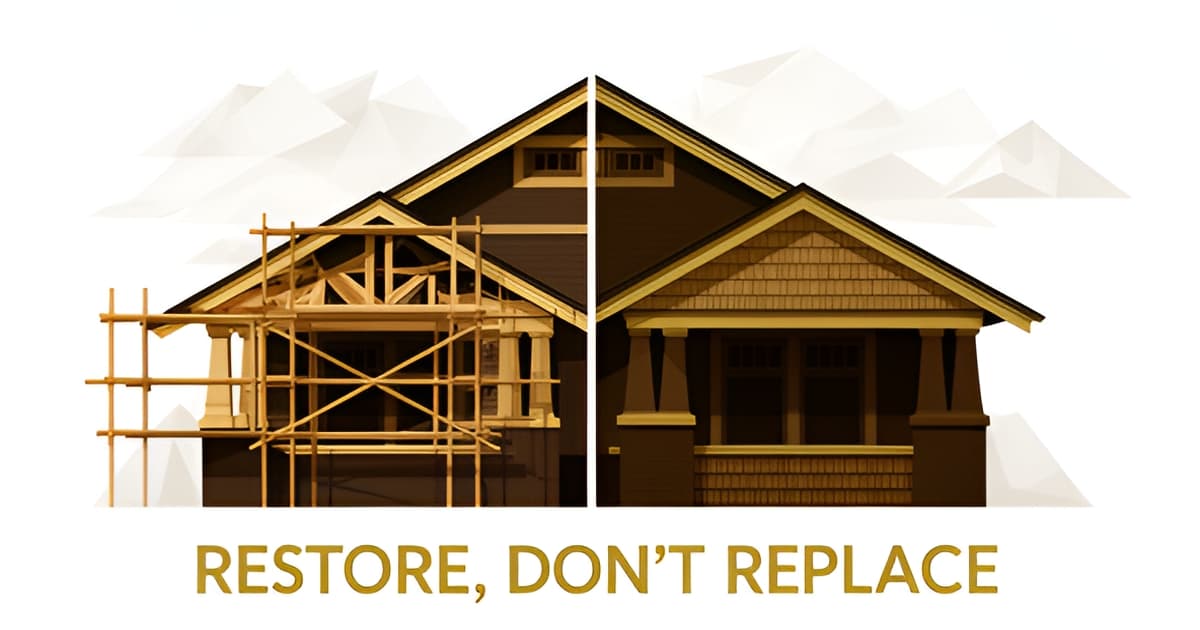
Historic Home Restoration in Altadena
Key Facts
- Altadena Craftsmans built 1905–1935 are now 90–120 years old, routinely hiding knob-and-tube wiring and lead paint behind plaster, per historic remodeling research.
- Historic restorations need a 15–20% contingency budget versus 10% for modern renovations, according to 2026 cost analysis.
- A $2,000 inspection can prevent a $50,000 surprise in a 90-year-old home, restoration cost research shows.
- A $100,000 restoration may add only $60,000–$80,000 in value — and sloppy work can reduce value below an untouched original, cost guides warn.
- Proper lime-mortar repointing lasts roughly 50 years, while poor Portland-cement work fails in about 10, per restoration cost analysis.
- Repaired historic wood windows paired with storm windows can match modern replacements' efficiency, Preservation Maryland reports.
- Historic district review can add 4–8 weeks to timelines, with permit fees of $1,000–$3,000, industry analyses find.
Why Altadena's Historic Homes Need a Rehabilitation Mindset, Not a Demo Crew
Walk through an Altadena Craftsman built between 1905 and 1935 and you're standing in a home that is 90 to 120 years old — beautiful, character-rich, and hiding a century of secrets behind its plaster walls. Knob-and-tube wiring, lead paint, corroded plumbing, and concealed rot surface routinely once work begins, according to historic remodeling cost research. That's why the first question isn't "how much?" — it's "what approach?"
Restoration, rehabilitation, or renovation? Restoration reverts a building to its original era. Renovation updates freely for modern living. Rehabilitation sits between them: converting a historic building into a liveable, usable space without detracting from its architectural relevance, as preservation practitioners define it. For Altadena's housing stock, rehabilitation is the right answer — preserve the box beams, built-ins, and tapered columns while modernizing kitchens, baths, and systems.
This is why Altadena Home Remodeling takes a renovate-over-demolish stance. The Craftsman signature elements that define these streets — woodwork, exterior brackets, tapered columns — are irreplaceable, and Craftsman remodeling guidance warns against the most common mistakes:
- Removing original woodwork and millwork
- Replacing divided-light windows with modern vinyl
- Creating overly open floor plans that disregard room transitions
There's also a hard financial warning. A 2026 cost guide notes that $100,000 spent on restoration may add only $60,000–$80,000 in value — and that a sloppy restoration using inappropriate materials can actually reduce value below an untouched original. Bad repointing with hard Portland cement mortar, for instance, causes historic brick and stone to crack and fail, while proper work lasts roughly 50 years versus about 10 for poor work.
The right materials matter as much as the right mindset. Preservation best practice calls for breathable lime mortar on historic masonry and repair-over-replacement for wood windows — it is, per Preservation Maryland's guidance, very rare to find a historic wood window that cannot be repaired. Well-repaired wood windows, paired with storm windows, can be as energy efficient as modern replacements.
None of this happens by accident. It starts with a professional conditions assessment before any demolition — identifying character-defining features early and routing new wiring and plumbing through closets, chases, and service spaces first, as systems-upgrade methodology recommends. Rehabilitation, done thoughtfully, produces a home that serves today's needs while honoring the past — and protects the value that makes Altadena's older streets worth living on in the first place.
Repair Over Replace: Protecting the Details That Make Your Craftsman a Craftsman
Walk into an Altadena Craftsman and the first things you notice are the ones a careless remodel destroys first: the coffered box beam ceiling, the oak built-in flanking the fireplace, the tapered columns on the porch. These character-defining features took master carpenters months to build in 1915. They can be ruined in an afternoon.
The preservation community's guidance is unambiguous: repair rather than replace. According to Preservation Maryland, it is "very rare to find a historic wood window which cannot be repaired" — and a well-repaired wood window, especially when paired with a storm window, can match or even exceed the energy efficiency of a modern replacement. That runs counter to the vinyl-window sales pitch, and the numbers back it up: cheap modern windows "will fail long before they ever repay themselves in reduced energy costs," while weatherstripping and air-sealing the originals is one of the most cost-effective efficiency moves a Craftsman owner can make.
Masonry demands the same discipline. Modern high-Portland-cement mortar is harder than the historic brick it surrounds and will cause old bricks and stones to crack and fail. The preservation standard is breathable lime mortar, which allows moisture to escape the wall the way the original assembly intended. Done right, repointing lasts roughly 50 years; done wrong, it can fail in about a decade — and a sloppy restoration with inappropriate materials can actually leave a home worth less than one left untouched, per cost analysis of historic restoration work.
The same repair-first logic applies to the woodwork itself. Refinishing original woodwork, restoring built-in cabinetry, and preserving tapered columns and exterior brackets consistently yield better results than ripping out and reproducing — especially since custom millwork can cost two to three times standard trim.
When new systems must go in — electrical, plumbing, HVAC — the guiding principle is simple: route new work through less significant spaces first. That means:
- Running conduit and ductwork through closets, attics, basements, and existing chases before touching finished rooms
- Documenting character-defining features — millwork, masonry, historic windows — in a conditions assessment before any demolition
- Disturbing historic fabric only when no reasonable alternative exists
- Designing installations to be reversible, so future removal causes no additional harm
The goal, as preservation contractors put it, is to make the house safer and more comfortable without treating historic materials as obstacles. At Altadena Home Remodeling, that repair-over-replace philosophy anchors every scoping consultation we facilitate — including a before/after concept render that shows how your Craftsman's box beams, built-ins, and wood windows stay exactly where they belong while the systems behind them come into this century. Featured builder JMB Builders LLC (CSLB #1103479) shares this preserve-first approach on Altadena period homes.
Budgeting the Real Numbers: Contingencies, Hidden Conditions, and Phased Sequencing
If there's one rule that separates successful historic restorations from budget disasters, it's this: expect the unexpected. A 2026 restoration guide recommends setting aside a 15–20% contingency for historic projects, compared to 10% for modern renovations — and for good reason. Once walls open up in a 90-year-old Altadena Craftsman, knob-and-tube wiring, lead paint, and deteriorated plumbing behind plaster are the norm, not the exception.
The cheapest money you'll spend is on discovery. A $2,000 inspection can prevent a $50,000 surprise, particularly when it comes to foundations — a crack that looks alarming may have been stable for 50 years, while an actively settling one could cost $3,000 to monitor or up to $30,000 to stabilize. Budget investigative work like surveys and hazardous-material testing separately from construction costs, and treat it as insurance against the unknown.
Phasing is how most owners make the numbers work. The typical restoration runs 6–12 months, and the best-preserved projects sequence work deliberately:
- Exterior envelope first — keeping rain out and addressing critical structural issues before anything else, typically 30–40% of the budget
- Systems second — electrical, plumbing, and HVAC, roughly 25–35% of costs
- Interior finishes last, at 20–30% of the budget
This sequencing also reveals why full renovations often beat piecemeal upgrades. A standalone shower conversion runs $8,000–$14,000, while a full bathroom renovation starts at $22,000 — but the partial fix leaves hidden wiring, plumbing, and subfloor problems untouched. Combining layout changes, electrical upgrades, and HVAC work during one gut renovation is more efficient and better supports resale.
On the big-ticket rooms, benchmarks vary widely by region. Kitchen renovations in historic properties range from $22,000–$65,000+ in one market study, while Portland-area Craftsman kitchen remodels run $70,000–$150,000. Window restoration by a craftsperson typically costs $150–300 per window — often less than replacement, and better for the house. Note these are general benchmarks from other markets, not Altadena quotes; every project needs its own scoping.
Finally, set honest expectations on return. A $100,000 restoration may add only $60,000–$80,000 in property value, and kitchen and bath projects typically return 50–60%. But the downside risk is real too: a sloppy restoration using inappropriate materials can reduce value below an untouched original. Renovations that preserve historical features and curb appeal tend to attract buyers and command higher prices — which is exactly why Altadena Home Remodeling advocates a scope-first approach. A free remodel-scoping consultation with a before/after concept render, working with a licensed contractor like JMB Builders LLC (CSLB #1103479), helps you sequence the work, size the contingency, and do it once, do it right.
Permits, Timing, and LA County Reality: Plan for Friction, Not Guarantees
If you've never pulled a permit in LA County unincorporated territory, assume the process will take longer and cost more than your contractor's first estimate suggests. Historic-period homes add another layer: design review and historic status checks can stretch timelines before a single wall comes down.
The numbers back this up. Historic district commissions and review boards can add 4–8 weeks to project timelines, and permit reviews in some markets have been known to drag past 8 weeks with fees running $1,000–$3,000, according to industry cost analyses. Full restorations typically run 6–12 months, with simple projects finishing in 2–4 months and major work sometimes taking years.
Before you sketch a single addition, do your homework on the property itself. Homeowners should confirm any historic district status in historic resource inventories before starting projects, since design review may be required — a step that catches many owners off guard, per guidance from Craftsman remodeling specialists. In Altadena, where many homes date to the early 1900s through the 1930s, this check matters even if your street doesn't carry a formal designation.
Here's what to scope early:
- Confirm whether your property carries any historic status or triggers design review before finalizing plans.
- Budget permit fees of roughly $1,000–$3,000 as a benchmark, understanding local fees may differ.
- Plan for review periods of 4–8+ weeks when historic considerations apply — and build slack beyond that.
- Treat the full timeline as 6–12 months for a whole-home restoration, with hidden conditions like knob-and-tube wiring or concealed rot capable of extending it.
The honest framing: nobody can guarantee a permit timeline or outcome, and any contractor who promises one is selling you something. What you can control is preparation. A thorough scoping process — like the free consultation with a before/after concept render that Altadena Home Remodeling offers — surfaces review requirements, likely friction points, and realistic sequencing before you're mid-project with a stalled permit.
Plan for friction, not guarantees. The homeowners who fare best are the ones who treat permitting as a project phase with its own budget and calendar, not a formality tacked onto the construction schedule. Working with a licensed contractor like JMB Builders LLC (CSLB #1103479), familiar with LA County unincorporated permitting, helps you scope that phase accurately from day one.
Your First Step: Scope It Before You Swing a Hammer
Every historic home hides its secrets behind plaster, and the worst time to discover them is mid-demolition. Before a single wall opens in your Altadena Craftsman, preservation professionals agree on one non-negotiable first move: a professional conditions assessment.
The logic is straightforward. According to preservation contractor methodology, that initial assessment documents materials, character-defining features, and problem areas so system routes can be planned around original millwork, windows, and masonry — not through them. The guiding principle: disturb character-defining materials only when no reasonable alternative exists.
The financial case is just as compelling. Cost research on historic restorations puts it bluntly: a $2,000 inspection can prevent a $50,000 surprise. That's because hidden conditions — knob-and-tube wiring, lead paint, corroded plumbing behind plaster — are the norm in homes of this age, not the exception. Budget 15–20% contingency for historic work versus the 10% typical of modern renovations, because surprises are a near-certainty.
A proper scoping assessment for an Altadena whole-home renovation should capture:
- Character-defining features: box beam ceilings, built-ins, tapered columns, and original windows worth repairing rather than replacing
- Hidden conditions: hazardous materials, undocumented circuits, and deteriorated plumbing or subflooring
- Phasing priorities: exterior envelope first, then systems, then finishes — the sequence that protects both budget and historic fabric
- Hazard testing: lead paint is required in pre-1978 homes, and asbestos remediation is common in pre-1980s construction
This is where Altadena Home Remodeling fits into your project. We offer a free remodel-scoping consultation that includes a before/after concept render, so you can see the rehabilitation vision before committing a dollar to construction. Because Altadena sits in unincorporated Los Angeles County, permit review adds real time to any project — scoping first means your plans and permit drawings start right, not twice. We make no timeline or permit guarantees, but we do guarantee a clear-eyed starting point.
Disclosure: our featured builder is JMB Builders LLC (CSLB #1103479), an Altadena-based licensed general contractor whose whole-home remodel and custom home work, including Eaton Fire rebuilds, is documented at jmb-builders.com. This is a paid placement.
The takeaway for any Altadena historic homeowner is simple: scope it, price it, do it once, do it right. As restoration cost analysis warns, the lowest bid rarely delivers the best outcome on historic work — and a sloppy restoration with inappropriate materials can actually reduce your home's value below an untouched original. Your 1920s bungalow deserves better than a guessing game. Start with the assessment, and let the hammer swing later.
Frequently Asked Questions
Is restoring my old Altadena Craftsman actually worth it, or should I just remodel it like a modern house?
Should I replace my original wood windows with new energy-efficient vinyl ones?
How much should I budget for surprises in a historic home renovation?
Can a bad restoration actually hurt my home's value?
How long will a historic whole-home restoration take in Altadena?
What's the smartest way to add modern electrical, plumbing, and HVAC without ruining the historic details?
Your Craftsman's Next 100 Years Start With One Honest Look Behind the Plaster
Restoring an Altadena Craftsman isn't a demolition project — it's a rehabilitation: preserving the box beams, built-ins, and tapered columns while bringing wiring, plumbing, and kitchens into this century. The principles that protect your investment are consistent. Repair over replace, from wood windows to lime mortar. Budget a 15–20% contingency, because hidden conditions in a century-old home are the norm. Phase the work — envelope, then systems, then finishes — and plan for LA County permit friction rather than hoping for guarantees. Remember that a $2,000 inspection can prevent a $50,000 surprise, and that sloppy work with wrong materials can leave your home worth less than untouched. The cheapest mistake is skipping discovery. Altadena Home Remodeling offers a free remodel-scoping consultation with a before/after concept render — working with licensed contractors like JMB Builders LLC (CSLB #1103479) — so you can scope it, price it, and do it once, do it right. Your 1915 bungalow has already lasted a century. Start with the assessment, and let the hammer swing later.