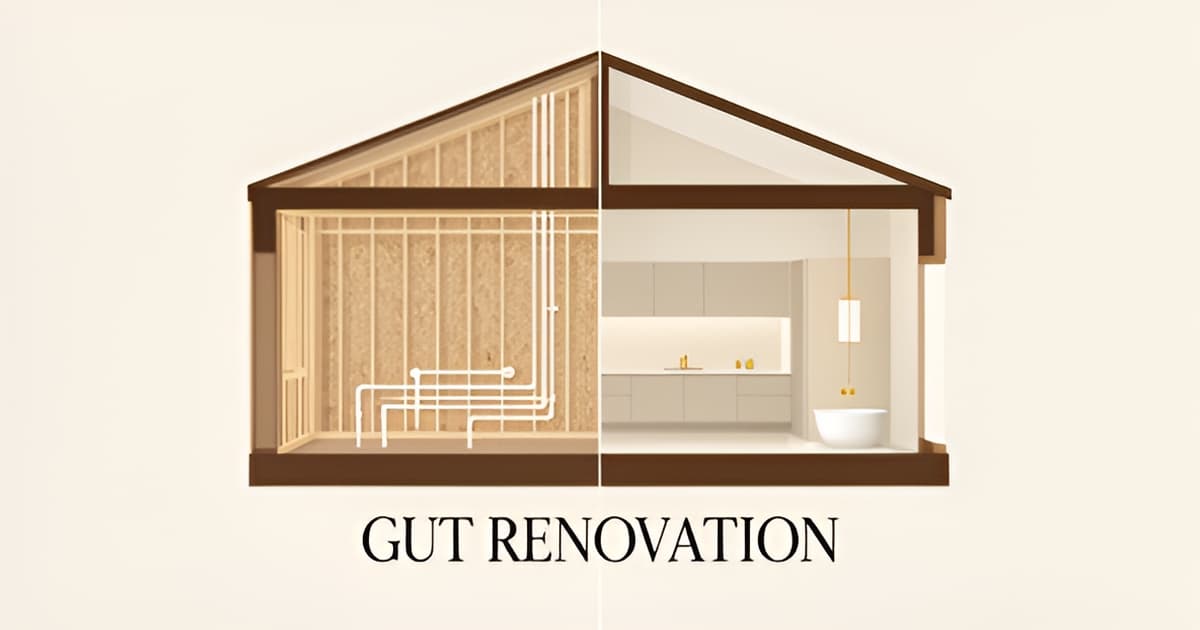
Gut Renovation in Altadena: What Gets Replaced and What Surprises Cost
Key Facts
- LA gut renovations run $150–$350 per square foot, with complex high-end work at $350–$500+, per LA cost tables.
- Demolition is the cheap part: $8–$30 per square foot, while the rebuild consumes nearly the entire budget, LA builders report.
- Wet rooms cost roughly 4x more per square foot than dry rooms — $400 versus $100, per Sweeten's LA guide.
- Rough plumbing, electrical, and HVAC quietly consume 20–30% of a gut renovation budget, per LA cost breakdowns.
- Removing pre-1960s knob-and-tube wiring runs $12,000–$36,600, per cost data.
- Older homes' hidden surprises add 10–25% or more to original estimates, remodeling analysis finds.
- Experts recommend a 15–30% contingency — $60k–$120k on a $400k project, per LA guidance.
What a Gut Renovation Actually Means (and What Gets Replaced)
Strip a house to its studs and you'll find out quickly what "gut renovation" really means: nearly everything behind the drywall gets replaced, and nearly everything you spend goes to the rebuild — not the demolition. That distinction drives every budget conversation we have with Altadena homeowners.
A true gut renovation means taking walls down to the studs and removing interior doors, trim, cabinets, and sinks, often including replacement of windows, exterior doors, and the roof, plus most or all plumbing and electrical systems, according to Sweeten's gut remodel guide. This is fundamentally different from a cosmetic remodel — new finishes, fixtures, and paint over existing systems. A gut reno replaces the machinery of the house: electrical service upgrades to 200–400 amps, copper repiping, full HVAC replacement, and often structural changes like load-bearing wall removal, per LA design-build cost guidance.
Here's the counterintuitive part: demolition is cheap. Tearing out the old interior runs just $8–$30 per square foot in the LA area, while the rebuild costs $150–$350 per square foot — and $350–$500+ for complex, high-end work, per Quality First Builders' LA cost tables. The rebuild, not the demo, is where the budget goes. Rough plumbing, electrical, and HVAC alone represent 20–30% of a gut renovation budget, while finishes account for 30–45%.
For planning purposes, LA-area benchmarks by home size look like this:
- 1,500 sq. ft.: $225k–$525k, with complex or high-end work at $525k–$750k+
- 2,000 sq. ft.: $300k–$700k, with complex or high-end work at $700k–$1M+
- 2,500 sq. ft.: $375k–$875k, with complex or high-end work at $875k–$1.25M+
These are planning ranges, not bids — and Altadena's older housing stock sits squarely in the range where surprises are the norm. Pre-1970s LA homes routinely hide knob-and-tube wiring, undersized electrical service, original lath, and unpermitted work behind the walls, and unexpected issues can add 10–25% or more to the original estimate.
Wet rooms concentrate the cost. Kitchens and baths start around $400 per square foot versus roughly $100 for dry rooms — about 4x more per square foot, per Sweeten's LA per-square-foot cost guide. A kitchen gut alone runs $60k–$150k+, a bathroom $25k–$60k+.
The decision framework matters too: a full gut makes sense when the shell, footprint, and structure are worth keeping. When the shell creates too many compromises, teardown and rebuild often wins financially. At Altadena Home Remodeling, we help homeowners scope that distinction honestly — because the goal is to price the whole project once, and do it right the first time.
The Surprise Engine: Hidden Systems and Older-Home Costs Behind Altadena's Walls
The walls come down, and suddenly your budget has a new author. In Altadena's older housing stock, the surprises that derail gut renovations almost never come from the finishes you picked — they come from the systems you can't see.
Pre-1970s Los Angeles homes carry "surprises behind every wall — knob-and-tube, original lath, undersized service," according to LA design-build guidance. Rough plumbing, electrical, and HVAC can represent 20–30% of a gut renovation budget — money spent entirely behind the drywall before a single tile is set, per LA cost breakdowns.
The headline offender is knob-and-tube wiring, common in pre-1960s homes. Removing it runs $12,000–$36,600, and undersized 100-amp panels often need upgrading too — typically $518–$2,191, but up to $4,500 with breaker box replacement or amperage expansion, per cost data from Homes.com. Whole-home rewiring in the LA area can reach $15k–$50k+.
The other frequent finds behind Altadena's walls:
- Mold, water damage, and rot — $1,000–$5,000 for small discoveries, $10k–$50k+ when broad
- Asbestos abatement — several thousand to tens of thousands of dollars, adding 1–3+ weeks
- Unpermitted past work — $2k–$25k+ to correct, more if structural
- Old wiring and plumbing corrections — $15k–$60k+ on large jobs
Foundation type quietly shapes your budget too. Homes on raised foundations let crews access rough plumbing from the crawlspace, while slab-on-grade homes require saw cuts, trenching, and backfill whenever fixtures move — a meaningful premium on the same floor plan, per Sweeten's LA renovation cost guide.
This is also why kitchens and bathrooms dominate the budget: wet rooms start around $400 per square foot versus roughly $100 for dry rooms — about 4x more per square foot — because moving water, drain, gas, and vent lines costs $5k–$25k+ per area.
Put it together and unexpected issues can add 10–25% or more to the original estimate, per remodeling cost analysis. On a $400k project, a 15–30% contingency equals $60k–$120k. As one contractor puts it, the contingency "is protection against stopping the project when the house reveals something real."
That's why Altadena Home Remodeling scopes the invisible systems — electrical service, repipe, HVAC, foundation access — before quoting finishes. The house will tell you what it needs either way; the only question is whether you've budgeted to listen.
Building a Budget That Survives What the Walls Reveal
The most expensive line in any Altadena gut renovation budget is the one you didn't write down. Walls opened in pre-1970s LA homes routinely reveal knob-and-tube wiring, undersized electrical service, and unpermitted past work — and unexpected issues can add 10–25% or more to the original estimate, according to LA cost benchmarks.
That's why experienced budgeters build the contingency first, not last. For older Los Angeles homes, planning guidance recommends a 15–30% reserve — meaning $60,000 to $120,000 set aside on a $400,000 project. As one practitioner puts it, the contingency is protection against stopping the project when the house reveals something real.
Price the invisible systems explicitly before you price a single finish. Rough plumbing, electrical, and HVAC typically represent 20–30% of a gut budget, with whole-home rewiring running $15k–$50k+, plumbing replacement $15k–$60k+, and HVAC replacement $12k–$35k+. If a bid treats these as afterthoughts, the bid is wrong.
- Electrical service upgrade to 200–400A, including panel replacement if the home still runs on 100 amps
- Copper repipe and drain replacement, especially if original galvanized lines remain
- Full HVAC replacement with new ductwork, not just condenser swaps
- Insulation upgrades — pre-2005 homes often fall below current energy standards
Budget for the permit and code cascade as its own line. LA-area permits range from $500–$1,000 for express kitchen/bath work to $5,000–$20,000 for major structural projects, and LA renovations must also account for LADBS fees, Title 24 2025 energy compliance, and seismic requirements. Pulling a permit can also trigger whole-house fixes — an inspector may require every smoke alarm brought to code once work touches a related area, per renovation cost reporting.
Finally, scrutinize any bid that looks too good. A construction team offering an unusually low estimate may be excluding critical scope items — the repipe, the panel upgrade, the permit fees — and those exclusions surface as change orders later. A low bid is often a scope question in disguise. At Altadena Home Remodeling, we scope it, price it, and build it once — because the alternative is paying for it twice.
Gut or Teardown? Making the Call and Sequencing the Project Right
The hardest decision in any Altadena whole-home project isn't the countertop — it's whether the house itself is worth keeping. Get this call wrong and every dollar after it is compromised.
The rule of thumb is simple: gut when the shell earns its keep. A full gut renovation makes sense when the shell, footprint, and structure are still worth saving, according to LA-area cost guidance. If the foundation is sound, the roofline works, and the layout only needs opening rather than rebuilding, a gut delivers most of the benefit of new construction without the teardown premium.
When the compromises pile up, rebuild instead. A house riddled with structural problems often makes new construction the smarter financial move — a home "riddled with problems" stops being a renovation candidate and becomes a land-value proposition. If you're correcting the foundation, fighting the footprint, and replacing nearly every system anyway, the shell is no longer an asset.
Once the decision is made, sequence matters as much as scope. Realistic planning looks like this:
- Timeline: 6–12+ months from planning to finish, with construction alone running 4–8+ months.
- Order cabinets, windows, and tile early — material lead times run 6–12+ weeks, and supply backlogs push late orders to the back of the queue.
- Sign your contractor early to lock in material prices before backlogs raise them.
- Budget a 15–30% contingency for older LA homes — on a $400k project, that's $60k–$120k set aside.
The material-ordering point deserves emphasis. Waiting to order means higher prices and back-of-the-queue delivery slots, per Sweeten's LA cost guide — a delay that quietly stretches a 6-month project into a 9-month one while your crew waits on a window package.
Be honest about living arrangements, too. Staying in the home during a gut renovation is possible, but Sweeten's guidance is blunt: nearly any other plan is preferable. If demolition reveals structural issues, mold, or asbestos, occupants may be forced out regardless — so plan for temporary housing from day one rather than hoping for the best.
Altadena Home Remodeling approaches this decision the same way we'd advise any neighbor: scope it fully, price it honestly, and commit once. A clear-eyed gut-vs-rebuild call, made before demo day, is what separates a project done once and done right from one done twice.
Your Altadena Gut Renovation Game Plan
Every gut renovation budget survives or dies before demolition day. The homeowners who avoid six-figure surprises are the ones who scope the invisible systems first and do their diligence while the walls are still standing.
Start with pre-construction diligence. As one remodeling professional puts it, drawing plans and walking the site with your subcontractors is a sizable investment of time, but it is essential if you want to cut down on unexpected costs. On Altadena's older housing stock, that walk-through is where you find out whether you are facing knob-and-tube wiring, undersized electrical service, or unpermitted past work before they become mid-project change orders.
Next, price the systems that drive the budget — not the finishes you can see in a showroom. Rough plumbing, electrical, and HVAC can represent 20–30% of a gut renovation budget, and wet rooms like kitchens and baths start around $400 per square foot versus roughly $100 for dry rooms, according to LA-area cost benchmarks. Your scope checklist should price these first:
- Electrical service upgrade (200–400A) and whole-home rewiring: $15k–$50k+
- Copper repipe and plumbing replacement: $15k–$60k+
- HVAC replacement and ductwork: $12k–$35k+
- Structural changes to load-bearing walls: $10k–$40k+ per change
- Permits and code compliance, including Title 24 energy requirements and seismic standards
Then run the contingency math on your own square footage. For an older LA home, contractor guidance recommends a 15–30% contingency — on a $400k renovation, that means setting aside $60,000 to $120,000. Unexpected issues in older homes routinely add 10–25% or more to original estimates, so treat this as a real budget line, not a wish. If your contingency is what keeps the project moving when the house reveals something real, it is the cheapest insurance you will ever buy.
Finally, lock in your contractor and material orders early. Supply backlogs mean waiting leads to higher prices and back-of-the-queue orders, and material lead times of 6–12+ weeks for cabinets, windows, and tile can stall a project that is otherwise ready to move.
This is exactly why Altadena Home Remodeling starts every whole-home renovation with a scoped, priced plan rather than a ballpark number. You get the systems priced, the surprises anticipated, and the contingency set before a single wall comes down. Scope it, price it, do it once, do it right.
Frequently Asked Questions
How much does a gut renovation actually cost in the Altadena / LA area?
Why is demolition so cheap compared to the rebuild?
What hidden problems should I expect in an older Altadena home?
How big should my contingency budget be for a gut renovation?
Should I gut renovate my house or just tear it down and rebuild?
Why do kitchens and bathrooms cost so much more than other rooms?
Can I live in my house during a gut renovation?
The Walls Will Talk — Make Sure Your Budget Is Listening
A gut renovation in Altadena isn't really a demolition project — it's a rebuild project, with $150–$350 per square foot going into new systems behind the drywall and only $8–$30 per square foot coming out. The homeowners who come out ahead are the ones who scope the invisible systems first: electrical service, repipe, HVAC, and the 15–30% contingency that keeps the project moving when an older home reveals knob-and-tube wiring or unpermitted work — surprises that routinely add 10–25% or more to original estimates, per LA remodeling cost analysis. Your next steps are concrete: walk the site before demo, price systems before finishes, run the contingency math on your own square footage, and lock in materials early given 6–12+ week lead times. That's exactly how Altadena Home Remodeling approaches every whole-home project — scope it, price it, do it once, do it right. If you're weighing a gut renovation against a rebuild, start with a scoped, priced plan before a single wall comes down.