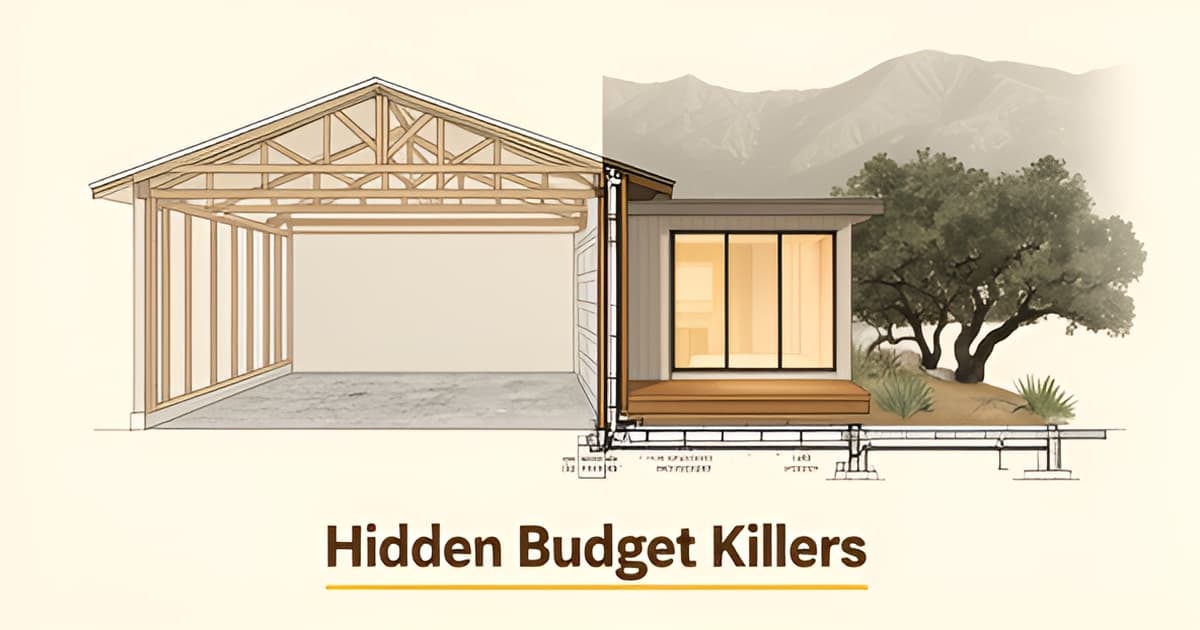
Garage to ADU Cost in Altadena: What Drives the Budget Up
Key Facts
- Garage conversions cost 30–50% less than detached ADU builds, but only when the existing garage cooperates.
- Statewide planning ranges put all-in garage conversion ADUs at $100,000–$175,000, per ADU cost research.
- Structural retrofit on pre-1970 garages adds $5,000–$25K, with hillside engineered foundations adding up to $60K, per cost-calibration data.
- Combined sewer, water, electrical, and gas upgrades on pre-1980 LA parcels often total $15,000–$50K, according to ADU cost research.
- First bids run 15–30% below final all-in cost because they omit soft costs and change-order categories, per bidding-pattern research.
- Code-triggered corrections can turn a $60K project into $120K once Title 24, egress, and fire separation arrive, per practitioner guides.
- Roughly 1 in 7 ADU feasibility assessments concludes the right answer is to wait or not build, according to ADUscale.
Introduction
Every homeowner in Altadena has heard the same pitch: converting your garage into an ADU is the cheapest way to add housing in California. The pitch is true — right up until the first wall opens. A garage conversion can cost 30–50% less than a detached new build, but only when the garage itself cooperates, meaning a sound slab, adequate ceiling height, a short run to the sewer, and an electrical panel with room to spare. When any of those conditions fails, the "cheap option quietly turns into a teardown with extra steps."
The numbers tell a story of wide disagreement. Statewide planning ranges put all-in garage conversion costs at $100,000–$175,000, with LA-area hard costs running $150–$300 per square foot, according to ADU industry cost research. Meanwhile, an Altadena-specific contractor estimate puts local conversions at $45,000–$95,000 — with older garages often landing in the $80K–$110K+ tier once upgrades surface. Both figures can't describe the same project, and understanding why they diverge is exactly what this guide covers.
That divergence comes down to what the baseline quote assumes. Most first bids price the physical work on a clean lot with the simplest assumptions — and skip the categories that turn into change orders. In Altadena, where many garages were built decades ago on hillside-adjacent parcels, those skipped categories are not hypothetical. Once work begins, it's common to find cracked slabs, outdated wiring, and unpermitted past modifications.
Three forces consistently push budgets upward here:
- Foundation condition — structural retrofit on pre-1970 garages adds $5,000–$25K, and hillside lots requiring engineered foundations can add $20,000–$60K.
- Utility connections — combined sewer, water, electrical, and gas upgrades on pre-1980 LA parcels often total $15,000–$50K, routinely omitted from first bids.
- Code-triggered corrections — a change of occupancy triggers Title 24 insulation, egress windows, and fire separation; a $60K project can become $120K once these arrive.
One honest caveat: no source we reviewed provides Altadena-specific WUI fire-hardening material costs, so we won't quote unsourced numbers there — we recommend scoping that pricing directly. This guide walks through each cost driver with documented ranges, explains why first bids typically run 15–30% below final all-in cost, and shows how to scope a project so you can do it once and do it right. At Altadena Home Remodeling, we offer a free remodel-scoping consultation with a before/after concept render for exactly that purpose.
Key Concepts
Garage conversions earn their reputation as California's cheapest ADU path — until the slab, the sewer, or the electrical panel disagrees. The price everyone quotes assumes "a sound slab, decent ceiling height, a short run to the sewer, a panel with room left in it," as one practitioner guide puts it. When those conditions fail, the cheap option quietly becomes a teardown with extra steps.
The numbers tell two stories. Statewide planning ranges put all-in garage conversion ADUs at $100,000–$175,000, with LA-area hard costs of $150–$300 per square foot, while an Altadena-specific source cites $45,000–$95,000, with older garages often landing in the $80K–$110K+ tier once upgrades surface. The lower figure covers garage conversions broadly; the higher figures reflect full ADU requirements — treat both as planning ranges, not bids.
Three conditions decide which end of the range you land on:
- Foundation condition. Garage slabs slope toward the door and rarely have vapor barriers; cracked slabs and shallow footings push structural work to $5K–$15K, and pre-1970 retrofits add $5K–$25K.
- Hillside terrain. Slope lots can require engineered foundations and soils reports adding $20K–$60K, with hillside ADUs in LA's Hillside Construction Regulation areas running $500–$700 per square foot.
- Utility distance. Sewer lateral tie-ins run $8K–$20K, and combined utility upgrades on pre-1980 LA parcels often total $15K–$50K — costs routinely omitted from first bids.
Slab plumbing deserves special attention. Cutting concrete and trenching to the sewer lateral is "the single biggest cost swing" in a garage conversion, and it depends on a distance you cannot see from the driveway. Price the sewer run before anything else.
Code-triggered upgrades — not finishes — are where budgets blow up. A change of occupancy triggers Title 24 insulation requirements, egress windows, fire separation, and panel upgrades; a project priced at $60K can become $120K once corrections arrive. The garage door opening is the most commonly underestimated line, since the widest span in the building needs a real header and often new footings.
One honest caveat: this research surfaced no Altadena-specific cost data for WUI (Wildland-Urban Interface) fire-hardening materials, so we won't quote figures we can't back. The closest documented requirement is the 1-hour fire-rated separation for attached conversions under CRC R302.6. WUI material pricing should be scoped for your specific property.
Finally, expect first bids to run 15–30% below final all-in cost, since they typically omit soft costs (12–18% of total), contingency, and change-order categories. Plan a 10–15% contingency from day one. At Altadena Home Remodeling, our free scoping consultation with a before/after concept render exists precisely to surface these conditions — foundation, utilities, ceiling height — before you commit to a number.
Best Practices
Most budget blowups on garage-to-ADU projects aren't caused by the work you can see — they're caused by the assumptions baked into the first bid. Follow these practices and you'll walk in with your eyes open.
Price the sewer distance before anything else. Slab plumbing — cutting concrete and trenching to the lateral — is what one practitioner guide calls the single biggest cost swing in a garage conversion, because it depends on a distance you cannot judge from the driveway. Sewer lateral tie-ins run $8,000–$20,000, and combined utility upgrades on pre-1980 LA parcels often total $15,000–$50,000, according to ADU cost-calibration data.
Get the slab and framing inspected before you commit. Many Altadena garages were built decades ago, and local contractors report that cracked slabs, outdated wiring, and unpermitted past modifications routinely surface once work begins. Structural retrofit on a pre-1970 garage adds $5,000–$25,000, and hillside lots can push foundations $20,000–$60K higher with engineered pier-and-beam systems.
Treat the first bid as a floor, not a ceiling. Research on contractor bidding patterns finds first bids run 15–30% below final all-in cost — not from bad faith, but because bids quote the physical work under the simplest assumptions and skip the categories that become change orders. Budget a 10–15% contingency from day one.
Before you sign anything, verify these make-or-break conditions:
- Ceiling height — CRC R305.1 requires at least 7 feet habitable; below about 7'6" to framing, the math stops working.
- Panel capacity — a 100-amp subpanel runs $5,000–$12,000, and a full upgrade changes the budget.
- Garage door opening — the widest span in the building needs a real header and often new footings.
- Fire separation — attached conversions require 1-hour fire-rated construction under CRC R302.6.
One honest caveat: none of the available cost data covers WUI fire-hardening materials for Altadena specifically. If your parcel sits in a fire-hazard zone, get that pricing scoped individually rather than relying on any published range.
Finally, know when not to build. Roughly one in seven feasibility assessments conclude the numbers land high enough that the right answer is "wait" or "don't build." Altadena Home Remodeling approaches conversions the same way — scope it, price it, do it once, do it right. A free scoping consultation with a before/after concept render shows whether your existing garage is worth preserving before you spend a dollar on plans.
Implementation
Turning a garage into a legal ADU looks straightforward on paper, but the budget lives in the details you can't see from the driveway. The practical path forward is to verify the four assumptions every baseline quote depends on — a sound slab, adequate ceiling height, a short sewer run, and panel capacity — before committing to a number.
Start with the slab and structure. Garage slabs typically slope toward the door and lack vapor barriers, and cracked slabs or shallow footings push foundation work into the $5,000–$15,000 range, according to garage conversion cost research. For pre-1970 garages, structural retrofit adds another $5K–$25K. In Altadena's hillside areas, engineered foundations with soils reports and slope analysis can add $20K–$60K, so a geotechnical check early is worth far more than a surprise mid-build.
Next, price the sewer run before anything else. Practitioners call slab plumbing "the single biggest cost swing" in a conversion, because trenching distance to the lateral is invisible until you dig (ADU Wizard). Sewer lateral tie-ins run $8,000–$20,000, and combined utility upgrades on pre-1980 LA parcels — sewer, water, electrical, gas — often total $15K–$50K. On older Altadena lots, assume the high end until verified.
Then pressure-test your bids. First bids run 15–30% below final all-in cost because they routinely omit soft costs, contingency, and change-order categories like structural corrections. Budget accordingly:
- Add a 10–15% contingency, the range recommended for Altadena projects where hidden slab, wiring, and drainage conditions commonly surface.
- Confirm the garage door opening is engineered — it's the widest span in the building and the most commonly underestimated line item.
- Verify ceiling height against the 7-foot habitable minimum; garages under roughly 7'6" to the framing may be a dealbreaker.
- Ask explicitly whether WUI fire-hardening materials are priced — published sources don't provide Altadena-specific WUI cost data, so get it scoped rather than assumed. Attached conversions do require 1-hour fire-rated separation under CRC R302.6.
Finally, reconcile the conflicting numbers honestly. An Altadena-specific contractor guide cites $45,000–$95,000, while statewide ADU planning ranges run $100,000–$175,000 all-in. Treat both as planning ranges, not bids — and remember that roughly one in seven feasibility assessments concludes the right answer is "don't build."
This is exactly how we approach scoping at Altadena Home Remodeling: verify the slab, the sewer, the panel, and the code triggers before quoting. Our featured builder, JMB Builders LLC (CSLB #1103479), builds ADUs and whole-home remodels across Altadena. Request a free remodel-scoping consultation with a before/after concept render, and scope it once — price it once, do it right.
Conclusion
The cheapest ADU in Altadena is only cheap if your garage cooperates. Every planning range we've covered — from the $45,000–$95,000 local estimates to the $100,000–$175,000 statewide all-in figures — assumes a sound slab, adequate ceiling height, a short sewer run, and a panel with room to spare. When those assumptions fail, the cheap option quietly becomes a teardown with extra steps.
The budget drivers are consistent across sources, and Altadena's older housing stock makes them especially relevant. Foundation and structural corrections run $5,000–$25,000 on pre-1970 garages, and hillside engineered foundations can add $20,000–$60,000, according to ADU cost research. Utilities are the other documented swing factor: combined upgrades on pre-1980 LA parcels often total $15,000–$50,000 and are routinely omitted from first bids.
One honest caveat: no source in our research provides Altadena-specific WUI fire-hardening material costs. The only adjacent data point is the 1-hour fire-rated separation required for attached conversions under CRC R302.6, per ADU planning guides. If your property sits in a fire zone, treat WUI material pricing as a line item to scope with a professional — not a number to estimate.
Before you commit to a conversion, do these three things:
- Price the sewer run first — practitioners call slab plumbing "the single biggest cost swing," and it depends on a distance you can't see from the driveway.
- Hold a 10–15% contingency, since first bids typically run 15–30% below final all-in cost.
- Verify ceiling height before anything else — anything under about 7'6" to framing is a likely dealbreaker under habitability code.
Sometimes the right answer is "don't build" — roughly 1 in 7 feasibility assessments reach that conclusion. That's not a failure; it's the scoping process doing its job. Altadena Home Remodeling exists to help you get that answer before you've spent six figures finding it the hard way. Scope it, price it, do it once, do it right.
Ready to find out whether your garage is one of the cooperative ones? Book a free remodel-scoping consultation with a before/after concept render, and see your conversion — or your whole-home remodel — mapped out before you spend a dollar on construction.
The Cheap ADU Is Only Cheap If Your Garage Cooperates
Every planning range you'll encounter — from the $45,000–$95,000 local estimates to the $100,000–$175,000 statewide figures — assumes a sound slab, adequate ceiling height, a short sewer run, and a panel with room to spare. When those assumptions fail, the cheap option quietly becomes a teardown with extra steps. The documented drivers are consistent: structural retrofit on pre-1970 garages runs $5,000–$25,000, hillside engineered foundations can add $20,000–$60,000, and combined utility upgrades on pre-1980 LA parcels often total $15,000–$50,000 — costs routinely omitted from first bids, which run 15–30% below final all-in cost. So before you commit to a number: price the sewer run first, inspect the slab and framing, hold a 10–15% contingency, and verify ceiling height. And if your parcel sits in a fire-hazard zone, get WUI fire-hardening pricing scoped individually — no published source covers it for Altadena. Sometimes the honest answer is "don't build," and roughly 1 in 7 feasibility assessments land there. That's not a failure; that's scoping done right. Altadena Home Remodeling offers a free remodel-scoping consultation with a before/after concept render so you can find out whether your garage is one of the cooperative ones — before you spend a dollar on construction.