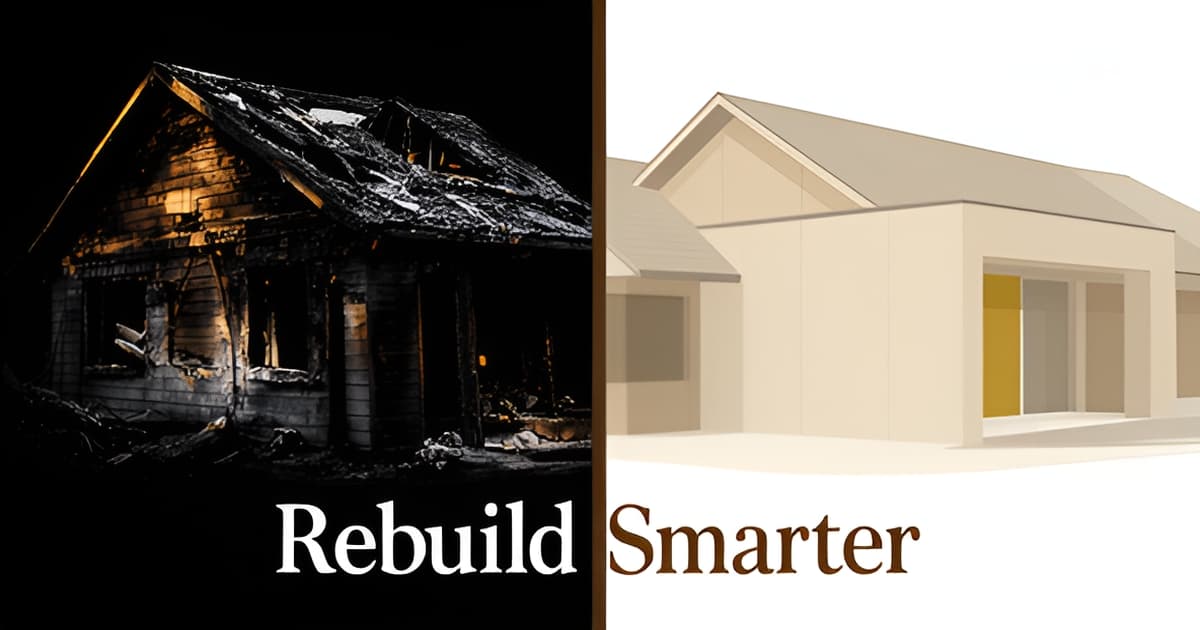
Fire Rebuild Design: Layout Choices That Cut Rebuild Costs
Key Facts
- Wildfire-resistant construction cost 2% less than typical construction in a Headwaters Economics and IBHS study.
- Fiber-cement siding saved $12,190 — 25% — versus cedar on the model home, per the Headwaters cost analysis.
- Retrofitting an exterior wall after construction costs $40,750, according to Headwaters Economics.
- Rebuilding a 1,500 sq ft home costs about $750,000 versus $607,000 in average Altadena coverage, a gap exceeding $140,000.
- Only 23 of nearly 6,000 significantly damaged Altadena homes had completed rebuilding as of December 2025, per Catalyst California's tracking report.
- Prefabricated homes cost $90,000–$200,000 versus $500,000–$1,000,000 for comparable site-built homes and installed in four weeks, per the California Community Foundation.
- Six of ten intact, remediated homes tested remained uninhabitable due to elevated lead or asbestos, according to Catalyst California.
The Altadena Rebuild Math Problem: Costs Exceed Coverage
If you're rebuilding after the Eaton Fire, the numbers likely don't add up on paper. At a benchmark of roughly $500 per square foot, replacing a 1,500 sq ft home costs about $750,000 — while the average Altadena insurance coverage was $607,000 in 2023, leaving a shortfall of more than $140,000 before you've paid for a month of temporary housing.
That gap explains why progress across the community has been so slow. As of December 2025, only 23 of nearly 6,000 significantly damaged homes had completed rebuilding, and just 43% of owners had applied for or received permits. Six months after the fire, county records showed just over seven dozen rebuilding permits issued — a system straining under 13,621 permit filings in 2025, a 35-fold jump in new residential applications over the prior year.
For most homeowners, then, the real question isn't whether to rebuild — it's how to close a five-figure gap through smarter decisions. This is where design choices matter more than most people realize. The good news, backed by hard data, is that cost control and fire resilience point in the same direction.
A study by Headwaters Economics and IBHS modeled a 2,500 sq ft home and found wildfire-resistant construction came in 2% less than typical construction overall. Fiber-cement siding saved $12,190 — 25% — compared to cedar. The same research showed why getting these decisions right at design time matters: retrofitting an exterior wall after the fact costs $40,750, versus saving money by specifying resilient materials from the start.
The practical levers available to Altadena homeowners include:
- Right-sizing square footage, since every 100 sq ft at the $500/sq ft benchmark adds roughly $50,000 to the rebuild bill
- Choosing fiber-cement siding and designing the roof, exterior walls, deck, and 5-foot noncombustible landscaping zone to code from day one
- Considering pre-approved or catalog plans, which architects say give homeowners "a head start" through the permitting bottleneck
- Exploring prefab ADUs as interim housing during the primary rebuild, then converting them to family space or rentals
There's also a long-term angle: fire-hardened homes can qualify for insurance benefits and stacked incentives, and homes showing vulnerabilities like unprotected vents tend to carry higher insurance premiums. At Altadena Home Remodeling, we've seen that the families who scope their rebuild carefully — before committing to a plan — are the ones who find the design trade-offs that shrink that $140,000 gap instead of widening it. A free scoping consultation with a before/after concept render is a low-risk way to test whether your coverage, your lot, and your wish list can actually meet in the middle.
The Counterintuitive Research: Fire-Resistant Design Costs Less, Retrofitting Costs More
Most rebuild budgets assume fire-resistant construction costs more. The research says the opposite — and the gap between building it right and retrofitting it later is the single biggest cost lever in your rebuild.
A joint study by Headwaters Economics and the Insurance Institute for Business & Home Safety found that a home built with wildfire-resistant materials and design features came in 2% less expensive than typical construction — what researchers called "negligible cost differences." The perceived cost premium of fire-resistant codes has long been a barrier to adoption, but as retired CAL FIRE Staff Chief David Shew noted, this is "the first time we've had a truly scientific answer" to the cost question, according to the IBHS report.
The component-level numbers tell a more nuanced story. Some features cost more; one saves significantly. Fiber-cement siding came in $12,190 (25%) cheaper than cedar siding on the model home, while roof hardening added $5,860 and a fire-resistant deck added $1,850, per the Headwaters cost analysis. The five-foot noncombustible rock-mulch zone around the home added $2,570 — a small price for the area ignition experts identify as most critical.
The real cost story is what happens when you defer these choices. Retrofitting the same exterior wall after the home is built costs $40,750 — versus $12,190 in savings when fiber-cement is specified at design time. A roof retrofit runs $22,010. That asymmetry is why Altadena rebuilders, including local contractor JMB Builders in its Eaton Fire rebuild guide, advise designing to California's WUI/Title 24 code from day one rather than retrofitting plans later.
For Altadena homeowners weighing a whole-home renovation or rebuild, the practical takeaways are clear:
- Specify fiber-cement siding at design time — it saves money outright, not just relative to retrofitting.
- Bundle roof, deck, and near-home landscaping decisions into the initial spec, where the incremental cost is modest.
- Treat the 5-foot noncombustible zone as a layout decision, not an afterthought — it shapes hardscape and planting plans.
- Document hardened features with photos, receipts, and inspection reports to support insurance and incentive conversations.
The design phase is when fire resistance is cheapest. Every dollar of hardening specified on paper costs a fraction of what the same protection costs to bolt on later — and in a market where rebuild costs already outpace average insurance coverage, that margin matters.
Design Choices That Pay You Back: Envelope, Insurance, and Incentives
The right design choices don't just protect your home — they can pay you back for years after move-in day. A scientific study by IBHS and Headwaters Economics found wildfire-resistant construction cost 2% less than typical construction overall, upending the assumption that fire hardening carries a premium.
The biggest single win is the envelope. Fiber-cement siding saved $12,190 (25%) versus cedar in the Headwaters model-home analysis, while a retrofit exterior wall would have cost $40,750 — meaning building right the first time is dramatically cheaper than upgrading later.
Airtight construction serves double duty in Altadena. According to Passive House California, an airtight envelope is "the biggest saving-factor here in California," because it cuts energy costs while limiting the cracks and openings where embers can intrude. Architect Christian Kienapfel notes that a typical building has many gaps where embers enter, while a Passive House building limits those openings.
Fire-hardened design can also influence your insurance picture. Homes showing vulnerabilities — unprotected vents, combustible materials within five feet of the structure, debris accumulation — are more likely to carry higher premiums, and aligning upgrades with IBHS Wildfire Prepared Home standards is identified as a path toward potentially reducing California FAIR Plan premiums. Be honest with yourself here: not every upgrade yields immediate savings, and no source quantifies exact premium reductions. A system-based approach beats piecemeal fixes.
Documentation is what turns upgrades into leverage. Keep a file from day one:
- Photos of every hardened component during and after installation
- Receipts for fire-resistant materials and fixtures
- Inspection reports verifying code compliance
- Records of the 5-foot noncombustible landscaping zone
Finally, stack the money that's available. Fire-hardened homes can qualify for insurance benefits and stacked incentives — federal, state, county, and utility programs — plus LA County fee waivers that reduce soft costs. Given that rebuild costs (~$500/sq ft) exceed average Altadena insurance coverage ($607,000) by more than $140,000 per Catalyst California, every dollar of offset matters.
At Altadena Home Remodeling, we help homeowners scope rebuilds with these paybacks built in from the start. Request a free remodel-scoping consultation with a before/after concept render, and work with our featured builder, JMB Builders LLC (CSLB #1103479), to design once — and let the envelope, insurance posture, and incentives do the rest.
Practical Paths: Pre-Approved Plans, Modular Options, and Phased Rebuilds
Rebuilding after the Eaton Fire is a race between your budget and your patience — and the fastest way to win it is choosing a build strategy that shortcuts the usual bottlenecks. With only 23 of nearly 6,000 significantly damaged homes fully rebuilt as of December 2025, per Catalyst California's tracking report, Altadena families need every acceleration tool available.
Pre-approved plans cut through the permit logjam. The Foothill Catalog Foundation is creating pre-approved home plans specifically to speed up permitting, and architects involved note the pre-approval process "really gets people that much further in the process" — a meaningful edge when county records showed just over seven dozen rebuilding permits issued six months post-fire. A similar free catalog of resilient designs came out of the Passive House California competition for Altadena and Pacific Palisades rebuilds.
Modular and prefab builds shrink the cost gap dramatically. Prefabricated homes run $90,000–$200,000, compared to $500,000–$1,000,000 for comparable site-built construction, and showcased units were installed in four weeks, per the California Community Foundation's modular showcase. A prefab ADU can serve as interim housing while the main rebuild proceeds, then convert to family space or a rental — spreading costs across years instead of months.
Whichever path you choose, budget for the realities of a foothill lot before design is finalized:
- Grading and geotechnical work for sloped lots — a flat-lot budget transplanted onto a foothill lot will be wrong every time, as JMB Builders' rebuild guide puts it
- Independent soil testing before pouring a foundation, since lead levels remained above residential standards at many properties even after debris removal
- Design to the WUI/Title 24 code effective January 1, 2026 from day one, rather than retrofitting plans later
- Stacked federal, state, county, and utility incentives, plus LA County fee waivers, to offset soft costs
The soil point deserves emphasis: Catalyst California found that 6 of 10 intact, remediated homes tested remained uninhabitable due to elevated lead or asbestos. Skipping independent testing to save a few thousand dollars risks a far more expensive discovery after the slab is down.
Altadena Home Remodeling helps families scope these decisions early — mapping site costs, phasing options, and design direction before commitments get expensive. Whether you pursue a catalog plan, a modular build, or a phased ADU-first strategy, the goal is the same: scope it, price it, and rebuild it once, the right way.
From Design Decisions to a Scoping Plan: Getting the Numbers Right Before You Build
Every design decision you make before breaking ground either builds equity into your rebuild or leaks money out of it. The good news: the most fire-vulnerable parts of a house are also where smart layout and material choices cost the least to get right the first time.
Start with the four components that matter most. Research from IBHS and Headwaters Economics identifies the roof, exterior walls, deck, and the five-foot zone around the structure as the most wildfire-vulnerable elements of a home. The economics reward early decisions: choosing fiber-cement siding at design time saves $12,190 (25%) versus cedar, while retrofitting that same wall later costs $40,750 — a swing of more than $50,000 on one component alone, according to the Headwaters cost study.
Your scoping plan should lock in these decisions first:
- Roof assembly — gutters, vents, and soffits add $5,860 (27%) new-build, but $22,010 as a retrofit
- Exterior walls — fiber-cement siding saves money; upgraded windows and doors add $5,370 (29%)
- Deck materials — wildfire-resistant decking adds $1,850 (19%)
- A five-foot noncombustible rock-mulch zone — about $2,570, the cheapest ignition defense you can buy
Verify the site before you finalize the design. Altadena's foothill lots demand grading and geotechnical work that flat-lot budgets never anticipate — and residual lead contamination has left even remediated homes uninhabitable in some cases, per Catalyst California's rebuild tracking. Independent soil testing before a foundation pour is cheap insurance against a six-figure surprise.
Then choose your path. Custom plans honor Altadena's Craftsman and Spanish Colonial character but face a permitting system that processed 13,621 permits in 2025 — with only 18% reaching Final status. Pre-approved catalog plans and modular builds ($90,000–$200,000 versus $500,000–$1,000,000 site-built) trade some customization for speed and cost certainty.
Finally, document everything — photos, receipts, inspection reports — because fire-hardened homes can qualify for insurance benefits, and insurers respond to evidence, not intentions.
Altadena Home Remodeling offers a free remodel-scoping consultation with a before/after concept render to help you price these decisions once, correctly. (No timeline or permit guarantees apply.) Our featured builder is JMB Builders LLC (CSLB #1103479), an Altadena-based licensed general contractor with Eaton Fire rebuild experience — a disclosed paid placement, with its work documented at jmb-builders.com.
Frequently Asked Questions
Does fire-resistant construction really cost more than a standard rebuild?
Why is it so much cheaper to design fire hardening in from the start instead of retrofitting later?
Will my insurance actually cover the cost of rebuilding my Altadena home after the Eaton Fire?
Can fire-hardening my rebuild lower my insurance premiums?
Are pre-approved plans or prefab homes a realistic way to rebuild faster and cheaper?
What hidden site costs should I budget for before finalizing my rebuild design?
Build It Once, Build It Right: Closing the Gap Before Ground Breaks
The math of an Altadena rebuild is daunting — rebuild costs outpace average insurance coverage by more than $140,000, and only 23 of nearly 6,000 significantly damaged homes had been fully rebuilt as of December 2025, per Catalyst California's tracking report. But the research in this article points to a clear path forward: fire-resistant design costs about the same as typical construction, fiber-cement siding actually saves money, retrofitting costs dramatically more than building right the first time, and pre-approved plans, modular options, and phased ADU strategies can shrink both your budget gap and your wait. The common thread is timing — the decisions that save the most money are the ones made on paper, before commitments get expensive. That's exactly where Altadena Home Remodeling's free remodel-scoping consultation with a before/after concept render comes in: a low-risk way to test whether your coverage, your lot, and your wish list can meet in the middle. Scope it, price it, and rebuild once — the right way, with our featured builder JMB Builders LLC (CSLB #1103479), a disclosed paid placement with Eaton Fire rebuild experience.