Fire Rebuild Cost in California: What Insurance Does and Doesn't Cover
Key Facts
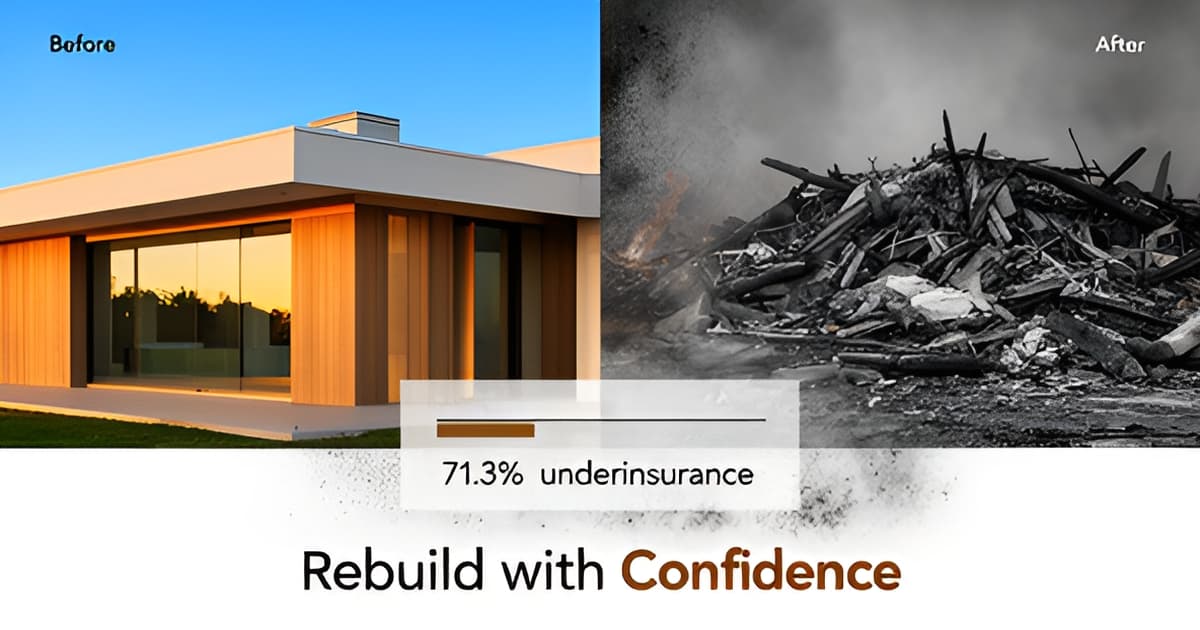
- 71.3% of destroyed California homes were underinsured by an average of 19%, a landmark study of 74,070 fire claims found.
- Only 7% of Eaton Fire total-loss households had enough insurance to rebuild, with shortfalls averaging 36%, United Policyholders' survey found.
- Insurers' own rebuild estimates fell below actual costs 75%–95% of the time, by more than 30% on average.
- In Altadena's 91001 ZIP code, Coverage A understated reconstruction value by roughly 35%, an e2Value analysis of 10,000 homes found.
- A 50% extended-coverage cushion on a 30%-low estimate covers only about 105% of true rebuild cost, analysts caution.
- Only 3% of standing-home survivors reported no claim problems versus 27% of total-loss households, Eaton and Palisades fire surveys show.
- Altadena burned lots now trade roughly 51% below pre-fire prices, with only four homes fully rebuilt despite 1,100+ permits, Realtor.com's one-year analysis reports.
The Underinsurance Problem: Why Most Fire Payouts Fall Short
Most California fire survivors discover their coverage gap only after their home is gone — and the data shows it's rarely their fault. A landmark study of 74,070 California fire claims found that 71.3% of destroyed homes were underinsured, by an average of roughly 19%.
The Eaton Fire made those numbers painfully local. United Policyholders' survey of total-loss households found that only 7% had enough insurance to rebuild, with Eaton Fire shortfalls averaging 36%. For Altadena specifically, an e2Value analysis of roughly 10,000 homes in ZIP 91001 found that Coverage A — the dwelling limit — understated reconstruction value by about 35%.
The root cause sits with insurers, not homeowners. The same claims study found insurers' own point-of-sale rebuild estimates fell below the final incurred loss 75%–95% of the time, with an average shortfall exceeding 30%. Roughly 90% of the destroyed homes already carried extended or guaranteed replacement-cost coverage, most commonly 150% of dwelling limits — and they still came up short.
Why the cushions fail:
- A 50% extended-coverage cushion on an estimate that's 30% too low covers only about 105% of the true rebuild cost — before any post-disaster price spikes, as analysts note.
- Replacement costs for property and casualty losses rose about 45% between 2020 and 2023, outpacing many policy adjustments.
- Catastrophe losses were underinsured 78% of the time versus 68% for ordinary house fires — meaning "wildfire isn't the problem," as study author Kenneth Klein puts it. The estimates were low from day one.
The consequences are visible across Altadena a year after the fire: only four single-family homes have been fully rebuilt despite more than 1,100 permits issued, with rebuilding hampered by rising construction costs, labor shortages, and disputes over insurance payouts. Many owners are selling instead — burned lots in Altadena now trade at roughly 51% below pre-fire prices.
For Altadena homeowners reconciling a payout against what a rebuild actually costs, the practical move is a line-item scope — structure, foundation, site work, utilities, WUI code compliance, and finishes — rather than trusting a policy figure. That's where Altadena Home Remodeling's free remodel-scoping consultation, including a before/after concept render, helps you see exactly what your budget will and won't deliver before you commit.
Scope it, price it, do it once, do it right. Book your free consultation with Altadena Home Remodeling today — and see your rebuild or remodel concept rendered before you spend a dollar.
What a Real Altadena Rebuild Costs (and What Insurance Typically Misses)
A 2,000-square-foot Altadena rebuild at current California wildfire pricing could run anywhere from $700,000 to well over $1.4 million. Industry cost guides put wildfire rebuilds at roughly $350 to over $700 per square foot, inclusive of debris removal, permitting, engineering, and code upgrades — and that range should be treated as directional, not definitive, because site conditions and design complexity move the number significantly.
The line items matter more than the average. A realistic rebuild budget breaks down into six categories: the structural frame and shell, the foundation, site work and grading, utilities and mechanical systems, interior finishes, and — the category most homeowners miss — WUI code compliance. Code-driven fire-safe features are commonly underestimated, including:
- Ember-resistant vents that block wind-blown embers from entering the attic and crawlspace
- Dual-pane, tempered windows throughout, not just on the street-facing elevation
- Ignition-resistant siding, which rules out some cheaper cladding options
- WUI compliance measures applied to the whole assembly, adding cost at every trade
Now map those line items against a standard policy. Coverage A sets your dwelling limit based on the insurer's own reconstruction estimate — and that's where the gap starts. A study of 74,070 California fire claims found insurers' point-of-sale estimates fell below actual rebuild cost 75% to 95% of the time, with an average shortfall of more than 30%. For Altadena specifically, an e2Value analysis of roughly 10,000 homes in ZIP 91001 found Coverage A understated reconstruction value by about 35%.
Extended replacement cost was supposed to solve this — about 90% of destroyed homes carried it, with 150% the most common level — yet 71.3% of those homes were still underinsured. The math explains why: if your base estimate is 30% too low, a 50% cushion covers only about 105% of the true rebuild cost, before any post-disaster price spikes. A percentage cushion cannot fix a low base number. That's why SB 876's mandated 50% extended-coverage offers, effective January 2027, are helpful but not a guarantee — analysts caution the cushion may still fall short if the underlying estimate is wrong.
Code-upgrade coverage is the other gray zone. A year after the Eaton Fire, households were still assessing whether policy limits and code-upgrade provisions would cover real-world Southern California rebuild costs, per United Policyholders' surveys. The ember-resistant vents and ignition-resistant siding your new build requires may not be fully reimbursed.
At Altadena Home Remodeling, we walk homeowners through a line-item scoping process before they commit to a rebuild path — including preserve-first options for standing structures — with a before/after concept render from a free scoping consultation. Featured builder JMB Builders LLC (CSLB #1103479) brings documented Eaton Fire rebuild experience. Knowing what your rebuild actually costs, line by line, is the only way to know what your policy is really worth.
The Coverage Gaps Nobody Warns You About: Smoke Damage, ALE, and Claim Delays
Even homeowners whose houses survived the flames often end up worse off than those who lost everything. Survey data from the Eaton and Palisades fires shows that only 3% of standing-home survivors reported no claim problems, compared with 27% of total-loss households — a striking reversal of what most people expect.
The reason lies in the gray zones. Smoke and toxin contamination in a standing home triggers disputes over whether belongings can be "cleaned" or must be replaced, with remediation costs still unresolved nearly a year after the fires. The FAIR Plan continued using a disputed smoke-damage policy as of September 2025 despite losing in court, leaving partially damaged homeowners in limbo. For Altadena owners of Craftsman and period homes weighing restoration versus demolition, these disputes directly affect whether a smoke-remediation scope — and the rebuild work that follows — gets funded at all.
Claim-handling problems compound everything. A Department of Angels survey found 80% of insured survivors reported serious claim issues, and a six-month United Policyholders study of 453 survivors found 50% received lowball settlement offers, 51% faced communication delays, and 48% were assigned three or more adjusters.
Then there's the ALE trap. Additional living expense coverage — the money that pays for rent while your claim is pending — frequently expires before claims resolve, turning insurer delays into direct financial threats. With 65% of Altadena residents still in temporary housing a year later, expired ALE is one reason nearly half of survivors exhausted savings and 43% took on debt.
California law does offer some guardrails:
- Up to 30% of your dwelling limit (capped at $250,000) for contents without itemizing every item — significant, since itemization was the single most common claim problem.
- A minimum four-month advance of living expenses after a declared disaster.
- A one-year moratorium on cancellations and non-renewals in designated fire areas.
These protections help, but they don't close the underlying gap between what insurers pay and what rebuilding actually costs. When payouts fall short, homeowners face hard choices about scope — and that's where careful planning matters. At Altadena Home Remodeling, our free remodel-scoping consultation includes a before/after concept render so you can see exactly what your coverage realistically buys, whether that's a phased gut renovation or a targeted kitchen and bath remodel while you prioritize the rest. JMB Builders LLC (CSLB #1103479), a licensed Altadena general contractor handling Eaton Fire rebuilds, is available through that consultation as our featured builder. Understanding the gaps before you commit to a scope is the difference between rebuilding once and rebuilding under pressure.
When the Payout Falls Short: Rebuild, Restore, or Sell?
When the settlement check arrives and it's 36% short of what a rebuild actually costs, the math feels impossible. But for most Altadena owners, the three options on the table — rebuild, restore, or sell — are not equally weighted, and the data says selling is often the worst of them.
The market tells the story plainly. Burned lots in Altadena are trading at roughly 51% below pre-fire prices, with the median sales price falling from $1.35 million to about $650,000, according to Realtor.com's one-year analysis. Meanwhile, roughly 30% of lot purchases are going to outside cash buyers — investors pricing the neighborhood's recovery, not its character. Selling under those conditions means locking in the loss and handing the upside to someone else.
Rebuilding, by contrast, is slow but real: Altadena has issued over 1,110 permits, even if only a handful of homes are finished. The honest question isn't whether a rebuild is possible — it's whether your settlement can be scoped to fit one. That's where a line-item budget changes the conversation. Instead of a single intimidating number, a rebuild breaks into decisions you can actually make:
- Structure, foundation, and site work sized to your actual lot conditions
- Code-driven items owners routinely underestimate — ember-resistant vents, dual-pane windows, ignition-resistant siding
- Utilities and site restoration sequenced so payments track insurance disbursements
- Finishes and scope phased so the essential shell comes first and upgrades follow
For owners of Altadena's surviving Craftsman and period homes, restoration is often the strongest financial position of all. Standing homes with smoke damage faced worse claim experiences than total losses — only 3% reported no claim problems — which means many settled low without ever pricing a true remediation-and-restoration scope. A whole-home restoration that preserves original millwork and character frequently costs less than replacement while keeping the home's value intact.
The preserve-first path only works, though, when it's priced honestly against the settlement. At Altadena Home Remodeling, we scope rebuilds and restorations line by line — no inflated promises, no timeline guarantees, just real numbers for LA County's unincorporated permit reality. When owners decide from data instead of pressure, the right choice usually makes itself.
Your Action Plan: Verify, Document, and Scope Before You Commit
The gap between what insurers estimate and what a rebuild actually costs is not a hypothetical risk in Altadena — it is the documented norm. An analysis of 74,070 California fire claims found insurers' point-of-sale reconstruction estimates fell below final losses 75%–95% of the time, by more than 30% on average. That is why your next moves matter more than any policy language you re-read.
Start with an independent line-item rebuild estimate. Ask a builder to price structure, foundation, site work, utilities, code compliance, and finishes separately, then compare the total against your Coverage A limit — not against your insurer's number. In Altadena's 91001 ZIP code, an e2Value study found Coverage A understated reconstruction value by roughly 35%, so the insurer's figure is exactly the one you should distrust most.
Next, use a new right coming your way. Under SB 876, effective January 1, 2027, insurers must provide updated replacement-cost estimates at new business and renewal. Review that estimate every renewal — but remember that a 50% extended-coverage cushion only helps if the base estimate is honest. A cushion stacked on a 30%-low estimate covers barely 105% of true cost, before post-disaster price spikes.
Then document everything. United Policyholders' survey of LA fire survivors found 57% were required to list and describe every damaged item, and itemization was the single most common claim difficulty. Keep a running inventory, photograph everything, and save every email and estimate in writing.
Before you cut scope or sign a contract, get a professional scoping consultation:
- An independent line-item estimate you can hand to your adjuster
- A realistic scope that preserves what matters instead of slashing blindly
- Code-upgrade costs priced in up front, not discovered mid-build
Set honest expectations about pace. A year after the Eaton Fire, Realtor.com reported that despite more than 1,110 permits issued in Altadena, only four single-family rebuilds were complete. Nobody can promise you a timeline — the permitting and construction bottlenecks are real.
Price the rebuild once, do it right. Altadena Home Remodeling offers a free remodel-scoping consultation with a before/after concept render, so you can see the finished home before you commit a dollar. Book yours and start with a scope you can defend.
Frequently Asked Questions
How much does it actually cost to rebuild a house in California after a wildfire?
Why do so many California fire victims end up underinsured even when they have extended replacement coverage?
How short were Eaton Fire insurance payouts for Altadena homeowners?
Is it better to rebuild or sell my burned lot in Altadena?
My house survived but has smoke damage — will insurance cover the cleanup and restoration?
Will California's new SB 876 law fix the underinsurance problem?
The Bottom Line: Your Coverage Is Only as Good as Your Estimate
The data tells a hard truth: in Altadena, the gap between insurance payouts and real rebuild costs isn't an anomaly — it's the norm. With 71.3% of destroyed homes underinsured and insurers' own estimates falling short 75%–95% of the time, waiting until the settlement check arrives to learn your true numbers is the most expensive mistake a homeowner can make. Whether you're weighing a full rebuild, a preserve-first restoration of a surviving Craftsman, or a phased remodel against a fixed payout, the decision only becomes manageable when it's priced line by line — structure, foundation, WUI code compliance, finishes — instead of trusted to a single policy figure. That's exactly what Altadena Home Remodeling's free scoping consultation delivers: a realistic line-item budget plus a before/after concept render, so you can see what your coverage actually buys before you commit a dollar. Featured builder JMB Builders LLC (CSLB #1103479) brings documented Eaton Fire rebuild experience to the conversation. Scope it, price it, do it once, do it right. Book your free consultation today and start with a scope you can defend.