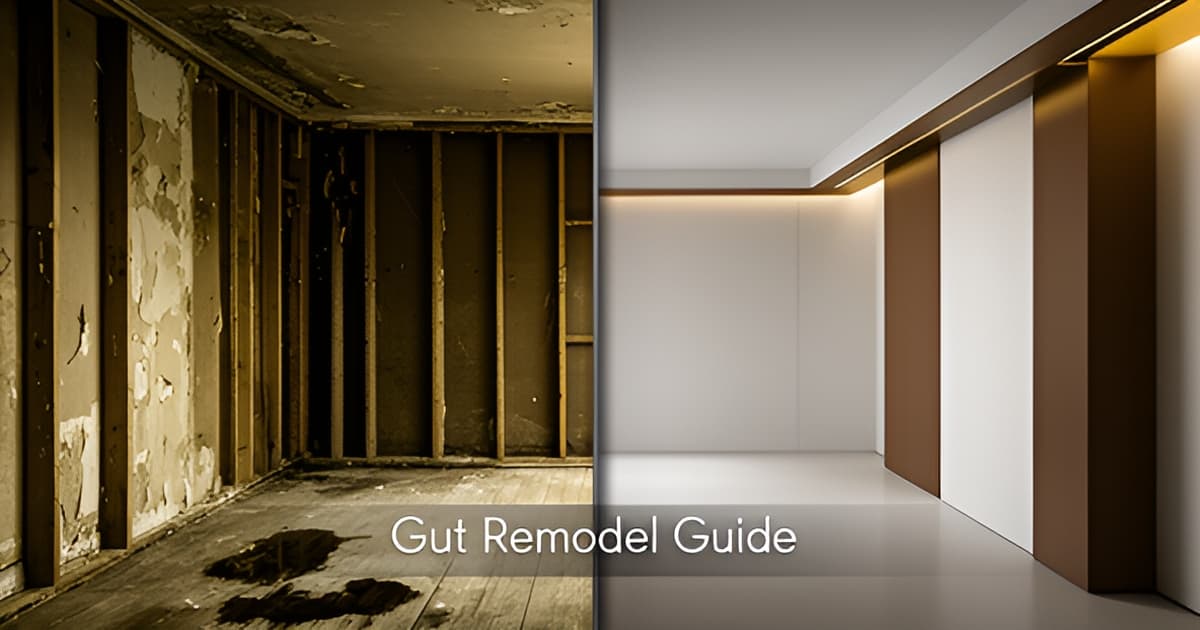
Down-to-the-Studs Remodel: What It Costs and When It's Worth It
Key Facts
- A full gut remodel typically runs $100,000–$300,000 nationally, at roughly $60–$250 per square foot according to HomeGuide.
- A gut remodel costs 20–50% less than a teardown rebuild when the foundation and structure are sound, per NerdWallet.
- Gut renovations finish in 3–9 months while teardown rebuilds stretch to 12–18 months or longer, per construction management estimates.
- Every source recommends a 15–20% contingency budget — about $37,500–$50,000 on a $250,000 gut remodel per CraftHaus Remodeling.
- Whole-house remodels recoup 50–85% of cost at resale, and kitchens return 54–80%, per national remodeling cost data.
- Contractor bids can vary by 20–40%, so getting at least three bids is due diligence, per CraftHaus's pricing analysis.
- Roughly 75% of renovation homeowners reported a greater desire to be home after completing their projects, per HomeGuide.
What a Gut Remodel Actually Costs in 2025
Stripping a house to its studs means removing walls, flooring, ceilings, plumbing, and electrical before rebuilding from the inside out — and the price tag reflects that depth. Nationally, a full gut remodel typically runs $100,000 to $300,000 or more, with per-square-foot rates of roughly $60 to $250 depending on finish level and region. For a 1,500-square-foot home, one contractor cost guide puts basic gut renovations at $150,000–$225,000, mid-range at $225,000–$300,000, and high-end builds at $300,000–$450,000 or more, per CraftHaus Remodeling.
Square-foot pricing, however, is an imprecise tool. Costs cluster around wet rooms and interconnected systems, which is why experienced renovators price by trade rather than by room, as Mammoth New York recommends. Regional swings are dramatic: major cities can run double rural prices, and New York City gut projects reach $400–$800+ per square foot — figures Altadena homeowners won't face, though Los Angeles County permitting and labor costs still push budgets above national averages.
A system-level breakdown for a 2,000-square-foot home, compiled by A2Z Construction Management, shows where the money goes:
- Demolition: $12,000–$30,000
- Plumbing and electrical: $20,000–$40,000
- HVAC: $10,000–$20,000
- Kitchen: $30,000–$75,000; bathrooms: $15,000–$45,000 each
- Permits and design: $5,000–$15,000
Those line items total $200,000–$400,000 — a reminder that finishes are only part of the story. Hidden conditions add more: asbestos remediation runs roughly $1,200–$3,300 and mold remediation $1,200–$3,750, according to NerdWallet, and knob-and-tube wiring in older Craftsman-era homes often surfaces only after walls open up.
Every source we reviewed recommends a 15–20% contingency budget on top of the base estimate, because the jobs that blow budgets are the ones where nobody inspected inside the walls before signing a contract. For a $250,000 gut, that means reserving $37,500–$50,000 for the surprises an older Altadena home will almost certainly hold.
Because these ranges are so wide, scoping matters more than averages. At Altadena Home Remodeling, our free remodel-scoping consultation includes a before/after concept render so you can see what your budget actually buys before committing — and, when the structure is sound, a gut remodel typically costs 20–50% less than tearing down and rebuilding, which is why we champion renovating over demolishing wherever the bones allow it.
Gut vs. Rebuild: Why Renovating Beats Tearing Down (When the Bones Are Sound)
Standing in a stripped-bare living room—studs exposed, dust everywhere—the same question hits every Altadena homeowner: do we rebuild this, or tear it down and start over? The answer usually comes down to money, time, and the condition of what you can't see.
The economics favor the gut, decisively. Industry cost guides put a full remodel at roughly $100,000–$250,000, while teardown and new construction runs $350,000–$800,000—making renovation 20–50% cheaper than building new. NerdWallet's analysis reaches the same conclusion: when the foundation and structure are sound, a gut remodel consistently undercuts a rebuild by 20–50%.
Time tells a similar story. A gut renovation typically finishes in 3–9 months, while a teardown-and-rebuild stretches to 12–18 months or longer, according to construction management estimates. That's a year of extra rental housing, storage fees, and life in limbo that renovation lets you skip.
This math aligns with how Altadena approaches its housing stock. A community with deep Craftsman roots and a preserve-first ethos tends to renovate rather than demolish—and the numbers back that instinct up. At Altadena Home Remodeling, we treat teardown as a last resort, not a default.
So when does the framework hold? Look for these markers before committing either way:
- Foundation and framing that pass a professional inspection without major red flags
- Mechanical systems under 20–30 years old, or replaceable within the gut scope
- A home in a desirable area where renovation value holds—CraftHaus notes a gut is "worth it if the home has solid bones"
- Total projected investment that stays below neighborhood sale prices, so you don't over-improve
The caveat matters as much as the rule. Major foundation issues can flip the math toward teardown—both NerdWallet and HomeGuide flag that failing systems or serious structural problems sometimes make demolition the cheaper path. That's why the pre-renovation inspection is non-negotiable: as one construction manager put it, the jobs that blow budgets are "the ones where nobody looked inside the walls before signing a contract."
Get the bones verified first. Then, and only then, commit to the path the numbers support.
When a Gut Remodel Is Worth It — and When You're Over-Improving
Spending $200,000 on a gut remodel in a neighborhood where homes sell for $400,000 is a bet you won't win. The single most important guardrail before committing to a down-to-the-studs renovation is simple: your total investment should stay within the neighborhood's sale-price ceiling. If your project pushes the home's value past what comparable sales support, that money is difficult to recoup, according to industry cost analysis.
So when does the math actually work? Several conditions consistently signal that a gut is worth it:
- Your mechanical systems are 20–30+ years old — at that age, a full gut often delivers better long-term value than repeated partial remodels
- Hazardous materials are present, such as asbestos, lead paint, knob-and-tube wiring, or mold
- The layout is inefficient or unsafe, and moving walls piecemeal would cost nearly as much as doing it once
- You bought a distressed or below-market property with solid bones in a desirable area
That last point matters in a place like Altadena, where many buyers take on older Craftsman and period homes specifically because the structure is worth preserving. A gut remodel runs 20–50% cheaper than a teardown and rebuild when the foundation and structure are sound, per NerdWallet's renovation analysis — which is why a preserve-first approach often beats demolition on both cost and character. The caveat: if a home has major foundation issues or failing systems, teardown may actually be the cheaper path.
The returns are real but not guaranteed. Whole-house remodels recoup roughly 50–85% of their cost at resale, while kitchens return 54–80%, according to national remodeling cost data. Notably, it's not always the most expensive projects that bring the best returns — smaller interventions like a garage door replacement or minor kitchen refresh can outperform major remodels on a percentage basis.
But ROI isn't the whole story. Roughly 75% of renovation homeowners reported a greater desire to be home and increased enjoyment of their space after completing their projects. For many long-term owners — especially those rebuilding after events like the Eaton Fire — that daily quality-of-life payoff justifies the investment even where the resale math is break-even.
Before committing, get eyes inside the walls. As one construction manager put it, the jobs that blow budgets aren't the ones where everything goes wrong — they're the ones where nobody looked inside the walls before signing a contract. A pre-renovation inspection for asbestos, outdated wiring, and rot is the highest-leverage step you can take, and it's where we start every Altadena Home Remodeling scoping consultation: a free assessment with a before/after concept render, so you know whether a gut, a targeted remodel, or a rebuild makes sense before you spend a dollar.
How to Protect Your Budget Before You Sign a Contract
Most gut-remodel budgets don't collapse because of bad luck — they collapse because nobody looked inside the walls before signing a contract. As one construction manager puts it, the costliest jobs are the ones where hidden conditions were never checked upfront. A few disciplined steps before you commit can protect tens of thousands of dollars.
Start with a pre-renovation inspection. Hazardous materials are the classic budget-blower in older homes, and Altadena's Craftsman-era housing stock makes this step non-negotiable. According to NerdWallet's cost research, asbestos remediation typically runs $1,200–$3,300 and mold remediation $1,200–$3,750 — manageable if planned, brutal if discovered mid-demo. If your plan touches load-bearing walls, budget $500–$1,000 for a structural engineer per Sweeten's remodeling guide.
Finalize the design before demo begins. Mid-project changes are significantly more costly than adjustments made on paper, and they're a leading cause of overruns, CraftHaus notes. Every decision you defer — outlet placement, fixture locations, window sizes — becomes a change order later. Lock the drawings, then let the hammers fly.
Price the work by trade, not by room. Because plumbing, electrical, and structural work interconnect, trade-based pricing gives you a clearer picture of where money actually goes — and makes bids easier to compare line by line.
Your pre-contract checklist should include:
- Hazardous-materials inspection before demolition, not after
- Complete, signed-off design documents
- At least three competing bids
- A 15–20% contingency line in the budget
- Temporary housing arrangements
On bids: variance between contractors runs 20–40%, per CraftHaus's pricing analysis, so three bids isn't shopping — it's due diligence. And hold back 15–20% for contingency, because a down-to-the-studs project will find something you didn't budget for.
Finally, plan to live elsewhere. Sources consistently agree that living in place isn't practical or safe during demo, hazard removal, and rough-in. Altadena Home Remodeling's free remodel-scoping consultation — which includes a before/after concept render — helps you scope, price, and sequence the project before a single wall comes down. Scope it once, price it right, and do it once.
Scoping Your Altadena Gut Remodel: Permits, Timeline, and Next Steps
Every Altadena gut remodel lives or dies on what happens before the first wall comes down — and in unincorporated LA County, that means permitting realities most homeowners don't see coming. Here's how to scope the project so your Craftsman gets renovated, not demolished.
Because Altadena sits in unincorporated LA County, permits run through the county's building and safety process rather than a city building department. Nationally, permit costs range from $200 to $3,000 for typical remodels, with complex whole-home projects sometimes exceeding $5,000, according to contractor cost guides. No one can guarantee permit timelines, so build slack into your schedule.
For a typical Altadena home between 1,000 and 2,500 square feet, industry benchmarks put a full gut at roughly 6–9 months. Smaller homes under 1,000 square feet often finish in 4–6 months, while larger homes stretch toward 9–12. These are planning ranges, not promises — mid-project design changes are a leading cause of overruns.
Altadena's stock of historic and Craftsman-period homes carries a premium. Cost data shows historic homes run $100–$400 per square foot, well above the standard $60–$150 band. Pre-1978 homes may also require asbestos and lead inspections before demo, adding $1,200–$3,300 in remediation if hazards surface.
Your scoping checklist:
- Schedule a pre-renovation inspection — hidden hazards are the #1 budget-blower
- Verify your contractor's license with the CSLB and confirm unincorporated-county experience
- Set a 15–20% contingency and lock material prices early
- Budget for temporary housing; living in place during demo isn't safe
One Altadena-based option is JMB Builders LLC (CSLB #1103479), a licensed general contractor building custom homes, ADUs, and whole-home remodels — including Eaton Fire rebuilds — with work documented at jmb-builders.com. This is a disclosed paid placement, and we still recommend collecting at least three bids, since contractor estimates can vary by 20–40%.
Scope it, price it, do it once, do it right. Altadena Home Remodeling offers a free remodel-scoping consultation that includes a before/after concept render of your home — so you can see the potential before committing to the studs.
Frequently Asked Questions
How much does it actually cost to remodel a house down to the studs?
Is it cheaper to gut remodel or tear down and rebuild?
How much contingency budget should I set aside for a gut renovation?
How long does a full gut remodel take?
Will I get my money back on a gut remodel when I sell?
What should I do before signing a gut remodel contract?
The Bottom Line: Great Bones Deserve a Great Plan
A down-to-the-studs remodel is a serious investment — typically $100,000 to $300,000+ nationally — but the numbers consistently favor renovation over teardown when the foundation and framing are sound, with a gut running 20–50% cheaper than demolishing and rebuilding. The decisions that protect your budget happen before demo day: a pre-renovation inspection for asbestos, outdated wiring, and rot; a finished design locked on paper; at least three competing bids; and a 15–20% contingency for the surprises an older Altadena home will almost certainly hold. Just as important, keep your total investment within the neighborhood's sale-price ceiling so you're improving your home, not over-improving it. Your next step is simple: get eyes inside the walls. Altadena Home Remodeling's free remodel-scoping consultation includes a before/after concept render, so you can see exactly what your budget buys — whether that's a full gut, a targeted remodel, or a rebuild — before a single wall comes down. Scope it, price it, do it once, do it right.