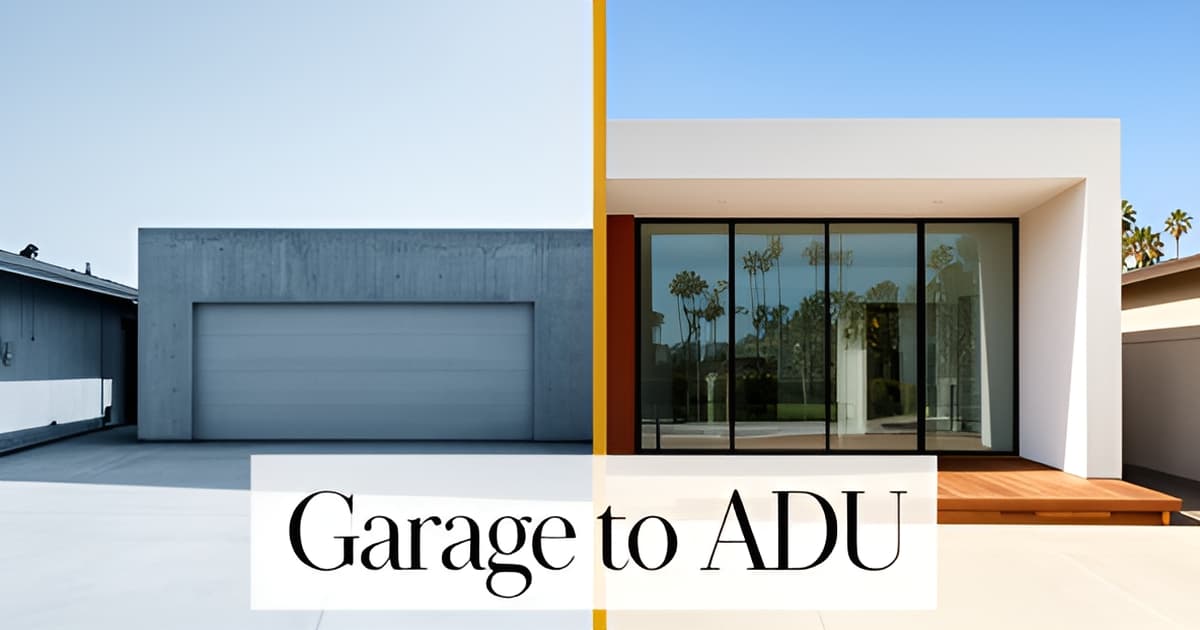
Detached Garage Conversion in Los Angeles: Permit and Cost Guide
Key Facts
- Converting a detached garage costs $80,000–$150,000 versus $200,000–$350,000 for a new detached ADU, according to industry cost breakdowns.
- LA County's streamlined six-step process requires no registered architect or engineer for standard garage-to-ADU conversions, per LA County Public Works.
- State law caps ADU permit review at 60 days — unaddressed applications are deemed approved, per code-cited permitting guides.
- ADUs under 750 square feet pay zero impact fees and are exempt from utility capacity charges under California law, per ADUZoning's permit analysis.
- Plumbing runs to a detached garage swing from $8,000 to $40,000 — the single biggest cost variable, per GatherADU's cost analysis.
- A $150,000 mid-range conversion pays back in roughly 5.4 years of gross rent at LA's average $2,050–$2,550 monthly ADU rents, per ADUZoning's rental data.
- Garage conversions add an estimated $150,000–$300,000 in property value, per Axe Construction's ROI analysis.
Why Altadena Homeowners Are Converting Detached Garages — And What Could Go Wrong
Altadena's detached garages — many of them original Craftsman-era carriage structures — sit on foundations nobody has inspected in decades, holding utility lines nobody has mapped. That combination makes garage conversions one of the best values in LA housing and one of the easiest projects to budget wrong.
The economics explain the enthusiasm. Conversions typically run $80,000–$150,000 versus $200,000–$350,000 for a new detached ADU of similar size, according to ADUZoning's cost guide, and they finish in 3–6 months. Because Altadena is unincorporated, homeowners use LA County Public Works' streamlined garage-conversion pathway rather than LADBS — a program that rewards adaptive reuse and explicitly prohibits complete demolition and rebuild, per the County's published process.
The problem is what you can't see. Most garages need upgraded framing to qualify as habitable space, and costs "can escalate if unforeseen issues arise, such as the need for foundation work or extensive electrical upgrades," as GatherADU's cost analysis warns. Older structures compound every risk.
The three escalation triggers that blow up budgets most often:
- Foundation and structural surprises — structural upgrades alone run $8,000–$25,000, and a failing slab discovered mid-permit forces redesign.
- Plumbing runs from the main house to a detached structure — the single biggest cost variable, ranging $8,000–$40,000 depending on distance and trenching conditions.
- Habitability upgrades most owners never price in: 7-foot minimum ceilings after drywall, egress windows, Title 24 energy compliance, and insulation — recurring plan-check corrections per ADUZoning's permit analysis.
A 1920s Craftsman garage with a six-foot-six ceiling and a slab poured before modern codes can hit all three at once. None of these appear in a brochure estimate, and each one surfaces after design money is spent.
That's why pre-permit scoping matters more in Altadena than in newer neighborhoods. Altadena Home Remodeling approaches these projects the same way it approaches historic restoration generally: assess the existing foundation and utility conditions before drawing a single wall, because the preserve-first path only saves money when you know what you're preserving. A free scoping consultation with a before/after concept render surfaces the ceiling heights, sewer distances, and slab conditions early — when they change the design, not the invoice.
Scope it first. Price it honestly. Then convert it once, correctly.
The LA County Streamlined Permit Pathway: Six Steps, No Architect Required
If your detached garage sits in unincorporated Los Angeles County — as most Altadena properties do — you may not need an architect to convert it into an ADU. LA County Public Works runs a dedicated streamlined pathway for garage-to-ADU conversions that treats the project as what it truly is: an adaptive reuse of an existing structure, not new construction.
The county's program, launched in response to a Board of Supervisors emergency declaration on housing, follows six steps: Regional Planning approval, application screening through the EPIC-LA portal, a plan recheck with Standard Notes and Title 24 sheets, fee payment and combination permits, a mandatory Pre-Construction Meeting with a County Building Inspector, and finally construction with staged inspections. Because the review is ministerial — no public hearing, no neighbor sign-off — state law caps the decision deadline at 60 days, after which an unaddressed application is deemed approved, according to code-cited ADU permitting guides.
Perhaps most surprising: a registered architect or engineer is not required for a standard garage conversion or junior ADU, per LA County Public Works. An engineer only becomes necessary if your project adds new square footage to the existing footprint.
The streamlined pathway does come with eligibility limits. Your conversion must fit within these boundaries:
- The ADU must be under 1,200 square feet and single-story
- No additional footprint or complete demolition and rebuild of the structure
- No slope, landslide, or liquefaction hazard zones — and no hillside construction
- No unpermitted construction on the structure, and no added roof loading greater than 5% of existing
- No basement conversions
Notice what that list rewards: keeping the garage's foundation, walls, and roof intact. This is the "renovate over demolish" philosophy codified into permitting. It also happens to be the cheaper path — a typical 400-square-foot conversion runs $80,000–$150,000, versus $200,000–$350,000 for a new detached ADU of similar size, according to industry cost breakdowns. Conversions under 750 square feet of livable space also pay zero impact fees and are exempt from utility capacity charges under California law.
For Altadena homeowners — particularly those working with Craftsman-era garages or planning post-fire rebuilding — the practical takeaway is to scope the structure before design begins. Foundation condition and existing utility lines are the biggest cost unknowns, and discovering them after plan submittal means expensive rechecks. At Altadena Home Remodeling, our free scoping consultation includes a before/after concept render so you walk into the county process knowing exactly what your garage can become. Featured builder JMB Builders LLC (CSLB #1103479) brings licensed ADU and whole-home remodel experience to that evaluation. Timelines and permit outcomes always vary, so verify current requirements with County Building and Safety before committing to a design.
What a Detached Garage Conversion Actually Costs in 2026
Expect to spend between $80,000 and $200,000 to convert a detached garage into a legal ADU in Los Angeles in 2026 — a fraction of the $180,000–$400,000 that new detached construction typically runs. Because your garage already has a foundation, roof, and walls, you're paying to make an existing structure habitable, not to build from scratch. That's why industry comparisons place conversions at roughly half the cost of a comparable new detached ADU.
Here's how the money breaks down for a standard two-car conversion:
- Architectural plans: $3,000–$8,000
- Structural upgrades (framing, foundation): $8,000–$25,000
- Plumbing for a bathroom and kitchenette: $8,000–$40,000
- Electrical panel and wiring: $5,000–$15,000
- HVAC (mini-split), insulation, drywall, flooring, and finishes: roughly $25,000–$55,000 combined
Plumbing is the single biggest variable. One 2026 cost guide puts bathroom and kitchen plumbing at $15,000–$40,000, and warns that foundation problems are the main way budgets escalate. Size matters too: a one-car garage (200–300 sq ft) typically runs $85,000–$170,000, while two-car conversions (400–500 sq ft) span $100,000–$200,000 or more.
The financial edge comes from what you don't pay. Under California law, conversions of 750 sq ft or less pay zero impact fees, are exempt from utility capacity charges, and cannot be treated as a new residential use for water and sewer fees. School fees are waived for garage conversions, and no replacement parking is required when you convert — even though you're eliminating a parking space.
One caution on permitting: published estimates conflict badly. Some guides cite permit fees of $2,000–$10,000, while others report $8,000–$22,000 for LA City. Request an itemized fee schedule before you commit, and if anyone quotes a sewer or water capacity charge for a conversion, ask which statute authorizes it. Altadena homeowners should note that unincorporated LA County runs its own streamlined six-step conversion process, which does not require a registered architect or engineer for standard garage conversions.
Before you budget anything, scope the two biggest unknowns: foundation condition and existing utility lines. Those site realities — not finishes — determine whether your project lands at $90,000 or $180,000. Altadena Home Remodeling offers a free remodel-scoping consultation with a before/after concept render, so you can see the finished space and an honest cost picture before spending a dollar on plans. Work is performed by JMB Builders LLC (CSLB #1103479), a licensed Altadena general contractor.
With one-bedroom ADU rents in LA averaging $2,050–$2,550 per month, a mid-range $150,000 conversion pays for itself in roughly 5.4 years of gross rent — if the budget holds from day one.
From Scoping to Final Inspection: Your Action Plan
A garage conversion succeeds or fails before the first wall comes down. The homeowners who move smoothly through permitting are the ones who scope their foundation and utilities first, submit a complete plan set, and anticipate the corrections plan checkers almost always issue.
Start with a scoping assessment, not a design. Foundation condition and existing utility runs are the two biggest cost unknowns in any conversion — foundation surprises are the main source of budget escalation, and plumbing alone can swing from $8,000 to $40,000 depending on how far water and sewer lines sit from the garage, per GatherADU's cost analysis. A professional scoping visit tells you whether your slab is sound, whether your electrical panel can carry new circuits, and whether your ceiling clears the 7-foot minimum after insulation and drywall — the single most common habitability correction.
Submit a complete plan set. Incomplete submittals are the most avoidable source of permit delay, according to ADUZoning's LADBS checklist guidance. Plan check rarely approves on the first pass, so expect corrections in these recurring areas:
- Ceiling height and egress window sizing for habitable space
- Title 24 energy compliance and insulation details
- Smoke and carbon monoxide alarm placement
- Framing upgrades, since most garages need reinforcement for habitation
Follow the inspection sequence without shortcuts. Inspections run foundation/slab, then underground plumbing, rough framing, rough electrical/plumbing/mechanical, insulation, drywall, and final — and each stage must be approved before you cover it up. In unincorporated areas like Altadena, LA County's streamlined six-step process adds a mandatory pre-construction meeting with a County inspector, and notably does not require a registered architect or engineer for a standard garage conversion.
Budget 3–6 months from design to done. Conversions typically finish in 3–6 months, with 2–4 months of construction on a typical 400–600 sq ft unit, per ADUZoning's timeline data. The payoff justifies the patience: one-bedroom ADUs rent for $2,200–$3,000/month in LA, and a mid-range conversion typically pays back in 5–8 years of rental income while adding $150,000–$300,000 in property value, per Axe Construction's ROI analysis.
One Altadena caveat: if your Craftsman home sits in an HPOZ or carries historic designation, budget extra time for design review before you draw anything. Altadena Home Remodeling's free remodel-scoping consultation — which includes a before/after concept render — is a low-commitment way to pressure-test your garage's conversion potential, and our featured builder, JMB Builders LLC (CSLB #1103479), builds ADUs and whole-home remodels throughout the Altadena area. Scope it, price it, do it once, do it right.
Frequently Asked Questions
How much does it actually cost to convert a detached garage into an ADU in the Altadena / LA area?
Do I need an architect or engineer to permit a garage conversion in unincorporated LA County?
What is the permit process for a garage conversion in Altadena, and how long does approval take?
Will I have to replace the parking space I lose by converting my garage?
My garage is an old Craftsman-era structure — what could go wrong or blow up my budget?
Is converting my garage to an ADU actually worth it financially?
Your Garage Is Already Half an ADU — Scope It Before You Spend a Dollar
Converting a detached garage in Altadena is one of the smartest values in LA housing: at $80,000–$200,000, it runs roughly half the cost of a new detached ADU, finishes in 3–6 months, and rides a ministerial county process with a 60-day decision deadline and no architect requirement for standard conversions. The fee exemptions — zero impact fees under 750 sq ft, waived school fees, no replacement parking — sweeten the math further. But the numbers only hold if the surprises stay buried, and most Craftsman-era garages have a few waiting: soft slabs, six-foot-six ceilings, and utility runs that can swing plumbing costs from $8,000 to $40,000. That's why the real first step isn't design — it's scoping. A free remodel-scoping consultation from Altadena Home Remodeling, including a before/after concept render, surfaces your foundation and utility conditions before they become change orders. With one-bedroom ADUs renting for $2,050–$2,550 per month in LA, a well-scoped conversion can pay for itself in five to eight years. Scope it, price it, do it once, do it right.