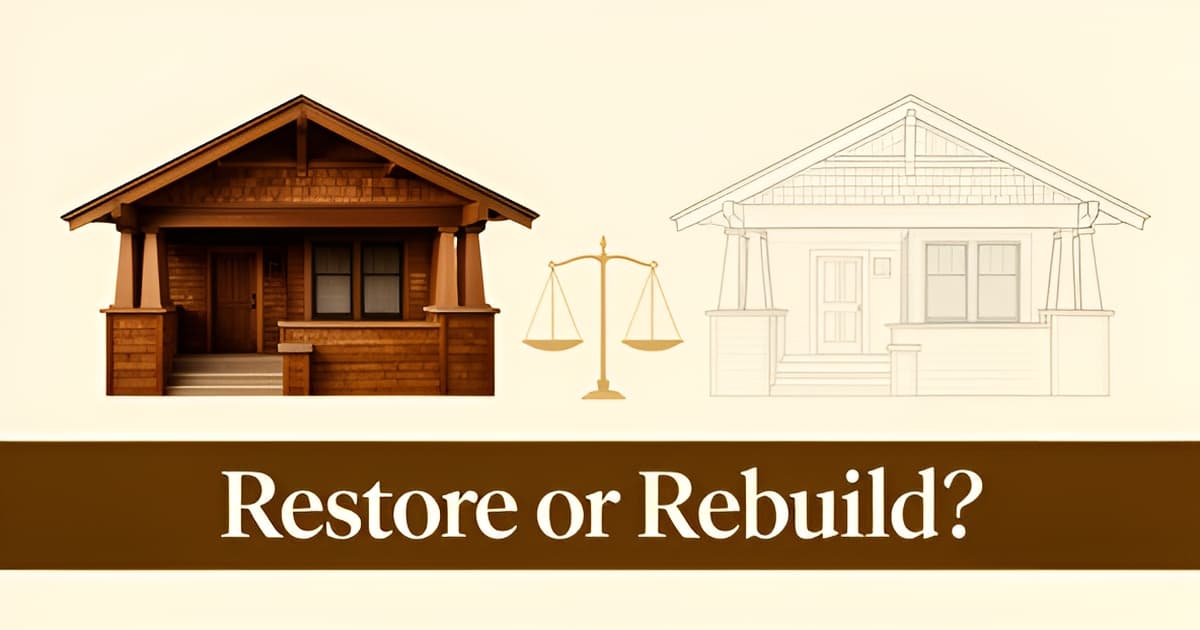
Craftsman Style Home Builders: Restoration vs. Replication Costs
Key Facts
- Restoration projects recoup 60–80% of costs versus just 40–60% for kitchen and bath remodels, according to restoration economics analysis.
- New Craftsman construction runs $150–$250+ per square foot, a 10–20% premium over comparable basic homes, per 2026 build-cost estimates.
- Pre-1980 homes carry up to $3,200 in unexpected first-year maintenance costs — four times the $800 typical of new builds, per annual maintenance data.
- The January 2025 Eaton Fire destroyed more than 6,000 homes, including hundreds of Altadena Craftsman houses, according to local reporting.
- Fire-safe composites mimicking old-growth redwood can recreate authentic Craftsman eaves and rafter tails on both new builds and historic frames, as Pasadena Heritage demonstrates.
- The plan you choose determines 80% of your build cost before breaking ground, builder Max Fulbright estimates.
- An $80,000 modern kitchen in an 1890s Victorian was judged by three appraisers to have cut the home's value, per restoration case analysis.
The Altadena Craftsman Dilemma: Restore, Gut, or Rebuild
The Eaton Fire destroyed more than 6,000 homes in January 2025, including most of Altadena's historic central core — hundreds of Craftsman houses among them, four by Louis B. Easton and a couple by Greene and Greene. For many families, per Altadena Heritage chair Hans Allhoff, the rebuild decision still isn't final. That hesitation isn't just grief; it's a financial calculation.
Three paths sit in front of every owner of a damaged or aging Craftsman. You can restore what remains, gut the interior and start over inside the original walls, or demolish and replicate the home from scratch. Each carries a different cost profile — and, counterintuitively, the gut option is often the worst investment of the three.
Consider what the numbers suggest:
- Restoration projects typically recoup 60–80% of their costs, while kitchen and bath remodels recoup only 40–60%, according to restoration economics analysis.
- Gutting a historic home can actually reduce its value — as preservationist Scott Sidler puts it, you end up "competing with new construction. And losing."
- New Craftsman construction runs $150–$250+ per square foot, a 10–20% premium over a basic home of similar size, per 2026 build-cost estimates.
- Pre-1980 homes carry up to $3,200 in unexpected first-year maintenance costs — four times the $800 typical of new builds, per annual maintenance data.
The gut path deserves special scrutiny. An $80,000 modern kitchen in an 1890s Victorian was judged by three appraisers to have cut the home's value, because buyers of historic houses pay for authenticity, not modernization. Strip the built-ins, box-beam ceilings, and original millwork from a 1910s Altadena Craftsman, and you've spent six figures erasing exactly what made the property worth more than its neighbors.
For fire-affected owners, replication raises its own question. As Rebuild Altadena advisor Steven S. Lamb frames it: is a Craftsman "a set of elevations and details, or is it the result of a philosophy applied?" Original materials are now unusual or unavailable, but fire-safe composites engineered to mimic old-growth redwood can recreate wide eaves, exposed rafter tails, and traditional siding on both new builds and historic frames — a solution demonstrated on the 1906 Greene & Greene Duncan-Irwin House restoration, per Pasadena Heritage.
At Altadena Home Remodeling, we approach these decisions preserve-first: renovate when the structure allows, replicate faithfully when it doesn't, and scope the true cost of each before committing. Whether you're weighing a gut renovation against a period restoration or planning an Eaton Fire rebuild, the smartest first step is a free remodel-scoping consultation with a before/after concept render — so you can see what each path costs, and what each path preserves, before you spend a dollar.
What Each Path Really Costs: Restoration Economics vs. New-Build Premiums
The cheapest Craftsman on paper is rarely the cheapest Craftsman in practice. Before you commit to restoring an original or replicating a style from scratch, you need to understand how the money behaves differently on each path.
Restoration economics favor patience. According to preservation-focused analysis, restoration projects typically recoup 60–80% of their costs, while kitchen and bath remodels recoup only 40–60%. Gut a historic home, and as Scott Sidler bluntly puts it, "you're competing with new construction. And losing."
The catch is ownership cost. A 2026 maintenance cost report found pre-1980 homes carry up to $3,200 in unexpected first-year maintenance — 4x the $800 typical of 2020s-era homes. Budget for HVAC replacement at $5,000–$12,000 and electrical panel upgrades at $1,500–$3,000+, and set aside $500–$1,000 annually for preventive maintenance, which can cut repair costs by roughly 30%.
New Craftsman construction runs $150–$250+ per square foot, per practitioner estimates — a 2,000 sq ft build lands at $300,000–$500,000+ before land. The style itself commands a 10–20% premium over a comparable basic home, driven by its signature elements:
- Full-width or wraparound porches: $15,000–$40,000
- Tapered columns: $800–$2,500 per assembly
- Custom millwork and built-ins: $3,000–$15,000+
- Multi-gable rooflines: 30–50% more than a simple gable
Value engineering softens the blow. Engineered siding saves 30–40% versus cedar, manufactured stone veneer saves 50–60%, and architectural shingles save $8,000–$15,000 versus metal roofing. As builder Max Fulbright notes, "the plan you choose determines 80% of your build cost before you ever break ground" — so concentrate authentic millwork where it's visible and substitute elsewhere.
For Eaton Fire rebuilders weighing both paths, modern fire-safe composites that mimic old-growth redwood can recreate wide eaves and rafter tails on both new construction and historic frames, per Pasadena Heritage's guidance. That means authenticity and code compliance aren't mutually exclusive on either budget.
Treat every figure here as a budgeting range, not a quote. Altadena Home Remodeling helps homeowners scope both paths — restoration and replication — with realistic numbers before commitments harden into concrete. Scope it, price it, and do it once, do it right.
Fire-Safe Replication: How Modern Materials Recreate the Craftsman Look
The Eaton Fire destroyed more than 6,000 homes in January 2025, including hundreds of Craftsman houses in Altadena's historic core — works by Louis B. Easton and Greene & Greene among them, according to local reporting. For families deciding whether to replicate what was lost, one question dominates: can a house built with today's codes and materials still be authentically Craftsman?
The answer, increasingly, is yes. Pasadena Heritage's Nick Giovanazzi points to composite materials engineered to mimic old-growth redwood, which recreate the wide eaves, exposed rafter tails, and traditional siding that define the style. Critically, these materials "can be applied to new construction as well as historic frames" — proven in the restoration of the 1906 Greene & Greene Duncan-Irwin House.
That flexibility matters in Altadena, where some homeowners are restoring surviving historic frames while others face full rebuilds. The Craftsman movement "worked with the environment and climate," Giovanazzi notes — "it was meant for California." Modern fire-safe composites extend that philosophy rather than abandon it.
A new Craftsman build typically runs 10–20% above a comparable basic home, with porches, tapered columns, and complex rooflines driving the premium, per practitioner cost estimates. The smartest budget move is concentrating authentic details where they're visible and substituting engineered products elsewhere:
- LP SmartSide engineered siding saves 30–40% versus cedar while accepting Craftsman-style trim profiles
- Manufactured stone veneer cuts foundation and column-base costs by 50–60% versus natural stone
- Architectural shingles save $8,000–$15,000 versus metal roofing while preserving the low-pitched silhouette
- Concentrating millwork and built-ins on the porch, main living area, and kitchen saves $5,000–$10,000 elsewhere
As builder Max Fulbright puts it, "the plan you choose determines 80% of your build cost before you ever break ground." Material and finish decisions made during planning — not after the foundation is poured — are effectively free changes. That's especially true for Eaton Fire rebuilds navigating LA County unincorporated permitting, where early decisions reduce costly revisions.
Rebuild Altadena advisor Steven S. Lamb frames the philosophical stakes: is a Craftsman house "a set of elevations and details, or is it the result of a philosophy applied?" The replication path succeeds when fire-safe materials carry the proportions, textures, and craftsmanship the originals demanded — not when a builder slaps decorative brackets on a standard tract plan. Altadena Home Remodeling approaches every replication scoping conversation with that distinction at the center, pairing budget discipline with a before/after concept render so homeowners see the Craftsman character before committing. If you're weighing a rebuild or restoration, a free remodel-scoping consultation maps which details deserve the spend — and where engineered alternatives earn their keep.
Budgeting Signature Details Without Breaking the Plan
The most expensive mistake in a Craftsman project isn't the millwork — it's changing your mind about it after construction starts. As one builder estimates, your plan determines roughly 80% of your build cost before you ever break ground, which means the budget is won or lost at the drafting table.
Lock your material decisions during planning, when changes are free. Every finish swapped after the foundation is poured becomes a change order, and in heritage work the wrong late-stage decision invites "cost overruns, delays, conflicts, and substandard results," as restoration guidance warns. This matters doubly in unincorporated LA County, where permit revisions add their own friction.
The core strategy is concentration: put your signature details where people actually see them. Altadena Home Remodeling advises clients to spend the millwork budget on the porch, main living room, and kitchen, then value-engineer elsewhere — a savings of roughly $5,000–$10,000 without anyone noticing. Substitutes like engineered siding (30–40% cheaper than cedar) and manufactured stone veneer (50–60% savings) let a bedroom hallway stay quiet while the front elevation sings.
Itemize the signature elements so nothing surprises you:
- Full-width or wraparound porches: $15,000–$40,000
- Tapered columns: $800–$2,500 per assembly
- Custom millwork and built-ins: $3,000–$15,000+
- Complex multi-gable rooflines: 30–50% more than a simple gable
Carry a 10–15% contingency on top of these line items. That buffer is not optional padding — it's what keeps a surprise from becoming a value-engineering panic that strips out the very details that make a Craftsman a Craftsman.
For owners of pre-1980 homes, the contingency logic extends past construction. A maintenance cost analysis found older homes carry up to $3,200 in unexpected first-year repairs — four times the figure for 2020s builds. Budget for that reality up front, and earmark $500–$1,000 annually for preventive care, which can trim repair costs by roughly 30%.
If you're weighing restoration against replication for an Altadena home, a free remodel-scoping consultation with a before/after concept render can show exactly where your dollars land — before you commit a single one.
Choosing a Heritage-Experienced Builder and Scoping the Project
The single most expensive mistake in a Craftsman restoration or rebuild isn't the wrong material or the wrong plan — it's the wrong builder. Heritage renovation with an inexperienced contractor "can lead to cost overruns, delays, conflicts, and substandard results," according to guidance from the Brett Furman Group, and in a period home those overruns compound quickly.
Why does contractor selection matter so much here? Because Craftsman work hides its difficulty in plain sight. Tapered column assemblies, multi-gable rooflines, and custom millwork demand tradespeople who understand period proportions, not just framing math. Complex multi-gable roofs alone can run 30–50% more than a simple gable, and full interior finish carpentry ranges from $20,000 to $40,000 on a new build — numbers that balloon when a crew has to learn Craftsman detailing mid-project.
Documentation and permitting come before demolition
The best heritage builders front-load two things: research and permits. Documented historical research — period photographs, original material samples, paint analysis — gives the crew a fixed target and protects you from expensive mid-build redesigns. In Altadena's unincorporated context, all permitting runs through LA County, and engaging planning officials early prevents the redesign-and-resubmit cycle that stalls heritage projects for months.
This matters especially for Eaton Fire rebuilders. The January 2025 fire destroyed more than 6,000 homes, including hundreds of Altadena Craftsman houses, and many families are still weighing whether to restore, replicate, or build new. Modern fire-safe composites that mimic old-growth redwood can recreate wide eaves, exposed rafter tails, and traditional siding on both new construction and historic frames, as Pasadena Heritage has demonstrated on the 1906 Duncan-Irwin House. A builder fluent in those materials can deliver authenticity without fighting today's fire codes.
- Verify the license and ask for period-specific work — restorations, Craftsman rebuilds, or fire rebuilds — not just generic remodels.
- Require documented historical research as a project phase, with photos and material samples gathered before construction starts.
- Confirm early LA County permitting engagement, since unincorporated Altadena follows county review rather than a city counter.
- Lock material and finish decisions during planning; as builder Max Fulbright notes, changes are "free" only before the foundation is poured.
- Budget a 10–15% contingency for the surprises that pre-1980 homes reliably produce.
De-risk the decision before you commit
The cheapest way to test a builder's fit is a scoping consultation. Altadena Home Remodeling offers a free remodel-scoping consultation that includes a before/after concept render, so you can see how a preserve-first approach treats your specific house before signing anything. For homeowners comparing options, JMB Builders LLC (CSLB #1103479), an Altadena-based licensed general contractor featured on this guide, documents its custom home, ADU, whole-home remodel, and Eaton Fire rebuild work at jmb-builders.com — a paid placement.
One final caution: older homes carry up to $3,200 in unexpected first-year maintenance costs, roughly four times the $800 typical of new builds, per Pearl Score's maintenance report. A builder who scopes for that reality — not just the construction contract — is the one worth hiring.
Frequently Asked Questions
Is it cheaper to restore a Craftsman home or rebuild it from scratch?
Should I gut my historic Craftsman and modernize the interior?
Can a rebuilt Craftsman still be authentic if it uses modern fire-safe materials?
How much does it cost to build the signature Craftsman details like porches and built-ins?
What hidden costs should I budget for when restoring an older Craftsman?
How do I choose a builder for a Craftsman restoration or Eaton Fire rebuild?
Do It Once, Do It Right: Your Next Move
The math is clear: restoration recoups 60–80% of its costs while gut remodels recoup far less — and can actually erase the authenticity that makes a Craftsman worth more than its neighbors. For Eaton Fire rebuilders, fire-safe composites that mimic old-growth redwood mean replication no longer means compromise. And whether you restore or rebuild, the plan you lock in during design determines roughly 80% of your build cost before ground is ever broken. The common thread across every path? Decide with real numbers, not guesses. Altadena Home Remodeling takes a preserve-first approach — renovate when the structure allows, replicate faithfully when it doesn't — and helps you scope the true cost of each option before commitments harden. If you're weighing a gut renovation against a period restoration, or planning a rebuild in unincorporated LA County, start with a free remodel-scoping consultation that includes a before/after concept render. You'll see exactly what each path costs and what each path preserves — before you spend a dollar. Scope it, price it, and do it once, do it right. And remember: pre-1980 homes can carry up to $3,200 in unexpected first-year maintenance, so budget for ownership, not just construction.