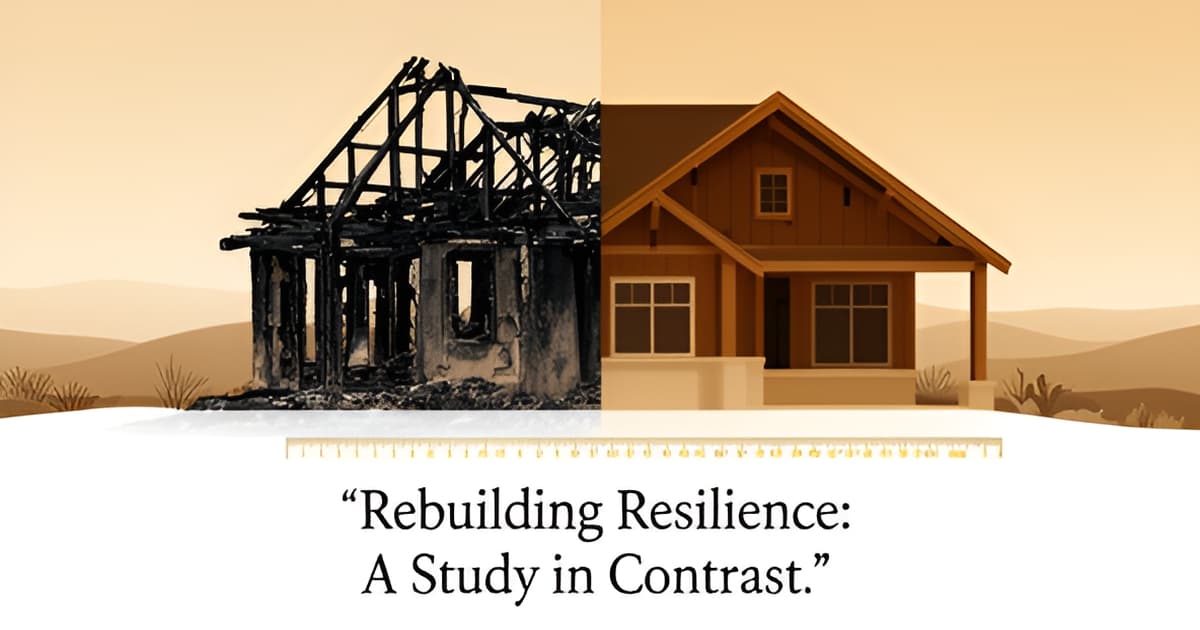
Cost to Rebuild a House After a Fire in Los Angeles County
Key Facts
- LA wildfire zone rebuilds run $450–$800+ per square foot — triple the $150–$250 national average, industry analysis shows.
- 69% of total-loss LA fire homeowners were underinsured, facing an average coverage gap of $247 per square foot, per rebuild cost data.
- Only 7% of LA total-loss households were fully insured — Eaton victims averaged 36% short, Palisades 46%, a peer-reviewed study found.
- Post-fire demand surge pushes contractor bids 20–40% higher within months, turning a $400/sf budget into $550–$600/sf, post-disaster research warns.
- Pre-construction soft costs — design, engineering, permits — consume $75,000–$200,000 before a single wall goes up, according to cost breakdowns.
- A 1,500-sf Altadena rebuild at the $500/sf benchmark costs $750,000 — exceeding average insurance coverage of $607,000 by $140,000+, Catalyst California tracking shows.
- IBHS Wildfire Prepared Home Plus upgrades add only ~$15,242 (under 10% of baseline) yet cut destruction risk by up to 43%, wildfire research finds.
What Rebuilding in Altadena Actually Costs Per Square Foot
If you've seen a headline claiming it costs $150–$250 per square foot to rebuild a house, that number will not survive contact with an Altadena lot. That figure reflects national averages — but LA wildfire zones are running $450–$800+ per square foot, and Altadena homeowners are learning the difference in real time.
For early planning, a realistic Altadena range is $400–$750+ per square foot, according to local rebuild cost estimates. Equity research tracking the Eaton Fire recovery uses a $500 per square foot benchmark for Altadena, while owner-reported figures compiled in the LA Times come in closer to $570 per square foot in the Eaton area — versus roughly $800 in Pacific Palisades.
What does that mean in actual dollars for a typical Altadena home?
- 1,500 sf home at $400/sf: roughly $600,000 — and that's the optimistic floor
- 1,500 sf at $550/sf: roughly $825,000
- 1,500 sf at $750/sf: roughly $1,125,000 — construction alone
- 2,000 sf home (Altadena/Palisades range): $1M–$1.6M+ before soft costs
Here's the trap that catches most homeowners: headline per-square-foot figures exclude nearly everything outside the frame. As LA County guidance warns, you should never treat a generic per-square-foot number as the entire analysis. Site work, design and engineering, utility upgrades, permits, and finish selections all sit outside that base number — and finishes alone can swing your budget by $75–$150 per square foot.
The soft-cost layer is where budgets break. Pre-construction phases routinely consume $75,000–$200,000 before a single wall goes up, and post-disaster demand surge pushes bids 20–40% higher than pre-fire quotes. A rebuild penciled at $400 per square foot can easily come back at $550–$600 once contractors are competing across thousands of fire-destroyed lots.
This is exactly why Altadena Home Remodeling scopes whole-home projects against total project cost — not just the build contract. If you're weighing a rebuild, addition, or gut renovation on your lot, a free remodel-scoping consultation (including a before/after concept render) can surface the soft costs and permit realities — LA County unincorporated timelines and fees included — before you commit to a number that only tells half the story.
Why Fire Rebuilds Blow Past Insurance Coverage: The Underinsurance Gap
For many LA fire survivors, the worst financial surprise isn't the fire itself — it's the letter from the contractor. Across the Eaton and Palisades burn areas, rebuild bids are routinely coming in far above what insurance will pay, and the gap follows a predictable pattern documented by researchers and industry analysts.
The biggest driver is underinsurance. According to industry analysis, 69% of total-loss homeowners in the LA fires lacked sufficient coverage, with an average shortfall of $247 per square foot. A peer-reviewed study found Eaton households averaged 36% short of what they needed, while Palisades households averaged 46% short — and only 7% of total-loss respondents were fully insured.
Demand surge makes the problem worse. When thousands of homeowners compete for the same contractors, materials, and inspectors, bids spike 20–40% within months of a major fire and can stay elevated for a year or more. A rebuild budgeted at $400/sf can easily come back at $550–$600/sf.
Mandatory code upgrades add another layer. Rebuilding in a wildfire-prone zone triggers Chapter 7A WUI requirements, adding roughly $13,070 to a typical 1,750-square-foot home before construction even begins.
Finally, costs keep climbing. LA residential construction costs rose 44% over five years, and replacement costs jumped roughly 45% between 2020 and 2023 — meaning policies written years ago were priced against a market that no longer exists.
What this means in practice:
- Your Coverage A limit likely understates today's true reconstruction cost — in Altadena's 91001 ZIP code, it was understated by roughly 35%.
- Soft costs like permits, design, demolition, and temporary housing sit on top of the build contract, adding 25–60% to the base price.
- A like-for-like rebuild simplifies permitting, but it isn't a discount on the build itself.
- A contingency of 10–30% is widely recommended to absorb demand-surge pricing.
The lesson many Altadena homeowners have learned the hard way: budget only for construction, and you'll run out of money mid-project. Getting a realistic, line-itemed scope before you commit is the single best defense against the underinsurance gap.
If you're weighing a rebuild or major renovation in Altadena, Altadena Home Remodeling offers a free remodel-scoping consultation with a before/after concept render — so you know what your project actually costs before you sign anything. Our featured builder, JMB Builders LLC (CSLB #1103479), brings direct Eaton Fire rebuild experience to the table.
The Hidden Costs Nobody Budgets For: Soft Costs, Permits, and Temporary Housing
When Altadena homeowners tally up what a rebuild will cost, most add up the builder's contract and stop there. That number is usually only 60–75% of the real bill — the rest disappears into soft costs, permits, and rent before a single wall goes up.
Pre-construction is the first surprise. According to post-wildfire cost research, design, engineering, surveying, and planning consume $75,000–$200,000 before construction begins. Demolition and debris removal add another $10,000–$50,000 or more, typically 5–15% of the total project.
Then comes the two-year lease you didn't plan for. With 6–18 month waits to even start construction in the Eaton burn zone, per rebuild timeline data, temporary housing over a 24-month rebuild runs $60,000–$120,000 — a cost insurance rarely covers fully, as Catalyst California's Altadena tracking bluntly notes.
Site and utility costs pile on quietly:
- Utility upgrades: $5,000–$25,000
- Seismic engineering: $15,000–$50,000
- Soil and foundation work: $10,000–$40,000
- LA County permits: roughly $12,000 for a 1,500-sf home, per LA construction cost benchmarks — though like-for-like rebuilds through Regional Planning can qualify for a reduced $1,404 fee
Now the math nobody wants to do. A 1,500-sf Altadena home at the documented $500/sf benchmark costs $750,000 — construction alone. Average Altadena insurance coverage was $607,000 as of 2023, leaving a shortfall exceeding $140,000 before temporary housing or contingency. That's consistent with the finding that 69% of total-loss LA fire homeowners were underinsured.
How big should your contingency be? It depends on demand-surge exposure: Altadena planning guidance suggests 10–15%, while post-disaster research recommends 20–30% because contractor and material bids spike 20–40% after a major fire. A build budgeted at $400/sf can easily return at $550–$600/sf.
This is exactly why Altadena Home Remodeling scopes whole-home rebuilds against total project cost, not just the construction line. If you're weighing a rebuild versus a gut renovation of a surviving structure, a free remodel-scoping consultation — including a before/after concept render — can surface these hidden costs before they surface themselves.
Your Rebuild Pathway: Like-for-Like Permits, Timelines, and Resilient Upgrades
Rebuilding in Altadena right now is a race between your permit timeline and a contractor market stretched thin by 16,000 lost structures. The good news: LA County has built a faster lane for homeowners who rebuild close to what they had.
The Like-for-Like Pathway
For homes in unincorporated LA County, a rebuild that modifies no more than 10% or 200 square feet of the previous footprint — whichever is greater — qualifies as "like-for-like." That classification matters: instead of standard permit fees that can run roughly $12,000 for a 1,500-square-foot home, like-for-like rebuilds through Regional Planning cost about $1,404, with expedited review targets of 10 business days for initial review and 5 days for rechecks, per LA County guidance.
Keep expectations realistic, though. Review targets are targets, not guarantees, and single-family permit timelines in LA currently run about 4–8 months, according to construction cost analysis. After permits, homeowners face 6–18 month waits to begin construction, versus a 1.98-month national average, due to post-fire demand for contractors and inspectors.
Planning Your Realistic Sequence
- Confirm your rebuild qualifies as like-for-like before finalizing plans — every square foot beyond the threshold can trigger full review and standard fees.
- Note that fee relief is non-transferable if you sell the lot, and timelines vary by address.
- Budget 10–15% contingency minimum; some advisors recommend 20–30% specifically to absorb post-disaster demand surge.
Why Resilient Upgrades Earn Their Keep
Here's where a modest premium pays outsized dividends. IBHS Wildfire Prepared Home Plus upgrades add roughly $15,242 — under 10% above baseline construction cost — while cutting the risk of destruction by up to 43%, according to wildfire rebuilding research. Mandatory Chapter 7A WUI compliance already adds about $13,070 for a 1,750-square-foot home, so the incremental step to full IBHS certification is small relative to the protection gained.
For Altadena's Craftsman and period homes, these upgrades pair naturally with a preserve-first rebuild: fire-rated venting, ember-resistant zones, and hardened exteriors that respect the original character. If you're weighing scope, budget, and resilience trade-offs, Altadena Home Remodeling offers a free remodel-scoping consultation with a before/after concept render — one conversation to scope it, price it, and do it right the first time.
How to Scope Your Rebuild Before You Sign Anything
The most expensive mistake in a fire rebuild isn't the construction — it's signing a contract based on numbers that were never real. Insurers' own rebuild estimates came in low 75–95% of the time in a peer-reviewed study of California coverage, so treat your carrier's figure as a starting point, not a budget.
Get an independent reconstruction estimate first. Commissions a line-item scope from a licensed general contractor who works in your area — not a desk estimate from a software tool. In Altadena, planning figures run $400–$750+ per square foot, and a rebuild penciled at $400/sf can easily come back at $550–$600/sf once post-disaster demand surge pushes contractor and material bids 20–40% higher.
Then budget the full stack, not just the build. Construction is only the headline number:
- Soft costs — design, engineering, permits, site prep — add 25–60% on top of the base contract
- Pre-construction phases alone consume $75,000–$200,000 before framing starts
- Temporary housing over a 24-month rebuild runs $60,000–$120,000
- Contingency of 10–15% minimum; some analysts recommend 20–30% for demand surge
Decide like-for-like versus expanded rebuild early, because it changes your permitting path. LA County's like-for-like rule allows up to 10% or 200 square feet of modification (whichever is greater) with a streamlined Regional Planning process and a $1,404 permit fee — but as rebuild guidance for Eaton Fire neighborhoods makes clear, it simplifies the process, it doesn't discount the build. If you want a second story or addition, scope that decision before design work begins, since mid-construction changes add $20,000–$50,000+.
Finally, verify who you're hiring. Check the contractor's CSLB license status and complaint history directly with the state board, and ask specifically about experience with LA County unincorporated permitting — Altadena sits outside city jurisdiction, and the process differs. Altadena-based JMB Builders LLC (CSLB #1103479), the featured builder on this site, documents its Eaton Fire rebuild work at jmb-builders.com — the kind of local, verifiable track record worth confirming with any builder you interview.
Before you sign anything, Altadena Home Remodeling offers a free remodel-scoping consultation that pairs a realistic budget breakdown with a before/after concept render — so you scope it, price it, and do it once, do it right.
Frequently Asked Questions
How much does it actually cost per square foot to rebuild a house in Altadena after the Eaton Fire?
Why are rebuild bids coming in higher than my insurance payout?
What hidden costs should I budget for beyond the construction contract?
What is the like-for-like rebuild rule in LA County, and does it save me money?
How much contingency should I set aside for my fire rebuild?
Is it worth paying extra for fire-resilient upgrades when I rebuild?
Budget for the Whole Truth, Not Just the Build
The numbers tell a consistent story: Altadena rebuilds run $400–$750+ per square foot, soft costs add 25–60% on top of the construction contract, and 69% of total-loss homeowners in the LA fires were underinsured — many by more than $100,000. The homeowners who come out ahead aren't the ones with the cheapest bid; they're the ones who scoped the full project cost before signing anything. That means an independent line-item estimate, a decision on like-for-like versus expanded rebuild made early, a contingency of at least 10–15%, and a builder who knows LA County unincorporated permitting inside and out. Altadena Home Remodeling helps homeowners do exactly that with a free remodel-scoping consultation — including a before/after concept render — so you can see what your rebuild or gut renovation actually costs, not just what the contractor's contract says. If you're ready to move from rough headlines to a real number for your lot, book your free scoping consultation today and start your rebuild with the full picture in hand.