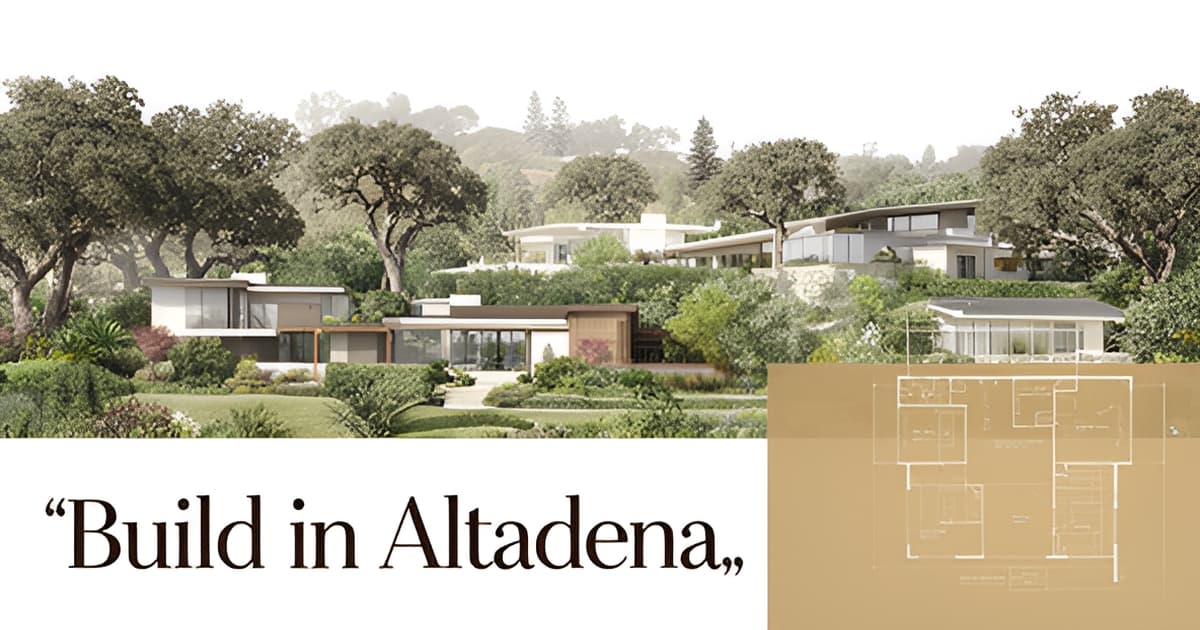
Cost to Build a House in Altadena
Key Facts
- Building a mid-range custom home in Altadena costs $400–$600 per square foot according to contractor cost data.
- A 2,000 square foot custom Altadena home runs $800,000–$1.4 million before land per a local licensed builder's analysis.
- Only 23 of nearly 6,000 significantly damaged Altadena properties had completed rebuilding as of December 2025 per Catalyst California's tracking data.
- Hillside lots common in Altadena add a 15–30% premium for grading, retaining walls, and soil engineering according to local contractor data.
- Wildfire code compliance under WUI and Chapter 7A standards adds 5–15% to overall build cost per contractor cost breakdowns.
- 94% of surveyed custom home projects initially ran 30–40% over budget according to a 2021 survey.
- Average Altadena insurance coverage of $607,000 left a $140,000+ shortfall against a $750,000 rebuild per Catalyst California's analysis.
What Building in Altadena Really Costs Per Square Foot
Ask three contractors what it costs to build in Altadena and you'll get three different answers — and the cheapest one is usually the most misleading. Headline per-square-foot numbers rarely survive contact with a hillside lot, Chapter 7A wildfire code requirements, or the realities of post-fire construction.
The most credible benchmarks cluster around $400–$600 per square foot for mid-range custom construction. Contractor-matching service GreatBuildz puts typical builds at $400–$500 per square foot, with most fire-rebuild bids landing at $400–$600, while its tier breakdown shows basic rebuilds starting at $300–$450 and luxury or hillside builds reaching $600–$800+. Go Home Builders cites $480–$550 per square foot for average custom work, and Catalyst California uses roughly $500 per square foot in its rebuild modeling.
Translate those figures into real houses and the numbers get serious. A 2,000 square foot standard build runs about $960,000 before land, per Go Home Builders, while a 2,000 square foot custom California home ranges from $800,000 to $1.4 million excluding land, according to JMB Builders, an Altadena-based licensed general contractor (CSLB #1103479) whose published cost analysis we reference in this guide.
Why don't generic figures work here? Several Altadena-specific factors push costs well beyond regional averages:
- Hillside lots — common in Altadena — carry a 15–30% premium for grading, retaining walls, and soil engineering, with slope stabilization alone costing $20,000–$100,000+
- WUI/Chapter 7A wildfire compliance (Class A roofing, ember-resistant vents, fire-rated windows) adds 5–15% to overall cost
- Soft costs sit outside headline numbers: design and architecture ($25,000–$100,000+), permits ($15,000–$40,000+), soil reports, and utility connections ($10,000–$50,000)
- The post-Eaton Fire market adds material premiums, insurance complexities, and contractor demand pressures
The fire context matters more than any single number. As of December 2025, only 23 of nearly 6,000 significantly damaged residential properties had completed rebuilding, per Catalyst California's tracking data — and the average insurance policy covered $607,000, leaving a shortfall of more than $140,000 against a $750,000 rebuild. LA County's Unified Permit Process has sped up review for like-for-like rebuilds, but the market remains volatile enough that any figure is a snapshot, not a stable benchmark.
That's why we built Altadena Home Remodeling's guide around scoping rather than square-foot guessing — and why our free remodel-scoping consultation includes a before/after concept render. A real number for your lot beats a range so wide it means nothing.
The Hidden Costs Behind the Headline Number
That $400–$550 per square foot figure you keep seeing quoted? It's only the beginning. Industry sources consistently warn that site work, design, engineering, permits, and utilities sit entirely outside the headline construction number — and in Altadena, those extras add up fast.
Start with design and architecture. Expect $25,000 to $100,000 or more for design and planning, with architect fees often running 8–10% of total build cost according to contractor cost breakdowns. Permits come next: LA single-family permits typically run $15,000–$40,000+, and standard permit costs can exceed $40,000 once you tally plan check fees, school impact fees, and utility hookups.
Then there's the ground itself. Soil and foundation analysis ranges from $10,000 to $40,000, with seismic engineering adding another $15,000–$50,000 per local contractor data. Utility connections run $10,000–$50,000, and site prep or environmental studies can reach $75,000. For Eaton Fire rebuilds, foundation reuse requires forensic testing, and soil compaction reports are mandatory if soil was disturbed deeper than 12 inches.
Altadena's terrain and fire codes layer on further premiums. Hillside lots — common here — carry a 15–30% cost premium for grading, retaining walls, soil engineering, and difficult access. Wildfire code compliance under WUI and Chapter 7A standards adds another 5–15%, covering Class A roofing, ember-resistant vents, non-combustible siding, and fire-rated windows.
Here's what a realistic "hidden costs" budget layer looks like:
- Design and architecture: $25,000–$100,000+
- Permits and fees: $15,000–$40,000+
- Soil and foundation analysis: $10,000–$40,000
- Utility connections: $10,000–$50,000
- WUI/Chapter 7A compliance: 5–15% of build cost
The most sobering statistic: a 2021 survey found 94% of custom home projects initially ran 30–40% over budget. That's why local builders call the contingency reserve "the single most important budget decision you'll make" — and why a 15–20% cushion isn't pessimism, it's arithmetic.
At Altadena Home Remodeling, we approach budgets the same way we approach homes: scope it honestly the first time, before a single dollar is committed. If you're weighing a whole-home renovation against a rebuild, our free remodel-scoping consultation includes a before/after concept render so you can see — and price — the path that preserves your home's character.
Budgeting for a 12-24 Month Timeline, Not a 6-9 Month Build
The fastest way to blow a construction budget isn't bad math — it's bad time. When a project stretches from nine months into year two, every line item inherits the cost of waiting, and in the current Los Angeles market, waiting is expensive.
Altadena's post-fire permitting landscape looks encouraging on paper. LA County rolled out a Unified Permit Process in August 2025, letting disaster-recovery applicants file once instead of chasing separate departments, and the Altadena One-Stop Permit Center at 464 W Woodbury was purpose-built to speed things up. Like-for-like Eaton Fire rebuilds qualify for a 10-business-day review target — provided modifications stay within 10% or 200 square feet of the original footprint. But as LA County guidance makes clear, those are agency review targets, not construction timelines.
The realistic numbers are sobering. LA permitting data shows plan check and permitting typically run 4–9 months on their own, while end-to-end timelines — design, permits, site work, and construction — realistically land at 12–20+ months. Even with expedited pathways in place, only 23 of nearly 6,000 significantly damaged Altadena properties had completed rebuilding as of December 2025, per Catalyst California's tracking. Volume is the bottleneck, not paperwork alone.
Why timeline discipline is a cost strategy:
- LA residential construction costs rose 6% in Q1 2025 alone and are up 44% over five years
- Lumber is up 20–30% and copper 30–40% year-to-date, with a 17.8% average effective tariff rate in 2025
- 94% of surveyed custom home projects came in initially over budget by 30–40%
The math rewards early movers. A documented case study found that pre-ordering materials avoided an 8% price increase, early utility planning saved $15,000, and a contractor's permit familiarity cut review delays by two months. As Altadena Home Remodeling advises homeowners weighing a rebuild versus renovation: treat pre-construction as part of the build, not a preamble. Anyone quoting a firm move-in date before permits are filed is guessing.
Budget for the calendar, not just the structure. A 15–20% contingency and a 12–24 month horizon will protect you far better than an optimistic bid built on a six-month fantasy.
How to Get a Real Number for Your Altadena Lot
Every generic per-square-foot number you've read about building in Altadena is a starting point, not an answer. Getting a real figure for your specific lot requires four steps — and skipping any of them is how budgets blow up.
Step one: verify your rebuild eligibility. If your home was damaged in the Eaton Fire, like-for-like rebuilds qualify for expedited review through LA County's Unified Permit Process — as long as modifications don't increase floor area, size, height, or footprint by more than 10% or 200 square feet. Eligible projects target a 10-business-day review, though that's an agency target, not a construction timeline. Fee relief generally requires pre-January 7, 2025 ownership and doesn't transfer to buyers, so confirm your status before you plan around it.
Step two: investigate the ground before you commit. Foundation reuse after the fire requires forensic testing, and soil compaction reports may be mandatory if soil was disturbed deeper than 12 inches. Contamination is a real risk: even after debris removal, many Altadena properties show lead above acceptable residential levels, and Catalyst California's tracking found 6 of 10 tested, remediated homes remained uninhabitable due to lead or asbestos. Hillside lots — common in Altadena — add a 15–30% premium for grading, retaining walls, and soil engineering.
Step three: budget in layers, not in one headline number. Sources consistently warn that site work, design, engineering, and permits sit outside per-square-foot figures. A realistic Altadena budget stacks:
- Permits and fees: 8–12% of project cost
- Design and architecture: 10–15%
- Site prep and environmental studies: 5–10%
- Contingency: 15–20% — non-negotiable, given that 94% of surveyed custom home projects initially came in over budget by 30–40%
Step four: scope with a licensed local contractor before plans are drawn. Early planning pays measurably — one documented case saw early utility planning save $15,000, pre-ordered materials avoid an 8% price increase, and a local contractor's permit familiarity cut review delays by two months. At Altadena Home Remodeling, our preserve-first approach means we evaluate whether renovating or rebuilding your existing structure makes more sense before recommending either.
The fastest way to move from a wide range to a real number is a structured scoping conversation. Request a free remodel-scoping consultation with Altadena Home Remodeling — we'll walk your goals, constraints, and lot conditions, and you'll receive a before/after concept render so you can see the project before pricing it. Featured builder JMB Builders LLC (CSLB #1103479), an Altadena-based licensed general contractor with documented Eaton Fire rebuild experience, is available through our guide as disclosed paid placement. Scope it once, price it right, and build with confidence.
Frequently Asked Questions
How much does it actually cost to build a house in Altadena per square foot?
What hidden costs should I budget for beyond the per-square-foot price?
How long does it really take to build a home in Altadena?
Do Eaton Fire rebuilds qualify for faster permitting?
Why is building in Altadena more expensive than other LA areas?
Will my insurance cover the full cost of rebuilding after the Eaton Fire?
From Ranges to Real Numbers: Your Next Move
Building in Altadena in 2025 isn't a math problem — it's a scoping problem. The headline figures cluster around $400–$600 per square foot, but the real cost of your project lives in the details those numbers skip: hillside grading, Chapter 7A wildfire compliance, permits, soil testing, utility connections, and a 15–20% contingency that protects you from the fact that 94% of custom projects initially run 30–40% over budget. Add a 12–24 month timeline and a post-fire market where only 23 of nearly 6,000 significantly damaged properties had completed rebuilding as of December 2025, and the case for planning carefully — and early — becomes impossible to ignore. The good news: every dollar invested in pre-construction clarity pays measurable returns, from avoided price increases to shortened permit delays. Whether you're weighing a rebuild against a renovation that preserves your home's character, the smartest first step is a structured scoping conversation. Request a free remodel-scoping consultation with Altadena Home Remodeling — you'll walk through your goals, lot conditions, and budget layers, and receive a before/after concept render so you can see the path before you price it. Scope it once, price it right, and build with confidence.