Best Companies for Fire-Resistant Home Rebuilds: How to Evaluate
Key Facts
- Most wildfire homes ignite from wind-blown embers, not flames — so ember resistance should drive every rebuild decision per NPR reporting.
- Fire-resistant new construction costs only 2–3% more than traditional building — and one study found it was actually 2% cheaper according to Headwaters Economics and IBHS.
- After Colorado's Fourmile Canyon Fire, 100% of homes built under fire-resistant standards survived, versus just 63% of older homes NPR found.
- On a ~$500,000 Southern California build, Chapter 7A compliance adds about $13,000, while the stricter Wildfire Prepared Home Plus tier runs near $15,000 per Headwaters Economics.
- Retrofitting later is far costlier: a roof retrofit runs $22,010 and an exterior wall retrofit $40,750 according to Headwaters Economics.
- Vents need 1/16–1/8 inch noncombustible metal mesh, since gaps larger than 1/8 inch become ember entry points per CAL FIRE home-hardening guidance.
- Double-pane tempered-glass windows are roughly four times more resistant to breaking than standard glass during wildfire exposure according to CAL FIRE.
Why Code Compliance Alone Won't Protect Your Rebuild
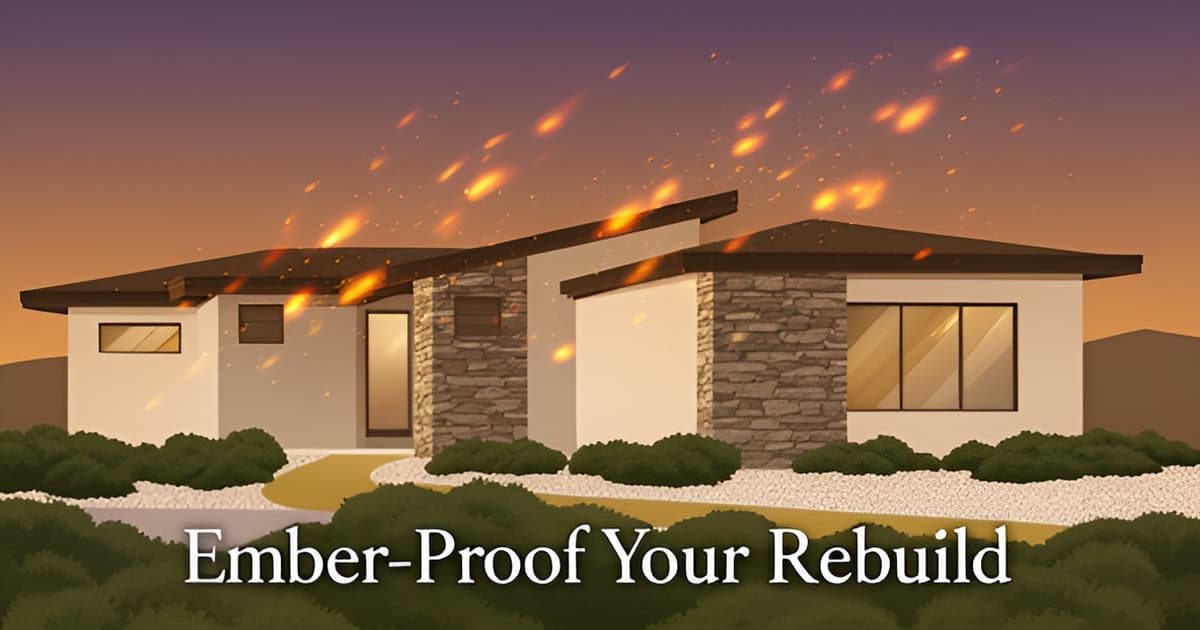
If your home survives the next fire, it won't be because a wall of flame stopped at your property line — it will be because wind-blown embers found nothing to ignite. That's the uncomfortable truth Altadena homeowners face as Eaton Fire rebuild planning begins: research shows most homes ignite from embers, not direct flame contact.
This creates a vetting problem. No independent source ranks or evaluates specific rebuild companies, so homeowners must judge builders themselves. And a builder who promises a "fire-safe" home without naming the standards behind that promise is asking you to gamble your largest asset on a vague claim.
Wildfire is a home-ignition problem, not a wildland fire problem. According to IBHS chief scientist Dr. Steve Quarles, two factors drive vulnerability: how the home is built — materials and installation details — and the landscaping on the property. Decades of post-fire assessments confirm these factors, not luck or distance from the fire line, determine which homes survive.
California code helps, but it sets a floor, not a ceiling. Chapter 7A compliance on a typical Southern California build adds roughly $13,000 — about 2.6% of a $500,000 baseline — while the higher IBHS Wildfire Prepared Home Plus tier runs about $15,000, per a Headwaters Economics analysis. That's a modest premium for meaningful protection. In Boulder County's Fourmile Canyon Fire, 100% of homes built under a fire-resistant program survived, versus 63% of older homes nearby.
The gap between code-minimum and genuinely resilient shows up in the details code doesn't require:
- Enclosed eaves and noncombustible gutters, which go beyond Chapter 7A's baseline
- Under-deck enclosures and 6-inch metal flashing at deck-to-wall intersections
- A noncombustible 0–5 ft zone around the home — the area IBHS calls critically important alongside the roof
- Vent mesh between 1/16 and 1/8 inch, per CAL FIRE home-hardening guidance
A builder fluent in these details will discuss them unprompted. One who can't, or who quotes a steep fire-resistance premium far above the published 2–3% range, deserves scrutiny. When Altadena Home Remodeling scopes a whole-home rebuild or renovation, we encourage homeowners to ask every candidate for itemized proposals covering roof, vents, windows, siding, decks, and the near-home zone — before signing anything. The evidence is clear: building it right the first time costs a few percentage points; retrofitting later costs tens of thousands.
The Four-Part Framework for Judging a Fire-Resistant Builder
Most homes lost to wildfire never touch a flame front — they ignite from wind-blown embers that find a single vulnerable gap. That means the difference between a rebuild that survives and one that doesn't comes down to how well your builder understands ignition science, not just framing and finishes. Here is a four-part framework Altadena Home Remodeling recommends for separating genuinely fire-resilient builders from those who simply meet paperwork minimums.
1. Fluency in named standards. A qualified builder should speak comfortably about CBC Chapter 7A, the IBHS Wildfire Prepared Home designation, the IWUIC, and NFPA 1144. As IBHS research engineer Daniel Gorham puts it, wildfire-resistant building codes demonstrably work — "we see that in the lab and we see that in the field." A builder who can't name these standards unprompted is learning on your dime.
2. An itemized component checklist. Vague promises of "fire-resistant materials" mean nothing. Require line-item proposals covering the components CAL FIRE identifies as most vulnerable:
- Class A roof covering — CAL FIRE calls the roof one of the most vulnerable areas of the home
- Vents with 1/16–1/8 inch noncombustible metal mesh, since gaps larger than 1/8 inch are ember entry points
- Double-pane tempered-glass windows, roughly four times more resistant to breaking
- Fiber-cement or stucco siding, with decks using ignition-resistant materials and minimum 6-inch metal flashing at deck-to-wall intersections
- A 0–5 ft noncombustible ember-resistant zone around the structure
3. Cost quotes benchmarked against published data. Headwaters Economics research with IBHS found fire-resistant new construction costs only 2–3% more than traditional construction — and in one study was actually 2% cheaper. For a roughly $500,000 Southern California home, Chapter 7A compliance adds about $13,000, while the stricter Wildfire Prepared Home Plus tier runs near $15,000. A builder quoting a large premium should justify it against these published California benchmarks.
4. Willingness to build beyond minimum code. California's codes are stronger than most states', but higher-tier features — enclosed eaves, noncombustible gutters, under-deck enclosures — remain optional. A builder who proactively proposes these "code plus" upgrades signals real commitment. The payoff is measurable: after Boulder County's Fourmile Canyon Fire, 100% of homes built under a fire-resistant program survived, versus 63% of older homes.
If you're planning a rebuild or whole-home renovation in Altadena, we offer a free remodel-scoping consultation with a before/after concept render — scope it, price it, do it once, do it right.
What Fire-Resistant Construction Should Actually Cost
Fire-resistant construction carries a persistent myth: that it costs a fortune. It doesn't. When a rebuild bid lands on your kitchen table with a five-figure "fire code premium," the published research says you should push back.
A Headwaters Economics analysis with the Insurance Institute for Business & Home Safety found that building new homes to high wildfire-resistant standards costs only 2–3% more than traditional construction. A companion study of a 2,500 sq ft Montana model home found wildfire-resistant new construction was actually 2% cheaper than typical construction, largely because fiber-cement siding beat cedar on price.
For Southern California specifically, the benchmarks are concrete. On a 1,750 sq ft model home with a ~$500,000 baseline build cost, Headwaters Economics calculated that CBC Chapter 7A compliance adds roughly $13,000 (~2.6%), while IBHS Wildfire Prepared Home Plus — enclosed eaves, noncombustible gutters — adds about $15,000. If a builder quotes a premium far above those figures, ask for an itemized justification.
California homeowners can also use a three-tier benchmark from a statewide cost report to pressure-test proposals:
- Baseline — Chapter 7A code compliance, adding roughly 2–8% to total new-home cost.
- Enhanced — Chapter 7A plus under-deck enclosure and a 0–5 ft noncombustible zone, about +$2,800.
- Optimum — "Code plus" features adding $18,200 in northern California and $27,100 in southern California.
The economics flip entirely when you retrofit instead of building right the first time. The Montana study priced a roof retrofit at $22,010 and an exterior wall retrofit — including windows and doors — at $40,750. That gap is why Altadena Home Remodeling advises homeowners rebuilding after the Eaton Fire to scope fire-resistant features into the original design, not treat them as a later upgrade.
One caution: industry cost claims vary widely. The Oregon Home Builders Association once claimed wildfire codes would add ~5% to home prices, while an Ashland builder survey put the added cost at roughly $1,200–$1,700 for a starter home, according to NPR reporting. The peer-reviewed numbers consistently land lower than the industry estimates.
If you're weighing a rebuild versus a gut renovation in Altadena, a free remodel-scoping consultation — including a before/after concept render — can help you map which tier of fire resistance fits your budget before you sign anything.
Your Builder-Vetting Checklist and Next Steps for an Altadena Rebuild
You've gathered the standards and the cost benchmarks — now it's time to put candidate builders to the test. A vetting process built on verifiable facts beats a slick portfolio every time, especially when the stakes are your family's safety.
Step one: verify licensure before anything else. Confirm each candidate holds an active California contractor's license through the CSLB lookup, and check the license number against their proposals and contract paperwork. One documented option in the Altadena Eaton Fire rebuild space is JMB Builders LLC (CSLB #1103479), an Altadena-based licensed general contractor building custom homes, ADUs, and whole-home remodels — including Eaton Fire rebuilds — with its work and service areas documented on jmb-builders.com. (Disclosure: JMB Builders LLC is a paid placement in this guide.)
Step two: demand an itemized proposal mapped to the component checklist. Ask each builder to price the roof (Class A covering), vents (1/16–1/8 inch noncombustible metal mesh), windows (double-pane tempered glass), siding (fiber cement or stucco), gutters (metal with drip edge), decks, and the 0–5 ft ember-resistant zone — the details CAL FIRE's home-hardening guidance identifies as decisive. A builder who can't itemize these components is guessing, not engineering.
Step three: probe installation details, not just materials. IBHS's chief scientist emphasizes that vulnerability comes from two things — how the home is built, including installation details, and the landscaping on the property. Ask specifically:
- How will you seal gaps larger than 1/8 inch where embers can enter?
- Will you install minimum 6-inch vertical metal flashing at deck-to-wall intersections?
- What is your plan for the 0–5 ft near-home noncombustible zone?
- Will you enclose eaves and use noncombustible gutters?
Step four: favor builders who propose beyond minimum code. California's Chapter 7A baseline adds roughly $13,000 to a typical $500,000 Southern California build, while the Enhanced tier — under-deck enclosure plus the 0–5 ft zone — adds only about $2,800 more, per Headwaters Economics' California cost analysis. A builder quoting far above these ranges should justify the premium in writing.
Finally, remember the survival evidence: after Colorado's Fourmile Canyon Fire, 100% of homes built under fire-resistant standards survived, versus 63% of older homes. That gap is what careful vetting buys you.
If you're weighing a rebuild versus a gut renovation of a fire-damaged Altadena home, Altadena Home Remodeling offers a free remodel-scoping consultation with a before/after concept render — so you can scope it, price it, and do it once, do it right.
Frequently Asked Questions
How much does it actually cost to build a fire-resistant home in California?
What should I look for when choosing a builder for my Eaton Fire rebuild?
Do homes really ignite from embers instead of the actual flames?
Does fire-resistant construction actually help homes survive a wildfire?
Is it cheaper to build fire-resistant from the start or retrofit later?
What specific components should my rebuild proposal include for ember resistance?
Build It Once, Build It Ember-Proof
Choosing a fire-resistant builder comes down to evidence, not promises. Homes don't burn because flames reach them — they ignite when wind-blown embers find a vulnerable roof, vent, or gap. The right builder speaks fluently in named standards like Chapter 7A and IBHS Wildfire Prepared Home, itemizes every vulnerable component, and prices fire resistance within the published 2–3% premium rather than inventing inflated figures. The payoff is real: after Colorado's Fourmile Canyon Fire, 100% of homes built to fire-resistant standards survived, versus 63% of older homes nearby. Your next steps are simple: verify licensure through the CSLB, demand itemized proposals, probe installation details, and favor builders who propose beyond minimum code. If you're weighing a rebuild versus a gut renovation of an Altadena home, Altadena Home Remodeling offers a free remodel-scoping consultation with a before/after concept render — so you can scope it, price it, and do it once, do it right.