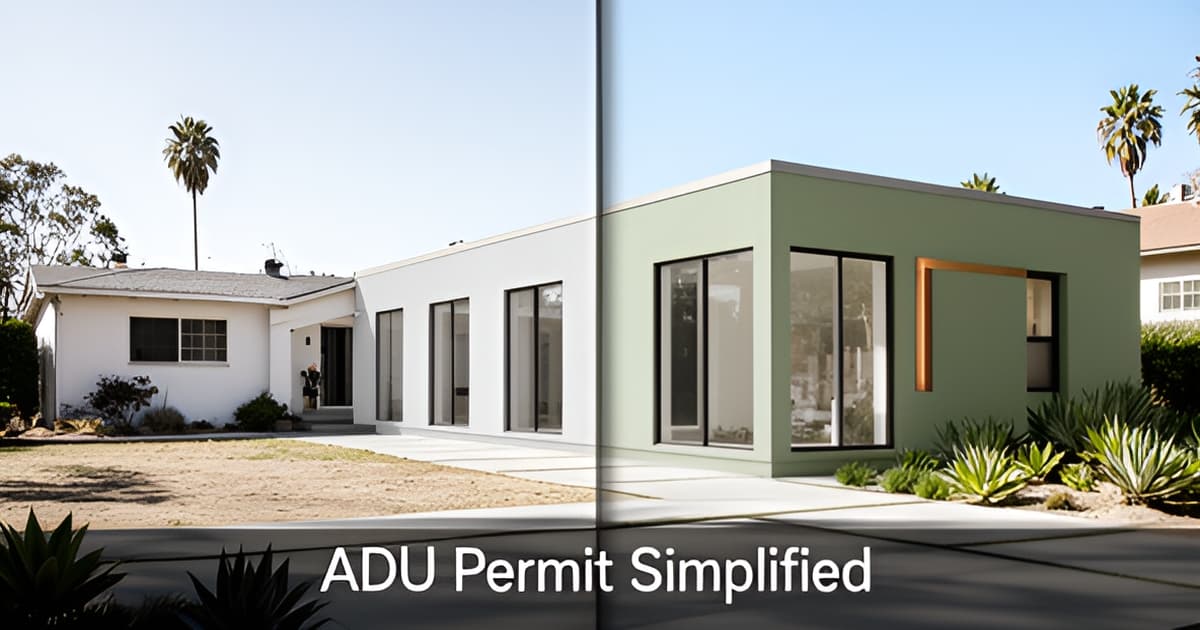
ADU Permit in Los Angeles: Standard Plans and Review Requirements
Key Facts
- Los Angeles adopted its ADU Ordinance 186,481 on December 11, 2019, effective December 19, 2019, according to LADBS.
- LA's ADU rules are codified as LAMC Section 12.22A.33, covering ADUs, Junior ADUs, and Movable Tiny Houses.
- LADBS pre-approves standard ADU plans for building, residential, and green code compliance, per the official ADU program.
- Using a pre-approved ADU standard plan shortens plan check so permits are issued more quickly, LADBS reports.
- Even pre-approved ADU plans still face site-specific review for zoning fit and foundation needs, LADBS confirms.
- California's AB 2533 creates a streamlined pathway to legalize unpermitted dwelling units as ADUs or JADUs, detailed in LADBS guidance.
- Altadena sits in unincorporated Los Angeles County, so City of LA ADU programs and LAMC 12.22A.33 do not govern its permitting.
Why ADU Permitting Feels Confusing — and What Actually Governs Your Project
If you've started researching ADU permits, you've probably hit the same wall most Altadena homeowners do: the rules feel opaque, the guidance feels scattered, and the finish line keeps moving. Worse, many homeowners aren't even sure whose rules apply to their property in the first place.
Here's the jurisdictional reality that trips people up: Altadena sits in Los Angeles County unincorporated territory, not inside the City of Los Angeles. That means City of LA rules are a useful reference point — a preview of how a major local jurisdiction approaches ADUs — but they are not the final word on your project. Your permitting authority operates under LA County's framework, which shares state-law foundations but differs in the details that matter.
So what does the City of LA framework actually say? It's worth understanding as a benchmark. The City adopted its Accessory Dwelling Unit Ordinance — Ordinance 186,481 — on December 11, 2019, and it took effect December 19, 2019, according to the Los Angeles Department of Building and Safety. That ordinance is codified as LAMC Section 12.22A.33, and it establishes local development standards for three distinct structure types:
- Accessory Dwelling Units (ADUs)
- Junior ADUs (JADUs)
- Movable Tiny Houses (MTHs)
Understanding this framework matters even if you never file with the City, because it shows how a mature ADU ordinance is structured — and what questions you should be asking your own jurisdiction. The same LADBS page also references guidance documents like ZA Memo 143 and information bulletins covering accessory and junior ADUs, plus a streamlined pathway under AB 2533 for legalizing existing unpermitted dwelling units as ADUs or JADUs — a detail worth noting for anyone whose property contains an older, unpermitted structure.
The confusion homeowners feel is understandable. Rules layered on rules — state law, city ordinance, county code — make it hard to know where to start. But the framework itself isn't mysterious once you know which layer governs your address. That's why Altadena Home Remodeling approaches every ADU and addition project by first confirming jurisdiction, zoning, and site conditions before anyone draws a wall.
One caution as you plan: even in jurisdictions with pre-approved ADU standard plans, reviewers still evaluate whether a chosen plan fits your specific lot. No permit outcome is guaranteed, and any contractor promising one is selling you short. The right first step is scoping — understanding your property, your jurisdiction, and your goals before committing to a plan.
Scope it, price it, do it once, do it right. Book a free remodel-scoping consultation with Altadena Home Remodeling and get a before/after concept render of your ADU or whole-home project. Schedule your free consultation today.
The LADBS Approved Standard Plans Program: The Shortest Route to an ADU Permit
For most Los Angeles homeowners, the slowest part of building an ADU isn't construction — it's waiting for the city to review the plans. The Los Angeles Department of Building and Safety offers a way around that bottleneck: the ADU Approved Standard Plans Program.
Under this program, private licensed architects and engineers design ADU plans suited to different site types, and LADBS then pre-approves those plans for compliance with building, residential, and green codes, according to the official LADBS ADU page. As the department puts it, the program "makes it easier for LADBS customers to get permits" for ADUs built repeatedly across the city.
The payoff is straightforward: using a pre-approved standard plan shortens plan check and allows permits to be issued more quickly. Because LADBS has already vetted the design against the applicable codes, reviewers spend less time on the structural and code-compliance details that typically slow down a custom submission.
A pre-approved plan is not a rubber stamp, though. Even after you select an approved plan, LADBS still reviews it against your specific property, confirming the design fits your zoning and that the foundation suits your site conditions. That site-specific check matters, especially on hillside or older lots common in neighborhoods like Altadena.
Here's what a standard plan covers — and what it doesn't:
- Pre-approval for building, residential, and green code compliance on the design itself
- Site-specific review for zoning fit and foundation requirements, which remains your responsibility to satisfy
- Applicability to ADUs governed by LAMC Section 12.22A.33, established under Ordinance 186,481, effective December 19, 2019
One caveat for Altadena readers: this program belongs to the City of Los Angeles. Altadena sits in unincorporated Los Angeles County, where permitting runs through the County's own building department — so confirm which jurisdiction your lot falls under before assuming a City-approved plan applies.
Where a standard plan makes sense, the practical first step is scoping your property. Altadena Home Remodeling helps homeowners assess whether their lot, existing structures, and renovation goals align with a pre-approved design — or whether a custom plan better serves a whole-home remodel, addition, or preserve-first restoration. We make no promises about permit outcomes or timelines; every property clears the city's site-specific review on its own merits.
If you're weighing an ADU as part of a larger renovation, a free remodel-scoping consultation — including a before/after concept render — is the easiest way to see what your property can support.
What Reviewers Still Check: Site-Specific Zoning and Foundation Review
A pre-approved standard plan gets you past the hard part of plan check — but it doesn't get you out of review entirely. Even after LADBS has signed off on a plan's building, residential, and green code compliance, the department still examines how that plan meets your specific property.
According to LADBS's official ADU guidance, "If you choose an approved plan, LADBS will review it to make sure it fits your property, following zoning codes and foundation needs." In practice, that site-specific review covers three things:
- Lot fit — whether the standard plan's footprint, height, and unit size work on your parcel's dimensions and configuration.
- Zoning compliance — confirmation that setbacks and other development standards under LAMC Section 12.22A.33 are satisfied for your lot specifically.
- Foundation conditions — verification that the plan's foundation design suits your site's soil and geotechnical realities, which vary block to block.
The zoning piece matters more than many homeowners expect. Los Angeles governs ADUs, Junior ADUs, and Movable Tiny Houses through Ordinance 186,481, adopted December 11, 2019 and effective December 19, 2019, codified as LAMC Section 12.22A.33. A standard plan is pre-approved for code compliance as a design — but your lot still has to pass the setback and development-standard test on its own merits.
This is also where most homeowners discover they need professional help. A standard plan tells you nothing about whether your slope, soil report, easements, or existing structures will clear review. Resolving those questions before submission is far less painful than correcting them after a plan-check comment, which is exactly the kind of front-end scoping Altadena Home Remodeling provides — a free remodel-scoping consultation with a before/after concept render can surface lot-fit and foundation questions before you commit to a plan.
One important caveat for Altadena readers: the Standard Plans Program and LAMC 12.22A.33 apply to the City of Los Angeles. Altadena sits in unincorporated Los Angeles County, where the permitting authority and ADU standards differ from LADBS's rules. Before relying on any City-specific program, confirm which jurisdiction your parcel falls under — the fastest path to a stalled project is applying the wrong rulebook.
Special Situations: Legalizing Unpermitted Units Under AB 2533
Many older Altadena properties include backyard cottages, converted garages, or guest quarters that were built without permits decades ago — and owners often discover them only when they try to sell or rebuild. California's AB 2533 creates a pathway to bring these structures into legal status as ADUs or Junior ADUs, and Los Angeles has implemented it through LADBS guidance document IB-P-BC-2026-161, which covers the streamlined permitting of unpermitted dwelling units as ADU/JADU.
This matters in Altadena's Eaton Fire rebuild context, where legacy and unpermitted structures are common and homeowners are rethinking every square foot of their lots. Legalizing an existing unit, rather than demolishing and rebuilding it, often preserves character and reduces waste — a preserve-first approach Altadena Home Remodeling takes with all renovation work. Note, however, that these City of LA procedures govern the City's jurisdiction; Altadena falls under LA County unincorporated permitting, which may differ.
The streamlined pathway exists alongside the city's broader ADU framework. Los Angeles adopted Ordinance 186,481 on December 11, 2019 (effective December 19, 2019), codified as LAMC Section 12.22A.33, establishing development standards for ADUs, JADUs, and Movable Tiny Houses. Legalizing an unpermitted unit means bringing it up to current building, residential, and green code standards — the same standards LADBS pre-approves through its ADU Approved Standard Plans Program for new construction.
Key reference documents for anyone pursuing this route include:
- IB-P-BC-2026-161 — LADBS guidance on streamlined permitting of unpermitted dwelling units as ADU/JADU under AB 2533
- IB-P-BC-2026-150 — LADBS public bulletin covering Accessory and Junior ADUs
- ZA Memo 143, Revision 1 — Zoning Administrator memorandum interpreting LAMC Chapter 1 provisions relevant to ADUs
Even under streamlined rules, the city reviews whether a structure fits the property's zoning and foundation conditions — the same site-specific check that applies to pre-approved standard plans. Before committing to legalization, document what exists: structure age, utilities, setbacks, and current condition.
If you're weighing whether to legalize, restore, or rebuild an unpermitted unit on your Altadena property, Altadena Home Remodeling offers a free remodel-scoping consultation with a before/after concept render — a grounded way to understand your options before you file anything.
Your Next Step: Scoping Before You Submit
If you've made it this far, you know the rules: even a pre-approved standard plan doesn't skip scrutiny. Per the LADBS ADU program, the city still reviews your chosen plan "to make sure it fits your property, following zoning codes and foundation needs."
That single requirement changes how you should approach the whole project. The standard plans program — where licensed architects and engineers submit designs that LADBS pre-approves for building, residential, and green code compliance — shortens plan check and gets permits issued more quickly. But the speed benefit only materializes if your lot actually supports the plan you pick.
Before you commit to a design or a builder, it's worth understanding what site-specific review actually evaluates:
- Whether your property's zoning allows the ADU configuration under the local ordinance (Ordinance 186,481, codified at LAMC Section 12.22A.33)
- Whether your existing foundation conditions match what the standard plan assumes
- How the unit's placement fits setbacks and lot constraints on your specific parcel
- Whether an existing unpermitted unit could qualify under the AB 2533 streamlined pathway instead
For Altadena homeowners, there's an added layer: much of the community sits in unincorporated Los Angeles County, where permitting runs through county channels rather than the City of LA. Rules may differ, and no two lots behave the same — especially after fire rebuild work.
That's exactly why Altadena Home Remodeling starts every project with a free remodel-scoping consultation, including a before/after concept render. Scoping answers the practical questions a plan check will eventually ask: does your lot fit a pre-approved plan, does the foundation need work, and what does the build realistically involve? It's the difference between picking a plan and picking the right plan.
If you'd rather talk to a builder who does this work daily, our featured partner is JMB Builders LLC (CSLB #1103479), an Altadena-based licensed general contractor building custom homes, ADUs, and whole-home remodels — including Eaton Fire rebuilds. Their placement here is paid, and we disclose it so you can weigh it accordingly.
One thing we won't do is promise outcomes. No one can guarantee a permit or a timeline — the research doesn't support specific numbers, and neither do we. What we can do is help you scope your property properly before you submit, so the review process starts with fewer surprises.
Frequently Asked Questions
Does using a pre-approved ADU standard plan in Los Angeles mean I skip plan check entirely?
What law governs ADUs in the City of Los Angeles?
I live in Altadena — do City of LA ADU rules and the standard plans program apply to me?
Can I legalize an unpermitted garage conversion or backyard unit as an ADU?
Who designs the pre-approved standard plans, and what are they pre-approved for?
Can anyone guarantee my ADU permit will be approved or how fast it will take?
The Right Plan Starts With the Right Lot
An ADU permit isn't won at the counter — it's won before you submit. As this article covered, even a pre-approved plan under the LADBS Standard Plans Program still gets reviewed to confirm it fits your property, following zoning codes and foundation needs, and Altadena homeowners face an added wrinkle: most of the community falls under unincorporated LA County permitting, not the City of LA. The smart sequence is simple. First, confirm which jurisdiction governs your parcel. Second, scope your lot — setbacks, slope, soil, and any existing unpermitted structures that might qualify under the AB 2533 streamlined pathway. Third, only then choose between a standard plan and a custom design. That front-end work is exactly what a free remodel-scoping consultation with Altadena Home Remodeling delivers, including a before/after concept render, so you know what your property can support before committing to anything. No one can honestly guarantee a permit or a timeline — but you can dramatically reduce surprises by scoping first. If you'd rather work with a builder who does this daily, our featured partner is JMB Builders LLC (CSLB #1103479), an Altadena-based licensed general contractor handling ADUs and Eaton Fire rebuilds. Scope it, price it, do it once, do it right.